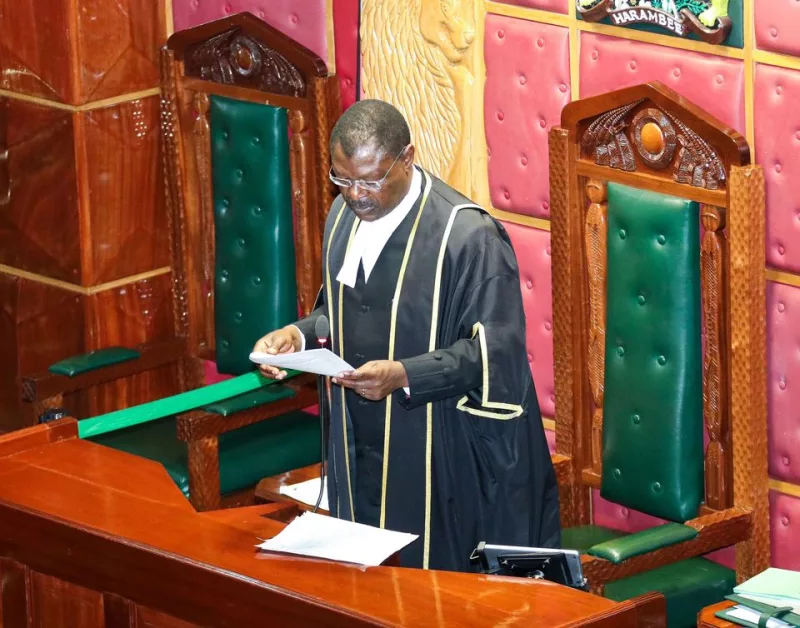
 Speaker of the National Assembly Moses Wetang'ula/HANDOUT
Veterinary doctors and veterinary interns in the public sector have petitioned Parliament to intervene in what they describe as disparities in salaries and allowances between veterinary personnel and medical doctors.
In conveying the petition to the National Assembly, Speaker Moses Wetang’ula said his office had received a petition from Dr Kelvin Osore, President of the Kenya Veterinary Association, submitted on behalf of veterinary doctors and interns serving in the public sector.
The petition seeks the harmonisation of veterinary doctors’ salaries and allowances with those of medical doctors, arguing that the two professions have comparable training periods, professional responsibilities, statutory mandates, public health roles and occupational risks.
“The Petitioner notes that the Fourth Schedule to the Constitution places veterinary services under county health services, and that Section 77(3) of the Employment and Labour Relations Act recognises veterinary services as an essential service,” Wetang’ula said.
According to the petition, veterinary personnel perform critical functions in veterinary public health, zoonotic disease control, disease surveillance, emergency outbreak response, border health control and regulation of foods of animal origin.
The veterinarians argued that these responsibilities expose them to significant occupational risks, including biological, chemical and physical hazards.
Among the risks highlighted are exposure to zoonotic infections, animal-related injuries, hazardous biological materials, dangerous drugs and chemicals, radiation, corrosive substances and abattoir conditions.
Veterinary officers also operate in hostile field environments and face risks associated with enforcement duties, according to the petition.
The petitioners contend that despite the nature and importance of their work, veterinary officers continue to receive remuneration that is not commensurate with their responsibilities and risks.
They further noted that proposals to harmonise veterinary salaries with those of medical doctors were first made in 2007 but have not been implemented despite repeated engagements with the State Department for Livestock Development and the Salaries and Remuneration Commission.
The petitioners want Parliament to engage the Directorate of Veterinary Services, the Salaries and Remuneration Commission, the Public Service Commission, the Council of Governors, the State Department for Livestock Development and other relevant agencies to review and harmonise their remuneration.
They are also seeking a review of various allowances, including risk, non-practice, call, hardship and internship allowances.
The veterinarians want the National Assembly to make any legislative, policy, budgetary or oversight recommendations necessary to address what they termed disparities in their salaries and allowances.
They argued that better remuneration would help strengthen veterinary public health, One Health approaches, border health security and disease preparedness while protecting Kenya’s livestock economy.
Wetang’ula said the matters raised fell within the authority of Parliament and were not pending before any court of law or constitutional body.
He subsequently committed the petition to the Public Petitions Committee for consideration under Standing Order 208A.
The committee is required to consider the petition and report its findings to the National Assembly and the petitioner in accordance with Standing Order 227(2).