

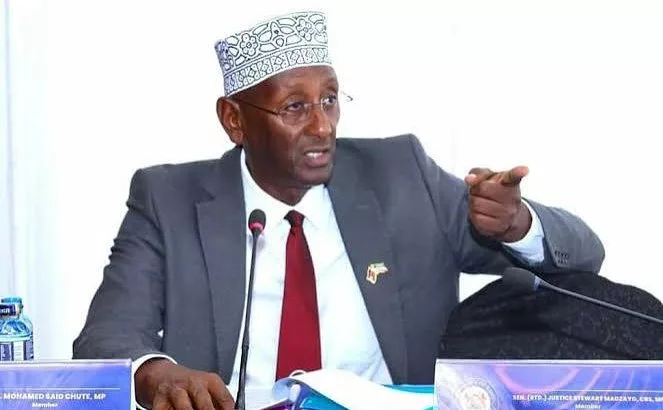
 Senate National Cohesion Committee chairman Mohamed Chute/ HANDOUT
A Senate inquiry has laid bare the deep ethnic imbalances that continue to affect the public service, with Kikuyu and Kalenjin dominating state jobs.
A report by the Senate National Cohesion and Equal Opportunity Committee reveals that Kikuyus and Kalenjins account for more than a third of workers in the 51 agencies examined by the panel.
The two communities have 56,774 employees out of a total of 148,092, representing 38.33 per cent of the workforce captured in the inquiry.
The report has an explicit verdict: the Kikuyu, the Kalenjin and the Kisii are overrepresented.
At Kenyatta National Hospital, 1,492 out of 5,056 employees, representing 29.51 per cent, are Kikuyus. At the Kenya Tea Development Agency, 554 of the 1,603 employees are Kikuyus.
The community also dominates the Public Service Commission, where 18,319 out of 89,819 employees are Kikuyus, representing 20.39 per cent.
At the Public Procurement Regulatory Authority, 15 out of 64 employees are Kikuyus. At the Kenya School of Government, there are 115 Kikuyus out of 492 employees, while at the Central Bank, there are 325 Kikuyus out of 1,311 employees, representing 24.79 per cent.
Other agencies with a high number of Kikuyus include the Capital Markets Authority, where they account for 24 of the 99 staff, and the Public Procurement Regulatory Authority, where 15 of the 64 employees are from the community.
At the Nyayo Tea Zone Development Corporation, 298 out of 577 employees are Kalenjins, representing 51.6 per cent.
The community also dominates the Central Rift Valley Water Works Development Agency, where 20 of 34 employees are Kalenjin, and the National Cereals and Produce Board, where 240 of 791 employees are Kalenjin.
Ten of the 33 employees at the Privatisation Commission are Kalenjin, while 5,639 of the 30,530 employees at the Kenya Prisons Service come from the community.
In other agencies, 36 of the 62 employees at Lake Victoria North Water Works are Luhya, 29 of 47 employees at Tanathi Water Works Development Agency are Kambas, 175 of 247 workers at Ewaso Ngiro South Development Authority are Maasai, while 96 of 158 employees at Coast Water Works Development Agency are Mijikenda.
As these communities command thousands of positions, others have representation in single digits — or none at all — across the agencies.
“The overall staffing profile for the 51 state agencies did not mirror national diversity,” the report concludes.
The damning report was tabled in the Senate by committee chairman Marsabit Senator Mohamed Chute.
The committee held 51 meetings, receiving oral submissions and written memoranda from state agencies before analysing their workforce profiles.
“Staffing composition analysis highlighted notable disparities between the ethnic distribution of staff in comparison to their national population proportions,” the report states.
Overall, Kikuyus are the largest group in the examined public entities, with 30,219 workers, representing 20.40 per cent of the workforce.
They are followed by Kalenjin employees, who number 26,555, or 17.93 per cent.
The Senate found that Kalenjin employees were overrepresented by 4.56 percentage points compared with their share of the national population.
Kikuyu were overrepresented by 3.27 percentage points, while Kisii employees exceeded their national population share by 2.21 percentage points.
On the other hand, Somali employees were underrepresented by 3.17 percentage points, Luhya by 3.15 percentage points, Turkana by 1.44 percentage points and Mijikenda by 1.06 percentage points.
The committee warned that the disparities could not simply be explained by differences in population size.
“Many government agencies had overrepresentation of certain ethnic communities, deviating from the 2019 census demographic proportions,” the report states.
The Luhya are third in the overall workforce, with 16,564 employees, but are highly underrepresented compared with their population.
They are followed by Luo with 15,348 employees and Kamba with 14,502.
Kisii account for 11,678 employees, Meru 6,736 and Mijikenda 6,172.
Kenyan Somali employees number 3,960, Maasai 2,898, Embu 2,106, Taita 1,949 and Borana 1,319 in the 51 agencies.
Turkana have 1,030 employees, Teso 950, Pokomo 722, Samburu 716 and Kuria 672.
At the bottom are communities whose presence in state agencies is barely visible.
El Molo have 19 employees, Dasenach 11, Walwana/Makote six and Wayyu and Gosha two each.
Konso and Makonde have one employee each. Dahalo and Kenyan American communities have zero representation.
According to the report, Kikuyu employees dominate several institutions.
Kikuyus and Kalenjins dominate agencies such as the Public Service Commission, Prisons, Kenya Tea Development Authority, Central Bank of Kenya, Kenya Airports Authority, Kenya Wildlife Service and Kenyatta National Hospital.
Luhya, Luo, Kamba and Kisii dominate specific regional or sectoral agencies.
They include Victoria North Water Works Development Agency, National Housing Corporation, Kenya Animal Genetic Resources Centre, Communication Authority of Kenya and Bomas of Kenya.
Across several agencies, Turkana, Kenyan Somali, Rendille, Gabra, El Molo, Konso, Wayyu, Makonde, Gosha, Dasenach and other smaller communities record single-digit or zero staff.
“There is need for intentional diversity and inclusion strategies,” the committee states in the report.
The Senate wants state agencies to undertake targeted recruitment in underserved regions and develop long-term capacity-building programmes for communities that remain poorly represented.
It also wants vacancies to be advertised more widely through national and local vernacular radio stations, social media and networks involving local leaders.
The aim is to ensure that public service jobs do not remain the preserve of communities with better access to information and established professional networks.
“Many communities remain underrepresented due to barriers in accessing information on employment opportunities,” the committee states.
The Senate wants state agencies to publish demographic information showing the ethnic composition of applicants and successful recruits.
This, it argues, would help identify where exclusion occurs — whether at the advertising stage, shortlisting, interviews or final appointments.
The committee has further recommended annual demographic audits covering ethnicity, gender, age and disability.
It also wants annual diversity, equity and inclusion audits institutionalised across State corporations and independent commissions.
Besides ethnic composition, the committee found serious shortcomings in other areas of inclusion.
Only three of the 51 agencies met the five per cent threshold for persons with disabilities, while seven reported having no employees with disabilities.
Some 14 agencies exceeded the two-thirds gender threshold, while two had no employees below the age of 35.
INSTANT ANALYSIS
The audit of 148,092 staff across 52 state agencies reveals sharp ethnic imbalances. Kikuyu and Kalenjin dominate, exceeding national shares, while Kenyan Somali and Turkana remain underrepresented. Regional agencies show extreme local majorities — Maasai at 71 per cent, Kamba at 62 per cent and Mijikenda at 61 per cent. Tiny communities such as El Molo and Konso are nearly absent. These gaps breach constitutional diversity requirements and reflect persistent recruitment biases favouring larger groups.







