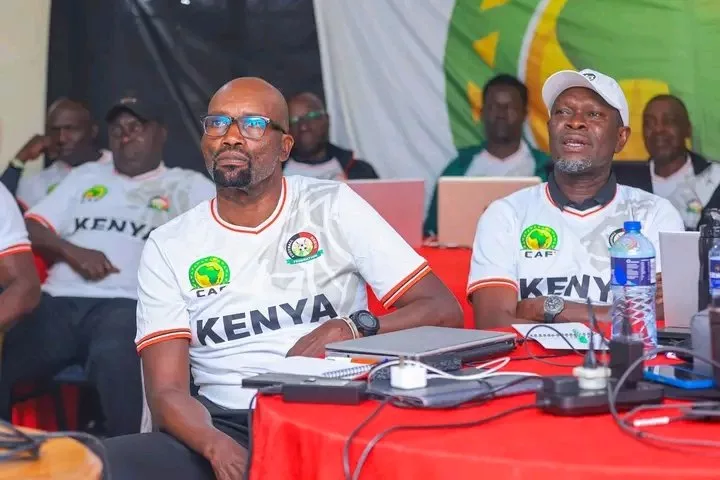
 APS Bomet head coach Sammy 'Pamzo' Omollo and Gor Mahia head coach Charles Akonnor follow the proceedings during the first day of the CAF A refresher course/HANDOUT
 The Football Kenya Federation (FKF) has begun a five-day CAF A Licence refresher course in Nairobi as the federation moves to ensure Kenya’s top coaches remain compliant with continental licensing requirements and keep abreast of the demands of modern football.
The programme, which began on Monday and runs until Friday, has brought together experienced coaches and technical personnel, including Gor Mahia head coach Charles Akonnor, Tusker’s Robert Matano, APS Bomet coach Sammy “Pamzo” Omollo, Francis Baraza, Jacob “Ghost” Mulee and Zedekiah “Zico” Otieno.
FKF President Hussein Mohamed said the course was part of the federation’s wider effort to strengthen coaching standards and ensure Kenyan football keeps pace with international developments.
“The programme is designed to keep our coaches compliant and aligned with the latest CAF and FIFA standards,” Hussein said.
The course is being conducted in line with Article 32.1 of the CAF Coaching Convention Regulations, which requires CAF coaching licences issued more than three years ago to be renewed through prescribed refresher programmes. The requirement is intended to ensure coaches holding advanced qualifications continue to meet the technical and professional standards expected across African football.
FKF Leagues and Competitions Committee chairman Peter Kamau Chege said the training would allow coaches to reassess their knowledge while adapting to the rapidly changing demands of the game. “The CAF A Licence Refresher Course kicked off today, bringing together coaches for a period of learning, reflection and continued professional development,” Chege said.
The course comes as Kenyan clubs face increasingly strict technical requirements for participation in top-level competitions, making the continued validity of coaching licences an important aspect of club compliance.
Football Development Director Francis Kimanzi said the refresher programme was not simply about renewing certificates, but about equipping coaches with knowledge applicable to the modern game. “The course is designed to strengthen coaching standards and support professional development across Kenya,” Kimanzi said.
The training covers tactical and technical development, elite game management, sports science and the use of digital performance information. Coaches are also being familiarised with contemporary CAF and FIFA methodologies aiming to improve decision-making and player development.
Head of Football Education Alex Alumirah said the initiative formed part of a broader effort to modernise Kenya’s coaching education structure. “These refresher courses are a core part of a broader, systemic plan to upgrade Kenya’s coach education curriculum and align local football with global best practices,” Alumirah said.
The emphasis on continuous education also reflects the federation’s attempt to establish a clearer pathway from grassroots coaching qualifications to the highest level of the profession.
Kimanzi said the system was designed to ensure coaches could progress through the various levels while maintaining the standards required at each stage.
“We want to structure local progress by standardising the transition of coaches upwards through the tier system, from the foundational grassroots courses up to the elite CAF A level,” he said.
Chege said the knowledge gained during the programme would ultimately have an impact beyond the coaches themselves. “The course provides an opportunity for coaches to refresh their knowledge, sharpen their technical and tactical understanding, and keep pace with the evolving demands of the modern game,” he said. Kimanzi added that maintaining valid qualifications was particularly important for coaches seeking to remain active at the highest level.
“Ensuring compliance with the CAF coaching regulations is essential if our coaches are to remain eligible and competitive in top-flight football,” he said.
Alumirah said the federation was also placing greater emphasis on digital systems, including the CAF Coaching Management System, which provides a centralised platform for coaching records and licensing information.
“We are driving the transition towards the centralised digital CAF Coaching Management System so that coaches’ records and licences remain properly recognised,” Alumirah said.
The five-day programme combines classroom learning, technical discussions and modern performance concepts, with coaches required to demonstrate that their knowledge remains aligned with current CAF standards.
For Hussein, the investment in coaches is ultimately an investment in players and the wider football ecosystem.
“Continuous development of our coaches directly translates to the growth of our players, and ultimately, the elevation of our football,” he said.
Kimanzi said the federation would continue expanding professional development opportunities as it seeks to build a deeper pool of qualified coaches capable of working across the country’s football structures.
“We must continue investing in technical education because better-prepared coaches create better environments for players to develop,” he said.
Alumirah said the responsibility now rested with coaches to embrace continuous learning rather than view licensing as a one-off achievement.
“Keeping education current is an essential checkpoint for every active coach, particularly those seeking to work at the highest levels,” he said.
As the Nairobi programme enters its final days, the emphasis is firmly on ensuring Kenya’s coaching fraternity does not merely retain its continental qualifications, but continues to evolve with the game.
The refresher course has attracted a strong cast of Kenyan coaching figures, bringing together experienced Premier League tacticians, former national team coaches and emerging technical minds.