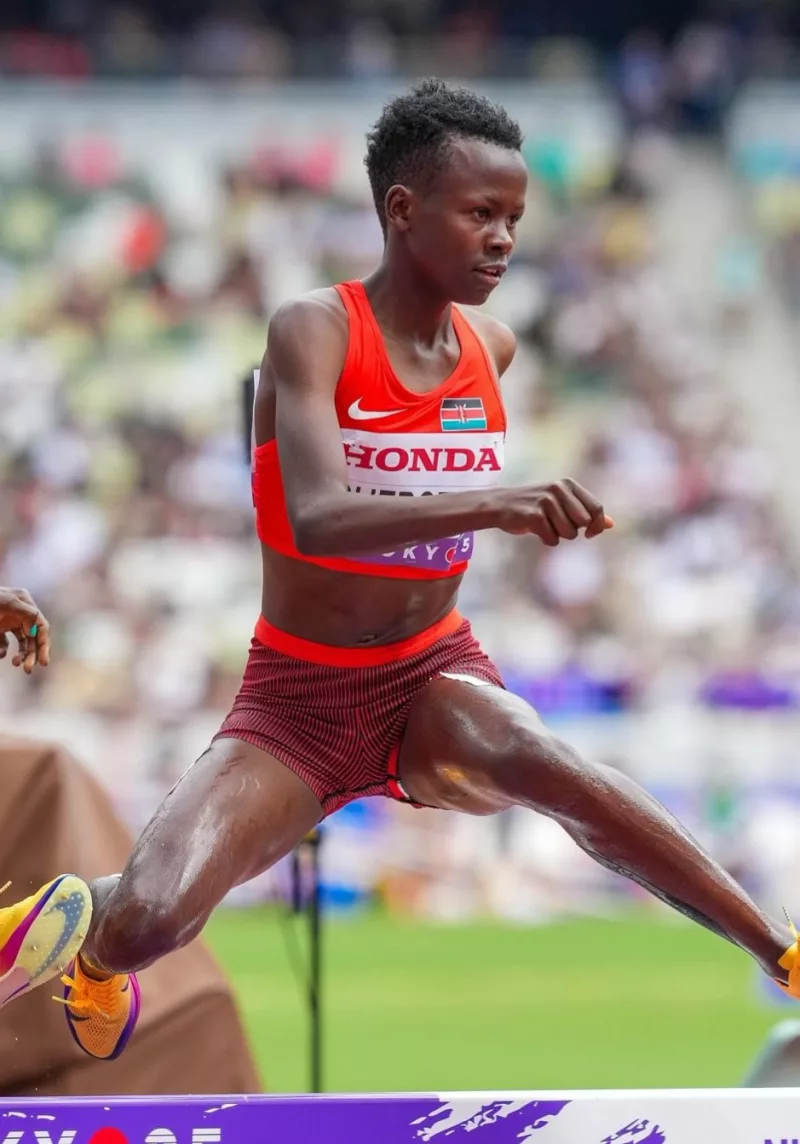
 Kenya's Faith Cherotich competes in the women's 3,000m steeplechase at the Tokyo World Championships/ FILE
In the demanding world of track and field, few events test an athlete’s tactical nous, endurance and technical ability quite like the 3,000m steeplechase.
While the event presents a formidable challenge to athletes across the globe, Kenya has established itself as a dominant force in the steeplechase.
In the women’s event, Kenya boasts a world record holder in Beatrice Chepkoech, who stormed to a sensational 8:44.32 at the Monaco Diamond League meeting in 2018. However, Kenya’s dominance has been most pronounced in the men's event.
At the World Athletics Championships, the country leads the all-time medal standings with 33 medals (13 gold, 12 silver and eight bronze), comfortably ahead of Morocco, which has seven medals.
Kenya’s supremacy is equally evident at the Olympic Games, where its male steeplechasers have amassed 24 medals— 11 gold, seven silver and six bronze—to stay ahead of Finland with nine medals.
But what exactly is the 3,000m steeplechase, and what makes it one of the most demanding and unpredictable events on the athletics programme?
Today’s episode of Know Your Sport takes a closer look at this unique track discipline, where athletes must combine the stamina with the agility and precision of an obstacle racer. The 3,000m steeplechase is a middle-distance track event that requires competitors to cover 3,000 metres while negotiating fixed barriers and a water jump.
The discipline traces its roots to horse racing, from which its distinctive combination of obstacles and endurance emanated. On a standard 400m outdoor track, the race covers seven-and-a-half laps. However, unlike conventional track races, steeplechasers must contend with 35 obstacles throughout the contest, including 28 fixed barriers and seven water jumps.
The barriers are evenly distributed around the course, with athletes required to clear five obstacles per full lap, including the water jump. Unlike conventional hurdles, which are designed to be knocked down when struck, steeplechase barriers are heavy, sturdy and firmly fixed in place.
This means runners cannot simply brush against them and expect them to fall away, making precise foot placement and well-timed take-offs crucial to maintaining momentum.
Athletes are permitted to plant a foot on top of a barrier to help propel them forward, rather than having to clear it entirely in the air. This technique can be particularly useful when fatigue begins to set in during the closing stages of the race. The most distinctive obstacle is the water jump, which consists of a fixed barrier followed immediately by a water-filled pit.
The pit has a sloping landing area, with the water reaching a maximum depth of approximately 70 centimetres near the barrier before becoming shallower towards the other end.
Athletes must clear the barrier and land beyond it, preferably as far into the pit as possible, to minimise water resistance and avoid losing precious momentum.
Landing too close to the barrier can leave a runner splashing into deeper water, forcing them to work harder to regain rhythm, while a well-executed jump can help preserve speed and keep an athlete firmly in contention.
Unlike sprinters and hurdlers, steeplechase athletes don't use starting blocks; instead, they begin the race from a curved line known as a waterfall start.
They are also not confined to individual lanes throughout the race, allowing the field to converge towards the inside lane as soon as the starting gun fires.
The opening section of the race is particularly important because athletes must establish a favourable position before the barriers come into play.
Runners typically cover the first 200 to 300 metres before encountering the first obstacle, giving them time to settle into the race and negotiate the crowded opening exchanges. This obstacle-free opening stretch is necessary for both safety and distance calibration. Beyond its physical demands, the steeplechase requires patience and tactical intelligence.
Athletes must judge when to make a move, conserve enough energy to clear the barriers efficiently and avoid getting boxed in behind rivals at crucial moments.
A runner who expends too much energy early can pay dearly in the closing laps, while a well-timed surge over the final barriers can make the difference between victory and defeat.
The event’s origins date back to 1752 in County Cork, Ireland, where it began as an informal horse race. In the mid-19th century, students at Oxford University in England adapted the concept into a running event, initially contested over cross-country terrain.
By 1879, the discipline had moved to an athletics track, where artificial barriers and water jumps were introduced at the English Championships, laying the foundations for the modern event.
The men’s 3,000m steeplechase made its Olympic debut at the Paris Games in 1900, although the format has evolved over the years. Women had to wait more than a century to compete at the Olympic level, with the event finally being introduced at the Beijing Games in 2008.