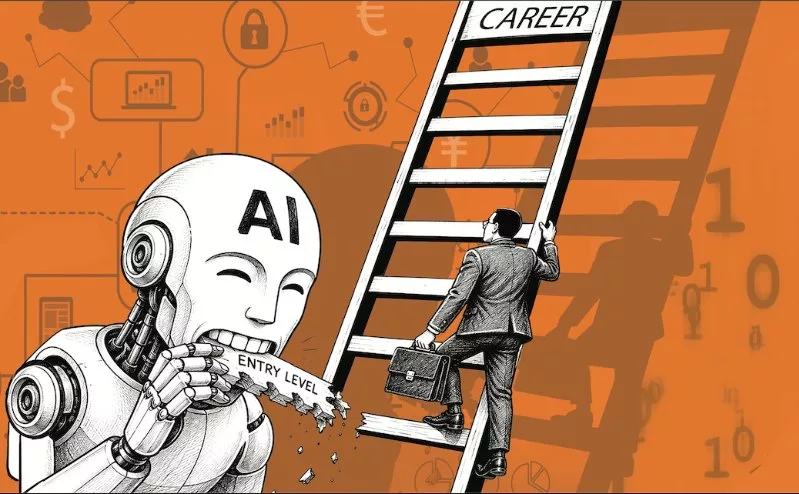
Artificial intelligence may not destroy the professions. It may do something more subtle: remove the work through which professionals learn to become professionals.
That is the real warning behind predictions that AI could erase large numbers of entry-level white-collar jobs. The headline is easy to sensationalise. The structural problem is harder. Law firms, banks, consultancies, audit practices, newsrooms and technology teams are automating precisely the tasks that once formed the apprenticeship layer of professional life: research, document review, first drafts, spreadsheet analysis, coding, reconciliation, monitoring and routine investigation.
The International Labour Organization cautions that transformation is more likely than wholesale replacement, with one in four jobs potentially exposed to generative AI. But exposure is uneven. OECD research published in 2026 warns that AI may disproportionately complicate labour-market entry because simpler cognitive tasks are common in junior positions. PwC’s 2026 AI Jobs Barometer adds a revealing twist: AI-exposed entry-level roles are seven times more likely to demand skills traditionally associated with senior workers, including judgment and leadership.
We are raising the floor faster than we are building the staircase.
A junior lawyer learns judgment by reading bad contracts, finding awkward precedents and being corrected. A young auditor learns professional scepticism by reconciling figures that refuse to agree. A finance analyst learns to distrust a beautiful model when its assumptions are weak. A cybersecurity analyst learns to distinguish noise from an incident by staring at logs, chasing false positives and watching experienced responders think under pressure.
Those tasks can look inefficient on a productivity dashboard. They are also training.
This is where organisations risk creating competence debt: short-term productivity gained by removing repetitive work that develops long-term expertise. Like technical debt in software, competence debt can remain invisible until the organisation needs judgment under pressure and discovers that too few people have learned how the machinery actually works.
The warning is no longer theoretical. Stanford researchers found relative employment declines among workers aged 22 to 25 in highly AI-exposed occupations, although researchers appropriately caution that isolating AI from wider labour-market forces remains difficult. Thomson Reuters’ 2026 research found that 48 per cent of legal professionals worry about AI’s effect on developing independent judgment, while 71 per cent believe early-career professionals need structured support from experienced colleagues.
Cybersecurity offers an especially important warning. ISC2 reports that organisations are already integrating AI into security operations while AI skills have become a major workforce need. AI can accelerate threat detection, log analysis and incident triage. But a junior analyst who learns only to accept an AI-generated verdict may never develop the instinct to challenge a false positive, identify poisoned data or recognise when an attacker has manipulated the system.
Automation without retained human competence is not resilience. It is concentration of risk.
For Kenya, this matters enormously. The country wants an AI-enabled economy, high-value digital jobs and globally competitive professionals. Its national AI agenda places skills, innovation and responsible adoption at the centre of that ambition. The ILO has separately argued for substantial investment in intermediate and advanced digital competencies among Kenyan youth. But a knowledge economy cannot be built by producing graduates while employers quietly remove the entry points through which graduates become trusted practitioners.
The answer is not to preserve low-value work for nostalgia’s sake. AI should automate drudgery. The answer is to redesign apprenticeship deliberately.
A junior lawyer using AI to prepare a case note should still defend the authorities and reasoning. A graduate analyst using an AI-generated financial model should explain every material assumption. A cyber analyst using AI-assisted detection should be able to investigate an alert without blindly accepting the machine’s conclusion. An auditor using AI to identify anomalies should still know why an anomaly matters and what evidence would prove or disprove it.
AI should compress the time to competence, not bypass competence.
That requires employers to measure something rarely found on AI dashboards: learning transfer. Whenever a task is automated, leaders should ask what skill was previously acquired through that task, where that skill will now be taught and how mastery will be demonstrated.
Boards approving AI programmes should examine talent-pipeline risk alongside return on investment, cybersecurity, data protection and model risk. Professional bodies should revise competency frameworks. Universities should assess reasoning, oral defence, verification and real-world judgment rather than reward polished output alone. ISACA’s 2026 research already shows the larger governance problem: organisational AI use is accelerating faster than readiness, controls and training.
The future of work is therefore not a contest between humans and machines. It is a contest between organisations that use AI to develop stronger professionals and those that use it to hollow out their own talent pipelines.
Kenya does not need to protect every junior task. It needs to protect the journey from beginner to expert.
AI can draft the memo, inspect the code, search the cases and analyse the spreadsheet. But if we automate away every place where judgment is learned, tomorrow’s institutions may be full of powerful machines and dangerously short of people qualified to challenge them.
ICT, cybersecurity and digital governance professional