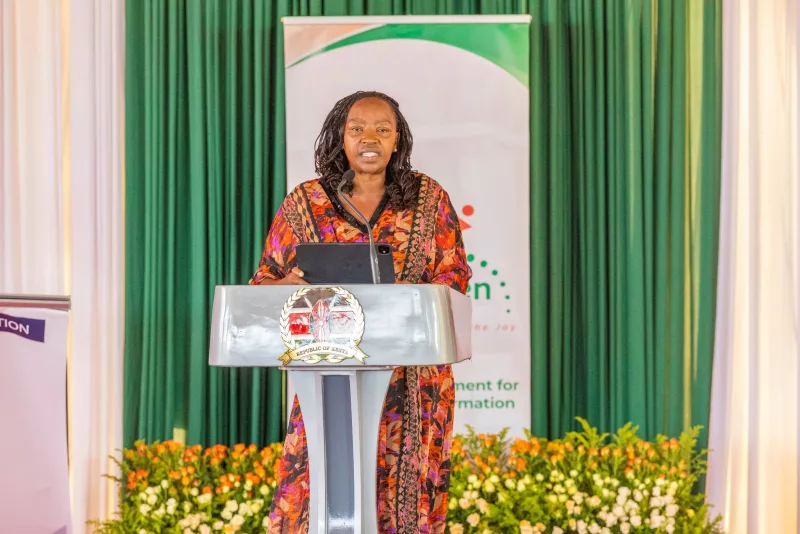
 DHA Chief Executive Officer Anthony Lenaiyara addresses participants during the Health Summit Presidential Townhall on healthcare at KICC in Nairobi on August 18, 2026. / SCREENGRAB
The Digital Health Agency (DHA) has said the Social Health Authority (SHA) has paid about Sh500 million for technology services since its establishment, while more than 42,000 digital devices have been supplied to public health facilities across the country.
DHA Chief Executive Officer Anthony Lenaiyara gave the figures during the National Health Summit at the Kenyatta International Convention Centre (KICC) in Nairobi, where he defended the government’s digital health investments and outlined how technology has been used in the management of SHA services.
Lenaiyara said the Sh500 million figure was significantly lower than claims that the government had committed tens of billions of shillings to the technology system.
“For the last two years, Sh500 million has been paid for this technology that we were told that we were going to pay Sh100 billion,” Lenaiyara said.
He said payments to technology service providers were governed by regulations, with SHA paying Sh25 for every active member under the prescribed arrangement.
Lenaiyara said the DHA had instead built what he described as a “digital superhighway” comprising 43 systems to support universal health coverage.
A key component has been the deployment of digital devices to public hospitals and other health facilities.
“As of today, we have supplied 42,327 gadgets. If you walk to any dispensary today, in the lowest village you can be, you will find a gadget,” he said.
According to Lenaiyara, the facilities did not pay for the devices, which form part of the digital health infrastructure being rolled out by the government.
He said the technology had also changed how public facilities process and account for SHA claims.
Under the former National Hospital Insurance Fund (NHIF) system, Lenaiyara said claims were handled through physical files and moved through different offices for approval.
He said the digital system now allows claims to be tracked electronically, improving accountability at facility level.
Lenaiyara also linked the digitalisation programme to an increase in the share of SHA funds going to public facilities.
He said public hospitals previously received about 35 per cent of payments under the earlier system but were now receiving about 62 per cent.
The DHA CEO also outlined other systems introduced under the digital health infrastructure, including a unique patient identification system using national identification details and fingerprints.
He said this had reduced reliance on physical cards and helped create a consistent health record for patients across facilities.
The system also allows patients using the SHA app to access information including claims, prescriptions, doctors and other health records.
Lenaiyara said digital systems had also been deployed to monitor health commodities, allowing the government to track medicines from manufacturers through distribution to dispensing to patients.
He said the system was intended to reduce losses, improve accountability and help prevent the distribution of unauthorised or counterfeit medicines.
The DHA has also introduced telemedicine and health information exchange systems to allow health workers to share information and consult across facilities.
On the impact of digitisation on staffing, Lenaiyara said the transition from NHIF to SHA had significantly reduced the number of employees required to process claims.
He said the former NHIF had close to 1,700 employees, while the current organisation has about 850 staff.
He gave the example of the SHA Claims Management Office, which he said has 35 employees but can process about 26,000 claims a day, or close to one million claims a month.
“We have reduced the staff by half because of technology, and we are processing more claims than were being processed by 1,800 staff. That is how efficiency looks, and that is how transformation is framed,” Lenaiyara said.