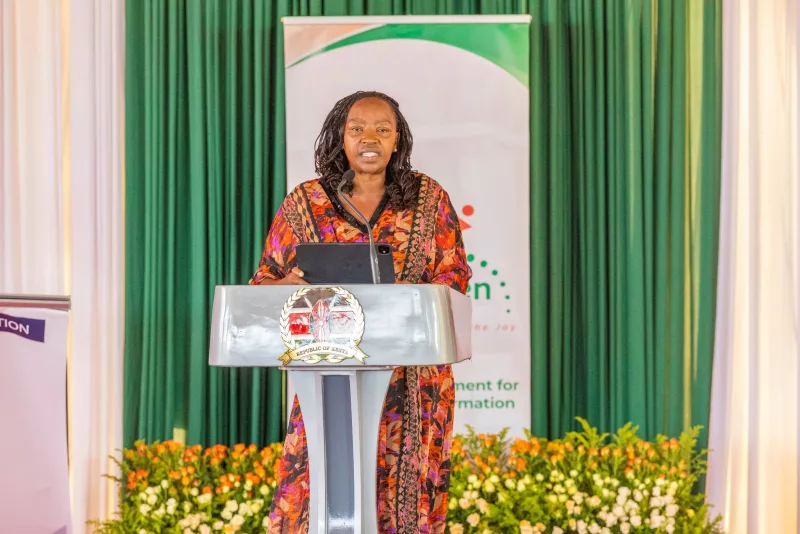
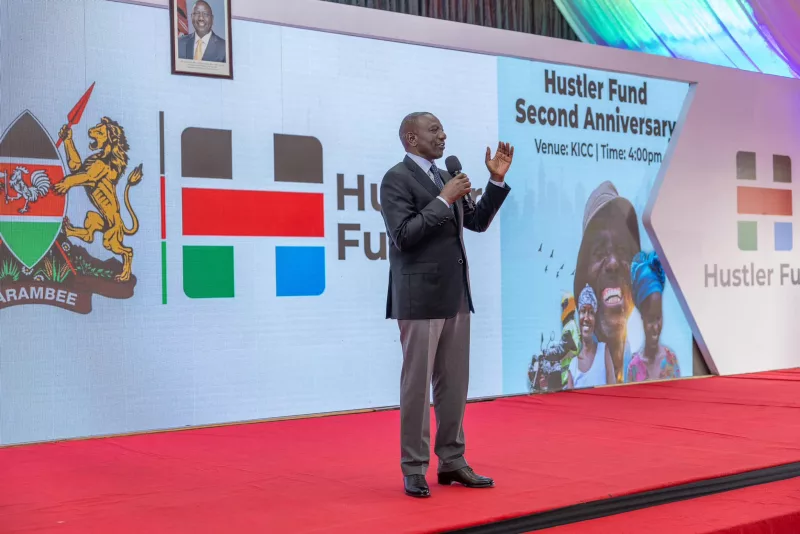
 President William Ruto speaking during the second anniversary of the Hustler Fund. / FILE
When President William Ruto launched the Hustler Fund in November 2022, the programme was presented as a way of changing how millions of Kenyans at the bottom of the economic pyramid accessed credit.
The fund was intended to provide affordable loans to people who had traditionally struggled to obtain financing from banks, SACCOs and microfinance institutions, while also encouraging saving and helping small businesses access working capital.
Four years later, the programme has reached 28 million Kenyans and disbursed Sh90 billion.
The government points to the size of the fund, the number of borrowers, repeat users, savings accumulated and individuals who have improved their credit profiles as evidence of its reach.
Borrowing: Millions reached
President Ruto launched the Hustler Fund as part of the Kenya Kwanza administration's Bottom-up Economic Transformation Agenda, particularly its financial inclusion and MSME pillar.
The programme began with an initial funding pool of Sh50 billion and was designed to provide personal, micro-business, SME and start-up loans.
By July 21, the President said the fund had disbursed Sh90 billion to 28 million borrowers through its Personal Loan, Bridge Loan and Hustler Groups products.
Hustler Fund CEO Henry Tanui subsequently said the fund had more than 28 million customers and was serving about 5,000 borrowers daily, with daily lending averaging Sh50 million.
“Since inception, we've disbursed more than Sh90 billion to Kenyans. We have beneficiaries or borrowers in every county. They have repaid more than Sh76 billion and currently what is outstanding is Sh13.7 billion,” Tanui said.
The fund is accessed digitally through *254#, with personal loans ranging from Sh500 to Sh50,000, while Bridge Loans can go up to Sh150,000.
Moses Banda, financial inclusion adviser in the Executive Office of the President, said Kenya's labour force includes about 17 million people in the informal sector who have historically lacked the financial records required by conventional lenders.
Who is borrowing?
Government data shows that 60 per cent of Hustler Fund borrowers are aged below 40.
Out of the 28 million registered customers, Tanui said 10 million are repeat borrowers.
Ruto has also highlighted the fund's credit-scoring component.
In July, he said 4.5 million customers had attained A and B credit scores because of consistent borrowing and repayment.
The government has linked the programme to efforts to help people who had been negatively listed with Credit Reference Bureaus rebuild their financial standing.
In June, Ruto said more than eight million negatively listed Kenyans had been given a second chance, with more than two million having already restored their credit status.
He said the government was working towards a National Credit Score framework that would give greater weight to repayment behaviour and financial discipline.
“Character and behaviour, not just a title deed or a logbook, should unlock financing,” Ruto said.
Tanui said borrowers who demonstrate a consistent repayment record would eventually be transitioned towards the banking sector.
“Those who have already established a track record, who have some data that can show they are responsible borrowers, we will be transitioning them to the banking sector,” he said.
What are borrowers using the money for?
Individual experiences show that the fund has been used for different purposes, including small-scale business activities.
Jane Kiptoo, who runs a fast-food eatery in Eldoret, said she borrowed Sh900 when she first joined the fund two years ago.
After repaying the loan, she continued borrowing, and her limit has since grown to Sh35,000.
“I have been using the money to buy stock, especially potatoes because I mostly sell chips and a few other fast foods at my kiosk,” she said.
Another borrower, Ben Kamau, operates as a hawker selling motorcycle spare parts to boda boda riders in Eldoret.
He started with a Sh500 loan and, after building his borrowing profile, his limit grew to Sh21,000. He uses the money to purchase stock.
In Mlolongo, Machakos, salon owner Esther Musyoka said she borrowed Sh3,000 in 2024 to expand her business.
“The loan enabled me to buy additional salon equipment, stock hair products and expand my services,” she said.
Musyoka said the additional investment helped her attract more clients and increase her daily income.
Tanui cited another borrower operating a shop near a university who had cumulatively borrowed Sh12 million.
“He borrows, pays online for the goods and they are delivered to his shop. So, he doesn't leave his shop anymore, and the students flock there to buy,” Tanui said.
Repayment: More than Sh76 billion returned
By July 2026, Tanui said borrowers had repaid more than Sh76 billion against cumulative disbursements of Sh90 billion.
The fund has also accumulated savings.
Tanui said borrowers had saved Sh7 billion since its launch. Of the approved loan amount, 95 per cent is deposited into the borrower's mobile money wallet, while five per cent goes into a savings account under the fund.
More than 275,000 Kenyans had also voluntarily saved money without borrowing, with such savings exceeding Sh800 million, Tanui said.
But repayment has also emerged as a challenge.
An Auditor General's review reported in March 2026 raised concerns over Sh15.2 billion in loans whose recovery could not be confirmed.
The amount comprised Sh13.6 billion in principal and Sh1.6 billion in interest, with Sh13.2 billion, or 87 per cent, having remained unpaid for more than one year.
The audit also found that more than 26,100 loans worth Sh24.5 million had been issued to customers who were already in default.
Another 386,735 accounts were recorded as fully settled despite outstanding balances totalling Sh377.5 million.
The Auditor General further said the fund did not have a clear credit policy or collection strategy for non-performing loans.
The audit findings came as the fund continued to operate as a revolving credit facility, where repayments are expected to support subsequent lending.
The borrowers who did not succeed
Not every borrower has used the money to build or expand a business.
Andrew Kiyeng in Eldoret said he was not operating a business when he borrowed Sh500 after the Hustler Fund was launched.
He spent the money but was unable to repay it.
“The Hustler Fund is a good idea that was designed to help low-income people access funding for business and other needs, but for some of us, repayment became a major challenge,” he said.
Alan Sirima, a 28-year-old resident of Machakos, borrowed Sh500 once and did not return to the platform.
He said he had heard of friends who defaulted and stopped borrowing.
“At the same time, I've heard of others who tried to start small ventures with the loans, like selling boiled eggs on the roadside, opening small kiosks and mama mbogas who say they used the money to expand stock for their vegetable businesses,” Sirima said.
“Honestly, I am not sure how far Sh500 can go.”
Has the money translated into business growth?
The programme has registered 28 million customers, disbursed Sh90 billion, accumulated Sh7 billion in savings and produced 10 million repeat borrowers, according to its latest figures.
Individual businesses such as Kiptoo's food kiosk, Kamau's spare-parts business and Musyoka's salon provide examples of borrowers using the loans to purchase stock or equipment.
But the available figures do not show how many businesses have increased turnover, hired workers, survived beyond the initial borrowing period or graduated to larger forms of financing.
A 2025 study by the Kenya Human Rights Commission raised questions about the programme's impact on enterprise development.
The organisation's Failing the Hustlers report said that by September 2024 more than Sh53 billion had been disbursed but found no measurable impact on enterprise development or job creation in the evidence it reviewed.
The report also questioned whether initial loans of Sh500 to Sh1,000 were large enough to establish or substantially expand businesses.
KHRC further criticised the repayment design, particularly the short repayment period attached to personal loans.
From lending to business training
The government has introduced business training alongside lending through the Tukuze initiative.
Tanui said the Hustler Fund had launched the Tukuze App to provide capacity building to borrowers.
“Tukuze means 'let's grow'. We started last week with Mombasa county. We have partnered with Strathmore University and the African Management Institute to provide capacity building for the top borrowers, who have demonstrated the ability to borrow and save regularly,” he said.
The programme initially targets borrowers with a demonstrated history of borrowing and saving before being rolled out more widely.
“We want to start with those people and then roll it out to all the others because financial literacy is key to unlocking financial inclusion,” Tanui said.
Dr David Kabata, a lecturer in entrepreneurship and innovation at Kirinyaga University, said many Kenyans need business training before receiving start-up loans.
Charles Otwori, chairman of the Nyamira Professionals Association, similarly called for financial literacy training for beneficiaries.
“Give us the list of the people who have benefited from the Hustler Fund. Let's have an MoU, and we can build their capacity at minimum cost,” Otwori said.
The repayment problem
For a revolving fund, repayments determine how much money can continue circulating among borrowers.
The Auditor General's findings raise questions about the recovery of funds already disbursed.
The March 2026 audit found that Sh15.2 billion in principal and interest was at risk of recovery. It also identified weaknesses in loan-limit enforcement, with 4.3 million registered customers having no established loan limits.
Some 38,900 of those customers were nevertheless issued loans worth Sh60 million.
The audit further found that the fund had only 18 employees against an approved establishment of 119, limiting its ability to monitor lending and pursue defaulters.
The MSME financing gap
The Hustler Fund operates within a much larger financing gap facing Kenyan businesses.
Speaking during the 2026 World MSME Day celebrations in Nairobi in June, Ruto said MSMEs account for 98 per cent of businesses, generate more than 90 per cent of non-farm employment and contribute more than 40 per cent of GDP.
He said the country's MSME financing gap stood at about Sh3 trillion.
“Government funds can catalyse and prepare our people for credit. But government alone cannot close a Sh3 trillion financing gap,” Ruto said.
Tanui said borrowers who develop reliable repayment records would be transitioned towards banks once their financing requirements exceed the limits of the Hustler Fund.
For some borrowers, the programme has already resulted in higher borrowing limits.
Kiptoo moved from a Sh900 first loan to a Sh35,000 limit, while Kamau moved from Sh500 to Sh21,000.
For others, the first loan did not lead to repeat borrowing. The government responded by adding business training through Tukuze and using repayment records to develop credit profiles for borrowers.