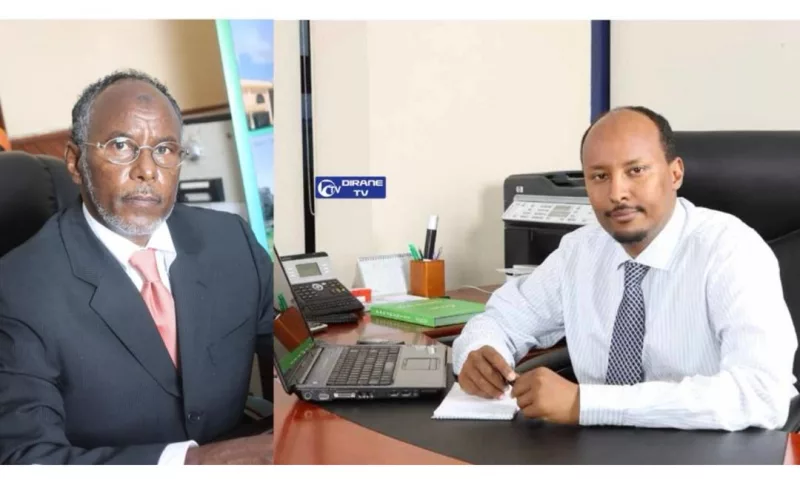
 Dahabshiil founder Mohamed Said Duale (left) and the company's Chief Executive Officer Abdirashid Duale (right). /HANDOUT
Few private institutions are as closely associated with the economic life of Somali communities as Dahabshiil. Its history is intertwined with the growth of Somali diaspora networks, the collapse of formal institutions after 1991, and the continuing importance of remittances to households across Somalia and the wider Horn of Africa.
The institution’s significance, however, is best understood through the circumstances that created demand for its services. For decades, Somali families have relied on cross-border financial networks to support relatives, sustain businesses and cope with limited access to formal banking.
Following the collapse of the Somali state in 1991, companies such as Dahabshiil helped fill part of that gap by connecting Somalis in Europe, North America, the Middle East and elsewhere with families and businesses across the Horn of Africa.
The importance of remittances goes far beyond the transaction itself. Money sent home can pay school fees, cover medical expenses, buy food, support a household or provide capital for a small business. At community level, such transfers sustain consumption, support investment and provide resilience when public services and employment opportunities are limited.
The Somali diaspora has consequently become an important economic force. Its contribution extends beyond regular family support to investment in businesses and property, financing community projects, supporting education and healthcare, and responding rapidly during droughts, floods and other humanitarian emergencies.
From remittances to investment
The role of diaspora finance has evolved significantly. What began primarily as a means of supporting relatives has increasingly become part of a wider economic relationship between Somali communities abroad and their countries of origin.
Diaspora capital now supports businesses of different sizes, from small family enterprises to larger investments in telecommunications, financial services, energy, property and other sectors. These investments help create employment, expand services and strengthen economic links between the Horn of Africa and international markets.
Dahabshiil itself has evolved alongside this changing environment. While remittances remain an important part of its operations, its wider investments and services reflect the growing demand for banking, telecommunications, digital financial services and other infrastructure required by individuals and businesses.
Dahabshiil is also one of the major private-sector employers in the region. Beyond its own direct employment, its services and investments support customers, entrepreneurs and businesses that create jobs and economic opportunities across the Horn of Africa and in communities around the world.
Leadership across generations
Dahabshiil’s growth has been shaped by the vision of its founder, Haji Mohamed Said Duale, and the leadership of his son, Abdirashid Mohamed Duale. Founded in 1970, the business grew from serving local communities into an international financial group connecting the Somali diaspora with families and businesses across the region.
Building on his father’s foundations, Abdirashid has led Dahabshiil’s international expansion and investment in financial services, technology, telecommunications and other sectors, while strengthening relationships with regulators, banks and international partners. Together, their leadership across two generations has helped create jobs, expand economic opportunities and strengthen connections between the diaspora and the Horn of Africa.
Enterprise, communities and resilience
The economic importance of diaspora finance is particularly visible during periods of difficulty. When communities face drought, conflict, economic disruption or other emergencies, diaspora networks can mobilise resources quickly.
At the same time, the long-term significance of these financial connections lies in their ability to support enterprise. A transfer that initially helps a household may later finance education, establish a small business or contribute to a larger investment.
This relationship between remittances, entrepreneurship and investment is increasingly important as younger generations of the Somali diaspora seek new ways to engage economically with the region. Many are interested not only in supporting relatives but also in investing, building businesses and contributing skills and professional expertise.
Technology has accelerated this transformation. Digital platforms, mobile money, banking services and improved international connectivity have made it easier for diaspora communities to interact financially with families and businesses across borders.
The sector has nevertheless faced significant challenges. De-risking by international banks has made correspondent banking relationships more difficult and expensive to maintain, with consequences extending well beyond individual companies. For families and businesses that depend on cross-border transfers, maintaining access to the international financial system has wider social and economic implications.
Dahabshiil has had to overcome these challenges by adapting its compliance systems, investing in regulatory requirements and maintaining and developing relationships with regulated financial institutions in different jurisdictions. Its ability to continue connecting diaspora communities with families and businesses in the region despite periods of international banking de-risking demonstrates the importance of resilient financial infrastructure and long-term institutional relationships.
Building the next stage
The next phase of Somali diaspora finance is likely to involve a deeper connection between remittances, investment, financial services and enterprise.
There is significant potential to channel more diaspora capital towards productive sectors, including agriculture, energy, technology, telecommunications, housing, education, healthcare and infrastructure. Doing so could help transform part of the enormous financial contribution already made by Somali communities abroad into longer-term investment and employment.
The challenge now is to build on and further strengthen existing institutions and financial systems so that these financial connections can generate even broader economic opportunities. That requires accountable institutions, improved infrastructure, greater access to capital and policies that encourage productive investment, while continuing to strengthen the financial and regulatory systems already serving communities and businesses.
For companies such as Dahabshiil, this means continuing to invest in technology, compliance, financial infrastructure and partnerships while ensuring that services remain accessible to the communities that have relied on them for decades.
The broader opportunity is to move gradually from finance focused primarily on survival towards finance that also supports investment; from household support towards enterprise creation; and from fragmented financial flows towards sustainable economic partnerships.
The Somali diaspora has already demonstrated its importance to the economic resilience of the Horn of Africa. The next chapter will depend on how effectively that financial strength, entrepreneurial experience and global connectivity can be converted into lasting investment, employment and economic development.