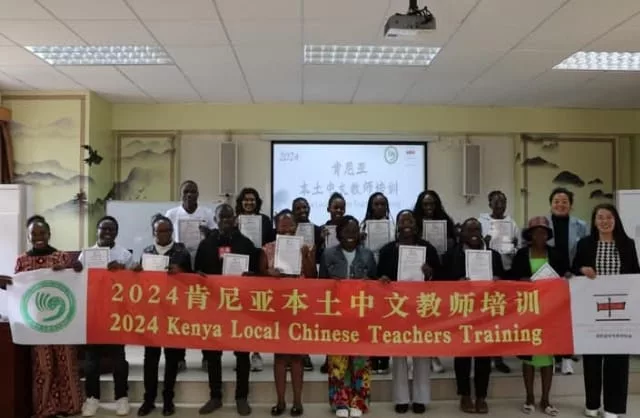
 The Confucius Institute Director, Prof Wang Shangxue (extreme right) poses for a photo with a section of Chinese language teachers during a past event/COURTESY
More than 250 Chinese language teachers and education stakeholders from across Africa have gathered at the University of Nairobi for a special training aimed at strengthening teaching skills and aligning Chinese language education with emerging international standards.
The two-day training, which began Friday at the Confucius Institute at the University of Nairobi, brings together participants attending physically and virtually as Kenya and other African countries seek to expand Chinese language education.
The 2026 special training on enhancing teachers’ competence, guided by the International Chinese Language Education Standards (Africa), is being held from August 14 to 15.
The programme seeks to promote the implementation of the Chinese Proficiency Grading Standards for International Chinese Language Education and the core standards for Chinese language education in Africa.
University of Nairobi Deputy Vice Chancellor for Academic Affairs Prof John Mande, who opened the training, said the growing interest in Chinese language education demonstrated that the subject had moved beyond being a specialised academic field.
“The development of Chinese language education is no longer a matter for language specialists alone. It is increasingly part of the broader conversation about teacher education, international engagement, employability, mobility, as well as the preparation of learners for an interconnected world,” Mande said.
He said the training would help teachers understand how international standards could be applied within Kenya’s education system while remaining relevant to local needs.
Mande said the university had strengthened its contribution to Chinese language education through academic programmes, including a Bachelor of Education Arts programme with Chinese as an option and postgraduate training.
He said sustainable growth in the teaching of Chinese required more than increasing the number of learners.
“It requires a strong pipeline of well-prepared teachers, supported by sound academic preparation, professional standards, as well as opportunities for continuous professional development,” he said.
The Confucius Institute Director Prof Wang Shangxue said the growth of Chinese language programmes in Kenya had benefited significantly from support by the University of Nairobi.
He said the university had established Chinese language programmes at undergraduate and postgraduate levels, creating opportunities for teachers to receive locally recognised training.
“Because of this programme, we can do more training, and this programme can be locally recognised,” Wang said.
He said the institute was also working to make learning materials more accessible to students and teachers, noting the importance of textbooks in language learning.
The training comes as teachers adjust to changes in Chinese language proficiency standards, including the transition to the new HSK 3.0 system.
Chinese Language Teachers Association national chairperson Faith Wanjiku, said the changes had increased the level of competence expected from both learners and teachers.
She said under the previous system, a Level One learner was expected to acquire about 150 vocabulary items, while the new standard requires at least 300.
“There is a need for the teachers to be well equipped in equipping their students to gain more vocabulary, the grammar structures that will enable them to handle situations in a better way,” Wanjiku said.
She said learning Chinese was increasingly linked to employment, scholarships and business opportunities, particularly as Chinese companies continue operating in Kenya.
“We are not only equipping them to learn the language and that’s it, but they need to learn the language and use it in the job market,” she said.
Wanjiku said teachers also needed to understand how the new Chinese language standards would fit within Kenya’s Competency-Based Education curriculum, particularly as the country prepares to implement Grade 10 and subsequent levels.
She said more than 80 schools across Kenya were currently offering Chinese language classes, reflecting growing demand for the subject.
The first day of the training covered interpretation of the core standards and the new HSK, alignment between Chinese and English standards, textbook selection, classroom activities, preparation of students for contests and examinations, and oral teaching skills.
Participants are also being trained on grammar standards, resource development and teaching demonstrations.
The programme is jointly organised by the Centre for Language Education and Cooperation under China’s Ministry of Education and the University of Nairobi, through the regional training centre for local Chinese language teachers in Kenya and Africa and the Chinese Language Teachers Association.
Mande said the training was also an opportunity for educators from different institutions to share experiences and develop approaches that could be applied in their classrooms.
“I hope that each one of you will leave with practical ideas that can be applied in your own teaching and professional settings,” he said.
The participants are also taking part in group discussions on how the international core standards can be aligned with Chinese language education standards in individual African countries.
Wanjiku said the ultimate measure of the growing investment in Chinese language education would be the opportunities created for learners.
“The way they would see fruits is through employment, through better relationships in businesses when the Kenyans can bring their things more from China,” she said.
The training is expected to strengthen teachers’ ability to prepare Kenyan learners for an increasingly interconnected world while ensuring Chinese language education remains responsive to the country’s curriculum and labour-market needs