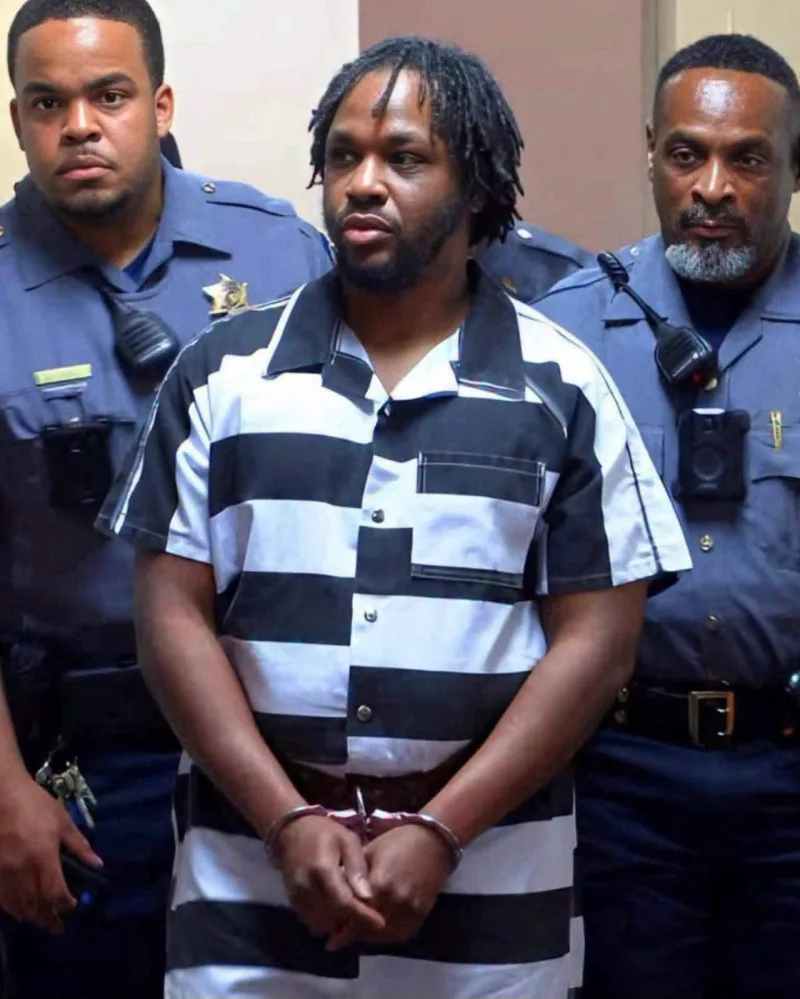
 Jeremy Tremaine Williams in court during the Kamarie Holland murder trial.
Warning: This article contains graphic descriptions of child sexual abuse, rape, murder and other disturbing content that some readers may find distressing.
Jeremy Tremaine Williams, 41, was among three American convicts scheduled to be executed by lethal injection on August 13, 2026, in three different states.
If carried out as scheduled, the executions would mark the first time three convicted murderers were put to death on the same day in different US states.
The other convicts were Anthony Darrell Hines, 66, in Tennessee and Carlos Cuesta-Rodriguez, 71, in Oklahoma.
But it is the chilling story of how Williams ended up on the most disturbing death row.
Williams was sentenced to death by lethal injection for raping and murdering five-year-old Kamarie Holland in December 2021.
On December 13 that year, two weeks before Christmas, Kamarie’s mother, Kristy Siple, agreed to let Williams sexually abuse her daughter in exchange for about Sh325,000.
Williams took the little girl to an abandoned house in Phenix City, Alabama, where he sexually abused her, forced her to use methamphetamine, filmed the abuse and then strangled her to death.
He continued sexually abusing her body after she had died.
Siple pleaded guilty to human trafficking involving her daughter and was sentenced to 20 years in prison.
Williams was convicted and sentenced to death.
Siple had initially called the Columbus Police Department in Georgia, claiming she had woken up to find her daughter missing from her bed.
After hours of searching, detectives found Kamarie’s battered and strangled body outside an abandoned house in Phenix City, Alabama.
Williams, then 37, was arrested the same day. Siple was later arrested and charged with agreeing to let Williams rape her daughter for $2,500.
Police said they believed Siple agreed to give her daughter to Williams in exchange for money to buy drugs.
Desperate search
Williams was arrested before police knew what had happened to Kamarie. He could not talk, leaving officers to continue their desperate search in the hope that they would find the little girl alive.
As the search continued, Sergeant Jane Edenfield and another detective interviewed people who knew Williams.
One of them provided a crucial lead. “If something happened to that little girl, she's going to be at this house in Phenix City.”
The property was owned by Williams’ family. Driven by the fear that Kamarie might still be alive, the officers began the long journey at about 10 pm. But they did not find her alive.
Her battered body had been positioned against a wall outside a cellar in such a way that Edenfield initially thought she was a doll.
Police said Williams had raped Kamarie inside the abandoned house, forced her to smoke methamphetamine and filmed the abuse.
He then strangled her but continued sexually abusing her after her death.
No mercy
During his 2024 trial, Williams reportedly wanted no mercy. He directed his defence attorneys not to put up a defence, declaring: “I'm just sick.”
The jury found him guilty of murder, sodomy, sexual abuse of a child, production of obscene material involving a child, human trafficking and abuse of a corpse.
When the judge handed him the death sentence, Williams again directed his defence team not to appeal.
According to Edenfield, Williams never expressed remorse for what he had done or offered an explanation.
“His words were that he was just sick, and that’s it. He didn't elaborate,” she told USA TODAY.
Williams had reportedly faced a string of other child sex abuse allegations in Alabama, Columbus and Georgia dating back to 2005, although he had not been convicted in those cases.
He was acquitted in 2012 of allegations that he scalded a five-year-old child with hot water in Phenix City.
He was also accused of throwing his one-month-old daughter down the stairs and molesting his stepdaughter.
During the Kamarie trial, Williams, a former US military serviceman, was convicted and sentenced to life imprisonment without the possibility of parole for raping his cousin's five-year-old daughter at a daycare centre he ran with his wife.
The conviction signalled a lost opportunity for law enforcement to stop him before he got to Kamarie.
“When a child talks, listen. When a child says something happened, you better pay attention,” Alabama District Attorney Rick Chancey said ahead of the execution.
Kamarie's family
During the trial, it emerged that Kamarie was not an only child raised by a single irresponsible mother, as had initially been imagined.
She came from a large family with several siblings and had a devoted father, Corey Holland, who called her Princess.
Holland had full custody of Kamarie but would occasionally allow her to stay with her mother.
He testified during Williams’ trial that allowing the visit was the biggest regret of his life.
Edenfield said Williams remained emotionless and stone-faced throughout the trial, even as Holland sobbed while telling him that he had taken his little girl away.
Kamarie's family described her as charismatic and larger than life. Her older sister, who was about nine years old at the time, moved the courtroom to tears as she spoke about how much she loved and missed her little sister.
If Williams' execution went ahead as scheduled, he would have been the first inmate executed in Alabama this year and the 22nd in the US.