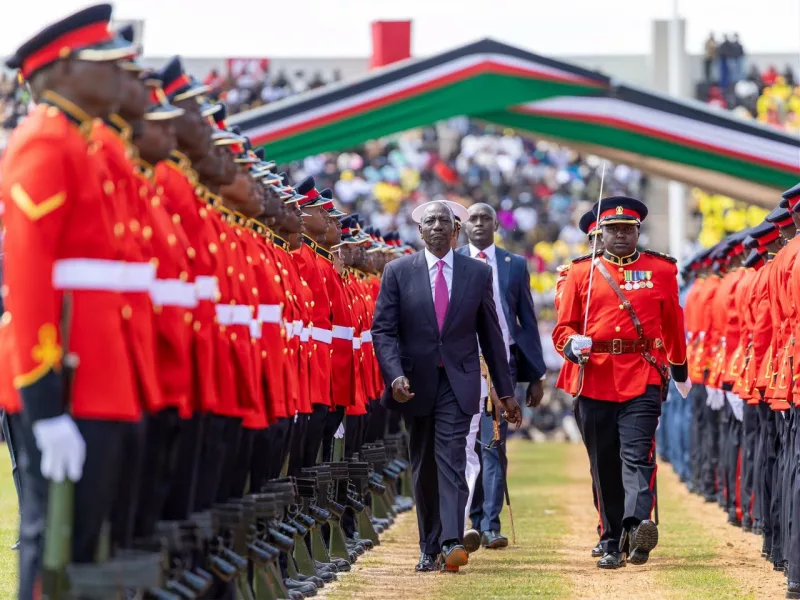
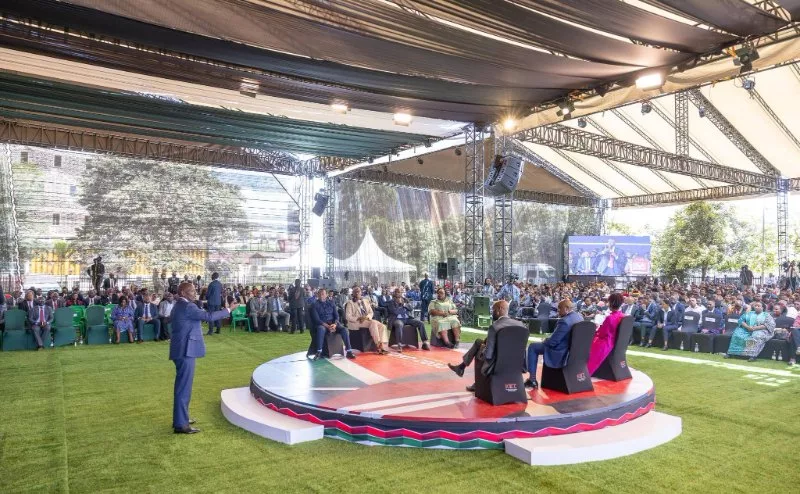
 President William Ruto, during the launch of the national conversation on the development of the
Beyond 2030 vision at the Kenyatta International Convention Centre in Nairobi
on Wednesday/PCS
President William Ruto, during the launch of the national conversation on the development of the
Beyond 2030 vision at the Kenyatta International Convention Centre in Nairobi
on Wednesday/PCS
Realising President William Ruto’s dream of a first-world Kenya, popularly dubbed “Singapore”, will require massive investment, ironclad fiscal discipline and an uncompromising war on corruption.
A panel of experts constituted by the President said realising the vision will require a multi-pronged, radical strategy with a focused administration.
This includes cutting down on public debt, supporting the private sector, slaying the dragon of graft, government financial discipline and increasing investment in infrastructure.
“I am told that many Kenyans are sceptical. They believe Singapore is too high a target for Kenya to reach in this generation,” Japanese economist and former adviser to the late former Prime Minister Raila Odinga, Prof Hiroyuki Hino said.
“I agree that reaching Singapore’s level of development in the next 30 to 40 years would be difficult,” he said.
Singapore has an economy roughly six and a half times larger than Kenya's despite having barely a tenth of Kenya's population.
Its GDP per capita is nearly 40 times higher.
Hino spoke when President Ruto launched the national conversation on the development of the Beyond 2030 vision at the Kenyatta International Convention Center in Nairobi on Wednesday.
According to Hino, runaway big money corruption was among key factors that could derail Kenya’s Singapore match.
“Corruption damages the economy and weakens the social fabric. Curbing corruption would be truly transformative,”
“Kenyans often say that the government tolerates corruption and public officials are rarely prosecuted. I agree where there is sufficient evidence, those responsible must be brought before the courts.”
Ruto and the delegates proposed the formation of a multisectoral team drawn from various sectors to lead the conversation across the country.
“It is important that at this point, we give ourselves another opportunity to think about the long-term development of Kenya in the context of the world that we live in today,” Ruto said.
In his address, Kisumu Governor Anyang’ Nyo’ngo who was part of the technocrats who drafted the vision said Kenya must priorittise national stability.
“One of the lessons that Kenya must learn from the countries that achieved socio-economic transformation in recent history, in Asia for example, is that long-term development goals must not be disrupted by electoral cycles and the political leadership that such elections bring up from time to time,” he said.
But it was Hino who spoke of the tough assignment ahead if Kenya is to catch up with the Asian Tigers.
He acknowledged that matching Singapore’s current development levels would be extremely difficult, but argued that the goal was achievable over the longer term.
The scale of the challenge is stark.
Singapore’s income per person exceeded Sh10.32 million ($80,000) in 2025, compared with just over Sh258,000 ($2,000) in Kenya, Hino said.
Hino said closing that gap by Kenya’s centenary in 2063 would require income per person to grow by more than 10 per cent annually for about 35 years.
He argued that Kenya could nevertheless match or surpass Singapore in three areas—childhood health, learning and basic infrastructure—if reforms were sustained over the coming decades.
Childhood stunting, for instance, is now concentrated largely in arid and semi-arid areas and could be virtually eliminated within 10 years through concerted intervention.
Kenya’s Harmonised Test Score was 26 per cent below Singapore’s level in 2025.
Closing that gap by 2063 would require annual improvement of only 0.63 per cent, which Hino said was achievable through continued improvements in the quality of primary and secondary education.
Infrastructure presents another attainable target, he said.
The biggest challenge, however, is generating the income needed to lift living standards.
Hino said Kenya should aim to sustain annual per-person income growth of about five per cent.
Assuming population growth of 1.5 per cent, this would translate into GDP growth of roughly 6.5 per cent annually.
But that would still not be enough to reach Singapore’s current income level.
Kenya would need an additional five percentage points of annual income growth—a “quantum leap” requiring transformative changes across the economy and society.
“Kenya must therefore accelerate economic growth. It should tighten fiscal management, increase investment in infrastructure and essential services, and bring public debt under control. It must also continue to support private enterprises. Reliance on the private sector has been a hallmark of Singapore’s development,” he stated.
Ruto and the delegates proposed the formation of a multisectoral team drawn from various sectors to lead the conversation across the country.
The team will collect the views of Kenyans on the Kenya they want beyond 2030. The views will then be consolidated and formulated into legislation to prevent successive governments from abandoning or mutilating the vision.
“It is important that we have legislation to guardrail the product of the people of Kenya so that no leader will sabotage the decision of the people,” Ruto said.
The President said Vision 2030, which is set to sunset in three years, suffered implementation challenges because it was not anchored in law, leaving successive administrations to implement it in their own way.
But even as Kenyans embarked on the conversation on the country’s long-term development blueprint, technocrats lifted the lid on the bumpy road ahead for Kenya to realise first-class status.
President Ruto has indicated that the country should match the economic and development status of Singapore in the next blueprint.
Japanese economist and former adviser to the late former Prime Minister Raila Odinga, Prof Hiroyuki Hino, gave a harsh reality check on the President’s dream.
Prof Hino is part of the team driving the Beyond 2030 Vision, alongside Kisumu Governor Prof Anyang’ Nyong’o.
Hino said reaching Singapore’s level of development in the next decades would be tough, noting that Singapore’s income per person in 2025 exceeded Sh10.4 million, compared with just over Sh260,000 in Kenya.
“I agree that reaching Singapore’s level of development in the next 30 to 40 years would be difficult,” Hino said.
President Ruto acknowledged the tough journey ahead but remained bullish.
He stated that countries that had achieved a quantum leap was that transformation was driven by people.
“What was central to their quantum leap was the people. Not the oil, not the gold or resources, it was the people,” Ruto said.
He said Kenya had the human resources needed to drive growth but remained burdened by poverty, unemployment and inequality.
“We have too many people who still sleep hungry. We have too many jobless people. We have too many people who don’t have income. We cannot progress as a nation when we cannot take care of the vulnerable,” he said.
ODM leader Oburu Oginga said the country must confront corruption and wastage if it was to bridge the gap with Singapore.
“When we were doing the manifesto for our party, my late brother used to tell us that at independence, Kenya and Singapore were exactly at the same level,” Oburu said.
“What did Singapore do to rise to the level it is today? What did Kenya not do right? Why is the per capita income in Singapore 40 times that of Kenya?”
Oburu said corruption was difficult to fight but Kenya could build a society that was intolerant to the vice.
“We must deal with this animal called corruption,” he said. “Corruption is difficult to fight, but we can build a society that is totally intolerant to corruption.”
He also called for an end to wastage in government and greater investment in education.
President Ruto said the new vision must also be protected from electoral politics.
“Kenya is bigger than any election,” he said.
“For far too long, we have made elections to look like it is a matter of life and death. It is not.”
Prof Bitange Ndemo said Kenya must build the infrastructure required for artificial intelligence and ensure that the country has sufficient energy to power the technology.
“We need to build the future infrastructure of AI. Every country is building their own sovereign AI. We cannot build AI going forward without energy,” Ndemo said.
INSTANT ANALYSIS
Vision 2063 could mean a fundamental shift in how the country plans its future, moving from short-term electoral promises to long-term national development. For ordinary Kenyans, its success would be measured through better jobs, higher incomes, quality education and healthcare, improved infrastructure and reduced inequality. However, the vision will only matter if it is protected from political interference, properly funded, implemented consistently and backed by strong accountability and action.