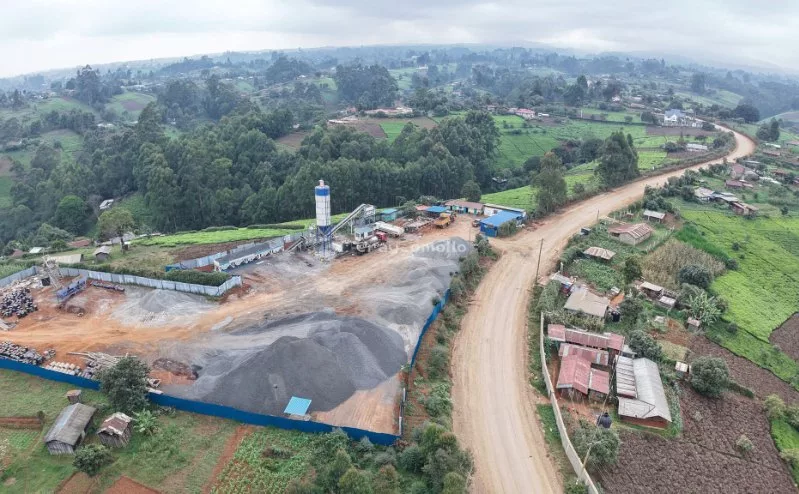
 A section of the Mau Mau roads project that covers four counties/ Courtesy
 The Mau Mau Road Lot 2 project is gaining momentum, with works progressing on the 154-kilometre corridor linking communities in Kiambu, Murang’a and Nyeri.
Principal Secretary for Internal Security Raymond Omollo said the project was transforming historic routes used by Mau Mau freedom fighters into modern roads while opening up communities that had endured poor transport infrastructure for years.
“The Mau Mau Road Lot 2 project is transforming the historic liberation routes once used by Mau Mau freedom fighters into modern roads that now liberate communities from decades of transport challenges,” Omollo said.
Implemented by the Kenya National Highways Authority (KeNHA), the project is upgrading the corridor to heavy-duty bitumen standards.
It is opening up the rugged Aberdare foothills while preserving the historical significance of the region.
The road begins at Mairi near the Kiambu-Murang’a border and passes through Kinyona, Karinga and Mununga before extending northwards through Ichichi, Thuthu, Wanjerere, Kagongo, Mioro and Kiamuturi. It terminates at Kairo on the Nyeri county border.
The latest progress comes after Deputy President Kithure Kindiki announced that the government had cleared Sh177 billion in pending bills owed to road contractors.
The move paved the way for the resumption of works on about 6,000 kilometres of stalled roads across the country.
The Mau Mau Roads project, initiated by the Jubilee administration in 2019, had stalled after contractors left some sections.
Residents were left to contend with excavated stretches, potholes and trenches that became difficult to navigate, particularly during the rainy seasons.
The Sh30 billion project covers 540 kilometres across Kiambu, Murang’a, Nyandarua and Nyeri counties.
Works on Lot 2 are now progressing, with a combined 38 kilometres across the Ichichi, Kiruri, Wanjerere and Mioro sections having reached the top upgrade layer.
Construction is moving to the cement-stabilised gravel sub-base, followed by graded crushed stone and, ultimately, Asphalt Concrete surfacing.
The corridor also provides a strategic inter-county link through the Kinyona-Gatare-Njabini road, strengthening connectivity between Murang’a and Nyandarua.
Omollo noted that improved road access was already supporting economic activity in the region, particularly in tea-growing areas where farmers depend on reliable transport to move their produce to factories.
Reliable all-weather access is expected to ease the movement of green leaf collection vehicles serving KTDA factories, including Mununga and Ikumbi, while reducing transport costs and post-harvest losses.
Dairy and horticultural farmers are also set to benefit from faster access to the Thika-Kenol-Marua Highway and other major markets.
This is expected to create opportunities for increased trade, higher household incomes and investment.
“Reliable all-weather access now enables green leaf collection vehicles serving KTDA factories such as Mununga and Ikumbi to move efficiently, reducing post-harvest losses and lowering transport costs,” Omollo noted.
The road has also been designed to withstand the steep terrain and heavy rainfall experienced along the Aberdare slopes.
It incorporates reinforced box culverts, pipe culverts and engineered roadside drainage systems aimed at reducing flooding, erosion and landslides.
Beyond agriculture and trade, the upgraded corridor is expected to improve security and access to public services in remote areas.
Better roads will facilitate emergency response, security patrols and the movement of residents seeking government services.
Omollo said infrastructure agencies were working with the State Department for Internal Security and National Administration to promote road safety and coordinate security interventions along the corridor.
“The project is also strengthening security and public safety. Better road access enhances emergency response, supports more effective security patrols and brings remote communities closer to essential government services,” he said.
The revival of the Mau Mau Roads project is part of the government’s wider push to complete stalled infrastructure projects following the clearance of contractors’ pending bills.
Kindiki has directed contractors who have returned to site to accelerate works while maintaining quality standards.
For residents along the corridor, completion of the roads is expected to end years of difficulties associated with impassable sections and provide a reliable link between farming areas, markets and major highways.
The government is yet to complete the entire 540-kilometre Mau Mau Roads network, but the renewed works have raised hopes that the historic routes will finally become dependable transport corridors connecting communities across the four counties.
Amos Kamenyi, a resident of Mioro village in Mathioya, Murang’a, confirmed that construction works have resumed on a section of the road passing through the area.