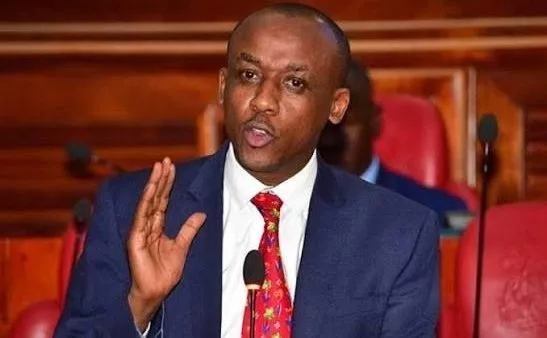
 Makueni Governor Mutula Kilonzo Jnr/ HANDOUT
Governors have called for affirmative action for urban areas and cities in the Division of Revenue Bill, saying municipalities need dedicated funding if devolution is to deliver services closer to the people.
Led by Makueni Governor Mutula Kilonzo Jnr, the county bosses said municipalities were being forced to compete with counties for limited resources.
This is despite carrying out functions that require substantial investment in infrastructure, planning, water, sanitation and other urban services.
Appearing before the Senate Devolution and Intergovernmental Relations Committee, the governor urged senators to create a specific funding mechanism for municipalities.
He argued that urban areas had grown rapidly but their financial needs had not been adequately recognised in the national revenue-sharing framework.
“If we can find in the Division of Revenue Bill a specific place where we can house municipalities, we ended up quarrelling for resources from a very small basket, and then the municipalities are not thriving,” Kilonzo said.
He proposed that urban areas should have a dedicated kitty within the revenue-sharing framework to support their development.
“The Senate would find it reasonable to argue about urban areas and resourcing to urban areas as part of our revenue-sharing universe. You have a specific kitty reinforced for urban areas because it is a way to go,” he said.
Kilonzo said municipalities could eventually become financially self-sustaining if they were properly funded and empowered to retain part of the revenue they collect.
He said the current arrangement leaves municipalities dependent on county governments, making it difficult for them to plan and implement major infrastructure projects.
The governor cited roads, drainage, street lighting, markets, solid waste management, water and sewerage as among the services that require predictable funding.
The plea came as the Senate committee reviewed the implementation of the Urban Areas and Cities Act across counties.
The committee commended Makueni for making progress in operationalising municipalities, saying many counties had failed to implement the law.
Kilonzo told the committee that Makueni had operationalised three municipalities — Wote, Emali-Sultan Hamud and the newly established Mbooni-Kee — with boards and management structures being put in place.
Wote and Emali-Sultan Hamud have fully constituted boards and municipal managers, while Mbooni-Kee, which is less than six months old, has an acting manager and seven staff members.
The governor also revealed that Emali-Sultan Hamud had emerged as the county's top revenue collector during the 2025-26 financial year after selected revenue streams were delegated to municipalities.
He said Makueni had delegated parking fees, vehicle parking charges, bus park user fees, market fees, toll rent, market space charges and related user fees to municipalities.
Kilonzo, however, argued that the country needs a uniform legal framework to determine how much revenue municipalities should retain.
He warned against allowing each county to develop its own formula, saying this could create disparities and conflicts.
“What needs uniform legislation is what to retain and what percentage to retain for defraying expenses,” he told the committee.
He said Makueni had begun experimenting with municipal revenue retention through an administrative arrangement, with the retained funds earmarked for roads and drainage, market improvement and sanitation, waste management, street lighting, beautification, enforcement and other operational needs.
The governor said the arrangement was intended to demonstrate that municipalities could use locally collected revenue to improve services without depending entirely on transfers from county headquarters.
Senators differed on whether new national legislation was necessary.
Senate vice chairperson Catherine Mumma said counties already had powers to establish administrative policies allowing municipalities to collect and retain revenue.
“I fall in the school of thought that doesn't think we necessarily need a new national law for the delegation of revenue collection to happen,” Mumma said.
She argued that county governments and assemblies could develop policies to ensure municipalities function effectively without waiting for Parliament to enact another law.
Kilonzo maintained that a national framework would provide uniformity and prevent counties from applying different retention formulas.
He said one county could decide to retain 25 per cent of municipal revenue while another could choose a different percentage, creating unequal treatment across the country.
The governor also linked the push for affirmative action to the rapid growth of urban areas, saying municipalities were increasingly becoming centres of economic activity.
He cited Emali, located along the Mombasa Road corridor, where businesses operate late into the night because of improved lighting, security and sanitation.
“Emali is the only town on Mombasa Road where people work in shifts. By evening, lights come up. The ones who are working during the day go home. The ones who have come for the night shift” begin work, he said.
Kilonzo said such investments demonstrate why municipalities need predictable funding.
He also warned that urbanisation without proper planning could create serious problems, particularly where industrial, residential and commercial developments are allowed to grow without adequate infrastructure.
He said Makueni had developed spatial plans for its municipalities and was using planning controls to prevent incompatible developments.
“No industry will be started to the disadvantage of the residents. And in any event, if it is not in the plan, because all the municipalities have a spatial plan, then it will not be appropriate,” he said.
The governor also called for greater national support for sewerage, water and solid waste infrastructure, saying some urban centres had inherited infrastructure deficits dating back to independence.
He cited Wote's lack of a comprehensive sewerage system as an example of the challenges facing growing municipalities.
Kilonzo said national funding should therefore complement county efforts instead of leaving counties and municipalities to shoulder the cost alone.
He argued that affirmative action for municipalities would strengthen devolution by ensuring that services are delivered closer to residents.
“If we want to accelerate these municipalities instead of relying on the goodwill of executives like myself and my colleagues, each of the municipalities must be given a grant to support urban development,” he said.
The governor further suggested that part of the equitable share allocated to counties should be ring-fenced for municipalities because counties are increasingly delegating functions to urban authorities.
INSTANT ANALYSIS
For Kilonzo, the next step is to move beyond establishing municipalities on paper and give them the financial muscle to deliver. He said the success of devolution should ultimately be measured by whether residents can access better services where they live, work and conduct business.