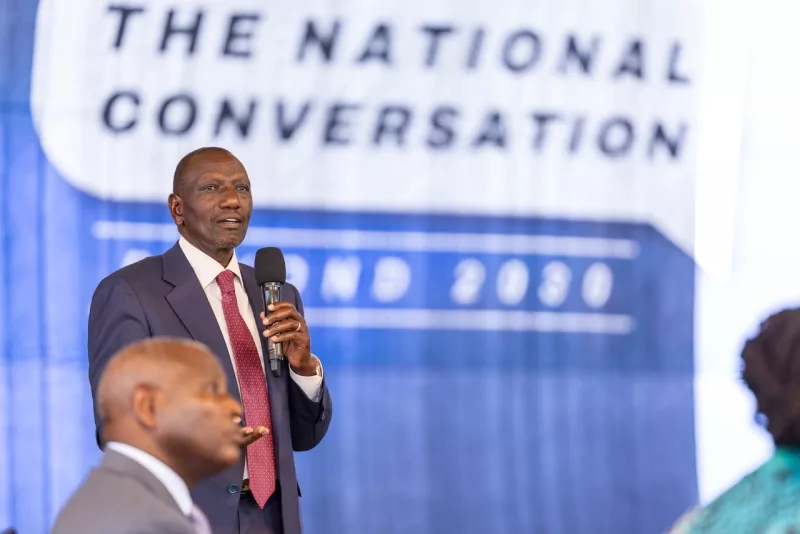
 President William Ruto speaks during the launch of Beyond 2030 national conversation at the KICC, August 12, 2026. /PCS
President William Ruto has given Kenya an “A” for its performance under the political pillar of Vision 2030, saying the country has made significant progress in several areas.
Ruto said Vision 2030, launched in 2008, had provided Kenya with a long-term roadmap for achieving economic prosperity and improving the quality of life.
He commended former President Mwai Kibaki and those who developed the blueprint, saying it had provided a framework for planning the country’s development.
“Vision 2030 has provided a framework for us to figure out our development. It set out that Kenya should be an industrialised nation, middle-income, high-quality-of-life, in a safe environment,” Ruto said.
The President said the Vision 2030 Secretariat had presented a scorecard assessing Kenya’s progress across its economic, social and political pillars, as well as various enablers.
On the political pillar, Ruto said Kenya had scored more than 80 per cent, which he described as an “A”.
“We have done fairly well in many aspects; we have done well in some more than others. We are at 80+, we have an A, and you can see it. "We have a new Constitution, a robust Bill of Rights, a democratic state, an open society, rule of law, and a working judiciary and civil society that is not constrained,” he said.
Ruto said Kenya’s democratic progress had also earned the country international recognition.
However, he noted that the circumstances under which Vision 2030 was developed had changed significantly.
“Globally, Kenya is recognised as a democratic country. We didn’t have the serious effects of climate change the way we have today. We had a completely different situation,” Ruto said.
He also noted that Vision 2030 was developed before the promulgation of the 2010 Constitution, which he said provides a clearer framework for long-term planning and public participation.
Ruto said the limited public participation during the development of Vision 2030 contributed to some Kenyans failing to understand or identify with the plan.
He said the Beyond Vision 2030 process provides an opportunity to develop a new long-term national plan under the constitutional framework and with greater public participation.
“It is important that we engage in this exercise in the context of a new constitution, a new constitution that does not request us to consult the people. No, it is mandated. The reason why you find in some cases that many people do not understand, do not relate to Vision 2030, was because there was no public participation to the extent that we know public participation as provided for in the constitution at the moment,” he said.