For generations, the most valuable tools on a coffee farm have been easy to identify: a hoe, a pruning saw, a knapsack sprayer and a pair of skilled hands. They remain indispensable today.
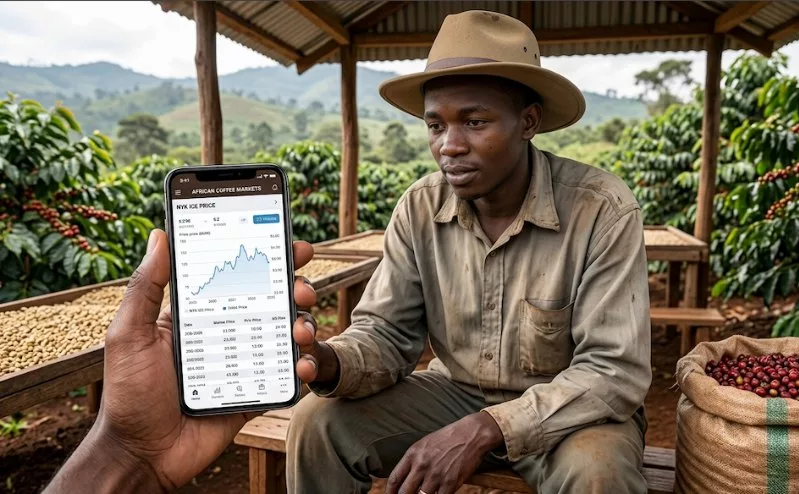
But if Kenya’s coffee industry is to compete in an increasingly demanding global market, another tool is rapidly becoming just as important—the smartphone.
This may sound like an overstatement. After all, coffee is still grown in the soil, not on a screen. Yet the business of producing and selling coffee has changed dramatically. Farmers are judged both by the quality of the beans they produce and the quality of the information they can generate, access and share. In this sense, data is becoming an agricultural input in its own right.
Consider what a coffee farmer must manage today. Weather patterns are becoming more unpredictable, requiring timely access to reliable forecasts. International buyers increasingly demand proof of where coffee was grown and whether it meets sustainability standards. Input prices fluctuate, market prices change from one auction to the next, and new pests and diseases emerge as climate conditions evolve.
Navigating this environment requires more than experience. It requires information. Therefore, the phone has quietly evolved from a communication device into a farm management tool.
A farmer can now receive weather alerts before deciding when to irrigate or apply fertiliser. They can monitor coffee prices, access extension advice, identify pests through digital platforms, receive mobile payments and maintain farm records without leaving the field. Cooperatives can communicate directly with members, while buyers can verify the origin of coffee through digital traceability systems.
Essentially, the future of Kenya’s coffee will depend less on producing more coffee and more on producing it using smart systems and technologies.
Take irrigation as an example.
Often, irrigation decisions are based on experience or routine. Now, weather forecasts, soil moisture data and digital advisory services can help farmers apply water only when necessary. The result is better crop management, lower water use, reduced electricity costs and improved productivity.
The same principle applies across the farm.
A digital record of fertiliser application helps farmers avoid unnecessary input use. Pest alerts issued through mobile platforms enable earlier intervention before infestations spread. Electronic payment systems improve transparency and reduce delays, while digital mapping supports access to export markets that increasingly require traceability.
In each case, better information leads to better decisions and artificial intelligence (AI) is likely to accelerate this transition. Across the world, AI-powered applications are beginning to diagnose crop diseases from photographs, recommend irrigation schedules based on weather forecasts, estimate nutrient requirements and provide personalised agronomic advice.
Many of these tools are already available on ordinary smartphones, bringing sophisticated decision support within reach of farmers who may never own expensive agricultural equipment.
This presents an important opportunity for Kenya. The country already has one of Africa’s strongest mobile technology ecosystems. Mobile money has transformed financial inclusion. Digital entrepreneurship continues to grow. And smartphone ownership is expanding steadily, including in rural areas.
Kenya’s coffee sector can build on this foundation by integrating digital tools more deliberately into extension services, cooperative management and farm decision-making. Doing so, however, requires more than distributing technology
Farmers need practical digital skills alongside agricultural skills. Extension officers need to embrace digital advisory services. Cooperatives need systems capable of efficiently managing farm records and traceability. Perhaps the biggest opportunity lies in attracting a new generation back into coffee.
For many young Kenyans, agriculture is often perceived as physically demanding, unpredictable and slow to modernise. Yet a sector that combines precision farming, digital platforms, mobile finance, satellite mapping and artificial intelligence presents a very different image. It becomes an industry driven as much by knowledge as by labour; a shift that could prove transformative.
Kenya’s coffee sector has rightly invested considerable attention in improving prices, strengthening institutions and expanding market access. These remain essential priorities. But competitiveness in the years ahead will increasingly depend on how efficiently farmers use information to reduce costs, improve quality and respond quickly to changing conditions.
The most successful coffee producers of the future may not be those with the largest farms or access to the highest rainfall. They might be those who make the best decisions quickly, and increasingly, those decisions might begin with a glance at a smartphone.
The writer is a journalist, multidisciplinary researcher and science communicator