President William Ruto has said rapid technological advances, artificial intelligence and climate change have fundamentally altered the global environment, making it necessary for Kenya to rethink its long-term development path.
Ruto said the changes were among the key reasons the country had embarked on the process of developing Kenya Vision 2060, a long-term blueprint that will succeed Vision 2030.
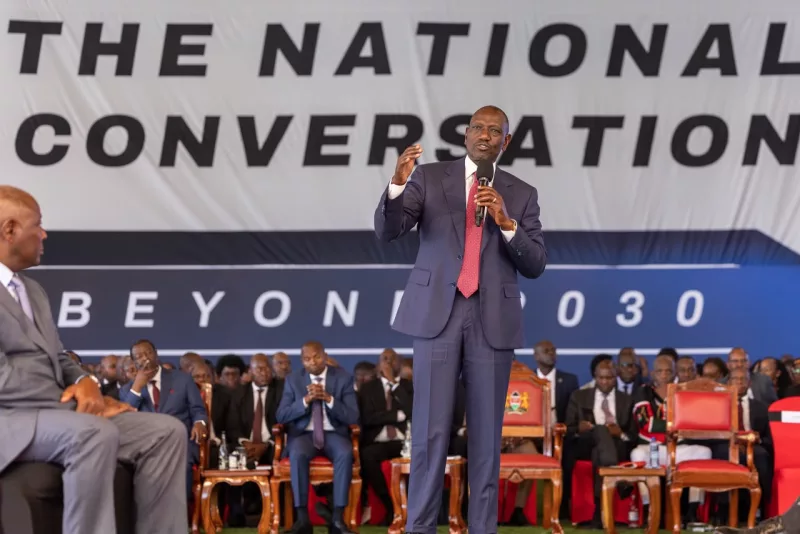
Speaking during the launch of the national conversation on Vision 2060 Wednesday, Ruto said Kenya could no longer rely on a development framework designed for circumstances that had significantly changed.
“We are having this conversation now because, number one, Vision 2030 will come to an end. Number two, the world has changed, with technology, AI and climate change reshaping our reality,” he said.
The President said another reason for developing a new vision was that Vision 2030 was formulated before the promulgation of the 2010 Constitution, which established a new framework for governance, planning and public participation.
Ruto said Vision 2060 should therefore provide a long-term national roadmap that goes beyond individual administrations and political cycles.
He said the plan should be owned by Kenyans and implemented by successive governments, regardless of who occupies State House in the coming decades.
The President urged Kenyans to actively participate in the process and contribute ideas on the kind of country they want to build over the next 30 years.
The national conversation comes roughly a year before the 2027 General Election, but Ruto urged the country to separate long-term development planning from electoral politics.
He has invited political leaders, including those in the opposition, to participate and present alternative ideas that could help shape the country’s future.
The proposed Vision 2060 is expected to address economic transformation, industrialisation, job creation, technology, infrastructure, energy, climate change and human capital development.
Ruto has previously set an ambitious target of transforming Kenya into a high-income, first-world economy, citing Singapore as an example of what can be achieved through sustained investment and economic reforms.
Treasury Cabinet Secretary John Mbadi said the exercise should not be interpreted as a blueprint belonging to the President or his administration.
“Ruto has not developed a vision. Tomorrow we are starting conversation on how to develop vision for this country,” Mbadi said ahead of the launch.
He said the public participation process would determine what Kenyans want incorporated into the new development framework.
“The vision is not for Ruto; it is 2060. Ruto can only be in power up to 2032, not beyond,” Mbadi said.
The process is expected to involve citizens, political leaders, experts, institutions, the private sector and other stakeholders across all 47 counties.
Ruto said Kenya must also build on the achievements and lessons of Vision 2030, which was launched in 2008 as the country’s long-term development blueprint.
He said the new framework should help accelerate economic growth, improve living standards and ensure Kenya is better prepared for technological and environmental changes.
The consultations will continue as the government gathers views that will inform the final Vision 2060 document.