ODM party leader Oburu Oginga has challenged Kenyans to examine why Singapore has overtaken Kenya economically despite the two countries having been at a similar level of development at independence.
Oburu said Kenya could still achieve Singapore’s level of development if it addressed corruption, reduced government wastage, invested heavily in education and research and created an environment capable of attracting private-sector investment.
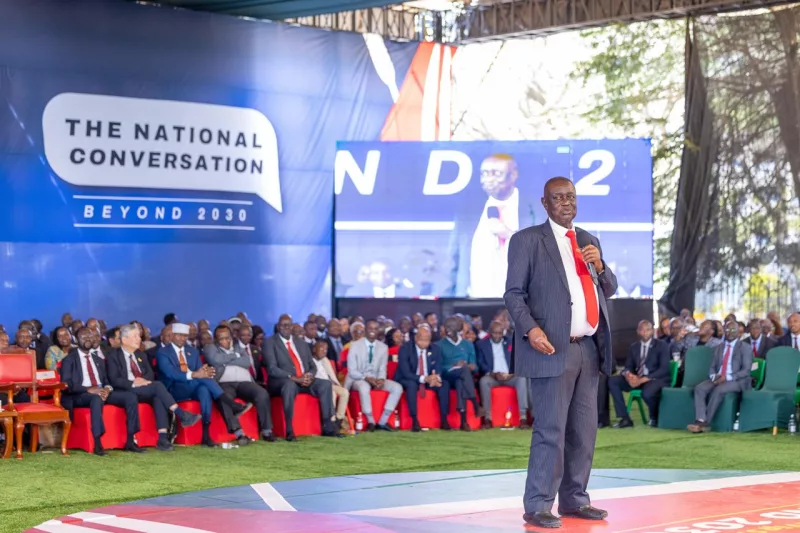
Speaking during the launch of the national conversation on Kenya Vision 2060 on Wednesday, Oburu said the country must learn from Singapore’s development journey as it seeks to chart its own long-term future.
He recalled how his late brother, former Prime Minister Raila Odinga, often questioned the divergence between Kenya and Singapore while preparing political manifestos.
“My late brother used to worry the President and used to worry us in the party when we were drafting our own manifestos, that how can we, if at independence in 1963-64, Singapore was exactly at the same level of development as Kenya?” Oburu said.
He said the two countries had comparable levels of income per capita, health indicators and economic development at independence, but Singapore had since pulled far ahead.
“What did Singapore do to rise to a level where their incomes per capita are now 40 times that of Kenya? We must think as Kenyans. What did we do? Where did we go wrong, and where did Singapore go right?” he asked.
Oburu said Kenya could bridge the gap if it adopted policies that promoted accountability, productivity and investment.
“First, we must deal with this animal called corruption,” he said, arguing that while corruption was difficult to eliminate completely, Kenya could build a society that was intolerant of the vice.
The Siaya senator also called for reduced government expenditure and greater discipline in the management of public resources.
“We need to tighten our belts. Those who are in government, let us tighten our belts for the people, for the sake of the people of Kenya,” he said.
Oburu identified education as another critical pillar of economic transformation, saying Kenya must equip its young population with technical and professional skills required by industry.
“Education is the only equaliser, and there is no shortcut to education,” he said.
He argued that Kenya could not depend on importing skilled labour while millions of young people remained unemployed.
“You are not going to import labour from elsewhere. The labour must come from us here. We have to get employment,” he said.
Oburu further called for increased investment in research and innovation, particularly partnerships between universities and industry.
He said universities should be supported to undertake research that addresses the needs of industries and helps Kenyan companies compete internationally.
“Kenya must be competitive. The world is moving so fast,” he said.
On the role of government, Oburu said the State should focus on providing infrastructure and creating an enabling environment while allowing the private sector to drive economic development.
“Government can only do infrastructure. Government cannot do development. Development is for the private sector,” he said.
He also urged Kenyans to take advantage of the opportunities created by the new national conversation, recalling the difficult political struggles that preceded the current constitutional order.
He said previous generations had faced violence while pushing for constitutional reforms and urged Kenyans to value the democratic space they now have to debate the country’s future.
“We tried it when we were struggling for the Constitution,” he said, recalling national dialogue efforts in the 1990s when protesters were beaten and dispersed by police.
Oburu said Vision 2060 should therefore be used to address Kenya’s structural challenges and build a competitive economy capable of delivering better opportunities for future generations.