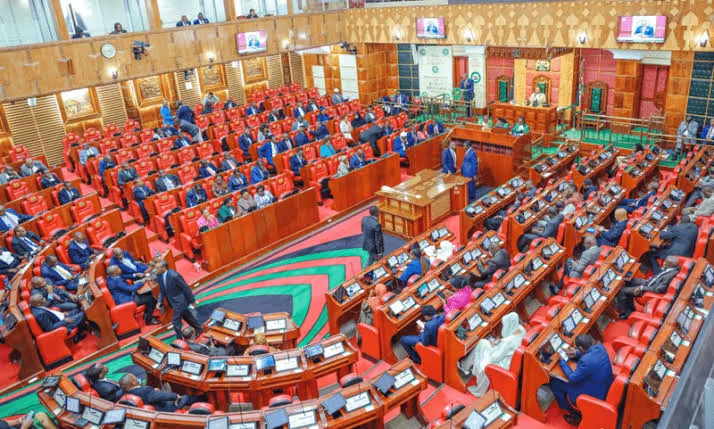
 MPs in session at Parliament Buildings
MPs have watered down proposed public participation laws by
deleting a provision that would have made state officers personally liable to
hefty fine for failing to seek public views.
Read Also
The Public Participation Bill, 2025 had proposed a fine of up to Sh500,000 for state officers who deliberately failed to seek citizens’ views.
However, the provision was removed through amendments proposed at the committee stage.
The Bill is sponsored by Rarieda MP Otiende Amollo and Ainabkoi MP Samuel Chepkonga.
The original Bill provided that a responsible authority who wilfully failed to adhere to the principles and guidelines governing public participation would commit an offence and, upon conviction, be liable to a fine not exceeding Sh500,000.
However, the Justice and Legal Affairs Committee, chaired by Tharaka MP Gitonga Murugara, proposed deleting Clause 20, which contained the offence and penalty.
Leader of Majority Kimani Ichung’wah separately proposed amendments to the Bill, including changes to the definition of responsible authorities and public participation guidelines.
The deletion means officials will no longer face the specific criminal penalty proposed in the original Bill for failing to comply with public participation requirements.
Instead, MPs have retained another significant enforcement mechanism, giving the High Court power to invalidate a public participation exercise conducted in wilful violation of the proposed law.
The committee proposed a new Clause 20A providing that: “The High Court may void a public participation exercise conducted in willful violation of the provisions of this Act.”
The provision could give citizens and other interested parties a direct avenue to challenge participation processes they consider to have been conducted in breach of the law.
The changes come after extensive public hearings on the Bill, during which citizens and civil society groups pushed for tougher sanctions against public officials who treat public participation as a formality.
Some stakeholders had called for penalties substantially higher than the Sh500,000 originally proposed, arguing that public institutions should not be allowed to disregard citizens’ views without consequences.
The committee has nevertheless retained several provisions designed to make public participation more meaningful and enforceable.
Under the proposed amendments, responsible authorities will be required to give the public reasonable notice before undertaking a participation exercise.
The Bill does not impose a uniform number of days for the notice, instead leaving authorities to determine what amounts to reasonable notice depending on the circumstances.
Responsible authorities will also be required to prepare a report as soon as practicable after concluding a public participation exercise.
The changes are aimed at ensuring that consultations do not end when citizens submit their views, but are followed by documentation of the exercise.
Another provision requires authorities to give citizens prior access to documents relating to the matter under consideration, including simplified versions of the documents.
The amendments also seek to protect freedom of expression during public participation forums.
A responsible authority will be required to facilitate the enjoyment of freedom of expression by all persons attending its forum while also maintaining order.
The legislation further requires responsible authorities to publish in the Kenya Gazette specific guidelines on how they will conduct public participation.
Parliament and county assemblies will instead incorporate their specific guidelines into their Standing Orders.
The proposed law also clarifies who will be responsible for public participation across government.
Responsible authorities will include both Houses of Parliament, county assemblies, constitutional commissions and independent offices, the Judiciary, the Attorney General, the Director of Public Prosecutions, Cabinet Secretaries, boards of state corporations and county governors.
The provision also covers any other person or entity implementing a public policy decision.
The definition of public participation has meanwhile been amended, with MPs replacing the word ‘involving’ with ‘engaging’ the public.
The change is intended to emphasise active participation rather than merely inviting citizens to attend meetings.
The Bill seeks to give effect to constitutional provisions requiring public participation in governance, including Articles 10, 69, 118, 174, 184, 196, 201 and 232.
The original Bill had sought to establish a legal framework for participation in decisions affecting citizens, including legislation, public spending and government policies.
The sponsors argued that although public participation is a constitutional requirement, its implementation has often been inconsistent.
There were concerns by stakeholders that the government agencies are holding ‘token consultations’ simply to meet legal requirements.
The latest amendments retain the obligation on public authorities to engage citizens but shift the emphasis to administrative compliance and judicial remedies.
The High Court could be asked to determine whether government decisions were made after genuine public participation.