
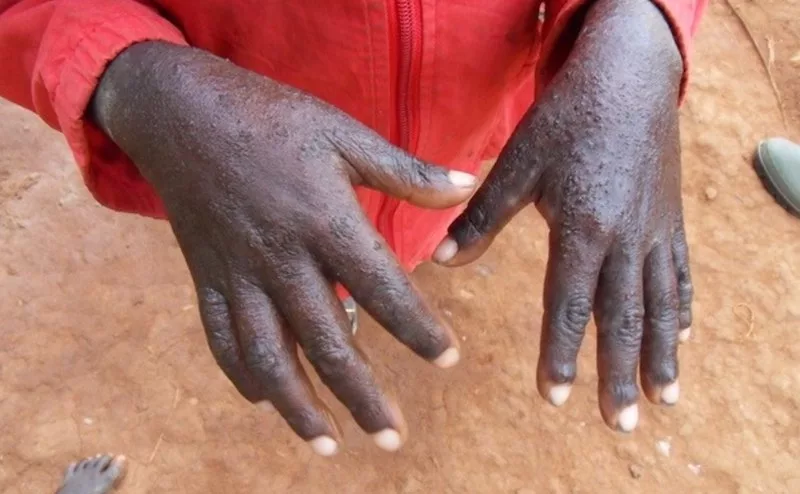
 A man hands affected by scabies, an infectious disease caused by tiny mites burrowing into the skin / MSF
More than half of the male inmates examined at Kiambu Main Prison had scabies, according to a new study that has raised concerns about the spread of the disease in overcrowded correctional facilities.
The study found that 54.8 per cent of the male inmates examined were infected, making it the first published research to measure the burden of scabies in a Kenyan prison since the World Health Organization (WHO) classified the disease as a neglected tropical disease in 2017.
Scientists from Amref International University, the Technical University of Kenya and Maseno University examined 188 male inmates between May and June using internationally recognised diagnostic criteria.
They found a scabies prevalence of 54.8 per cent, almost three times higher than the average reported in prisons across Africa.
The Kenya Prisons Service did not respond to requests for comment on the specific findings of the study, titled ‘Scabies among Male Inmates in Kiambu Main Prison’, by the time of publication.
Researchers say the findings should serve as a wake-up call for prison health services, arguing that scabies reflects wider challenges associated with overcrowding, hygiene and access to timely treatment.
The findings provide evidence that prison authorities can use to strengthen prevention and treatment programmes.
“These findings highlight the need for integrated control measures that combine routine screening of newly admitted inmates, improved access to hygiene resources and timely treatment, strengthened prison health education and interventions to reduce overcrowding,” lead author Esther Makokha of Amref International University and her colleagues said in the report, which is yet to be peer reviewed.
Scabies is caused by microscopic mites that burrow into the skin, causing an intensely itchy rash. The disease spreads easily through prolonged skin-to-skin contact and thrives in crowded settings such as prisons, refugee camps and boarding schools.
According to the WHO, more than 200 million people are living with scabies at any given time, while more than 400 million people are affected each year.
The agency designated scabies a neglected tropical disease in 2017 because it disproportionately affects poor and vulnerable communities while receiving little public health attention.
The WHO also warns that persistent scratching can lead to bacterial skin infections, which may trigger serious complications, including kidney disease, bloodstream infections and rheumatic heart disease.
The researchers linked the infections to prison conditions, citing overcrowding, inadequate hygiene resources, limited health education, medication shortages and delayed treatment as factors that could fuel transmission.
The study found inmates who bathed daily or washed their clothes every day were significantly less likely to contract scabies.
Remandees were nearly twice as likely to be infected as convicted prisoners.
The findings come as Kenya continues to grapple with prison overcrowding.
According to the Economic Survey 2026 by the Kenya National Bureau of Statistics, the prison population stood at 189,998 in 2025, almost half of whom were pre-trial detainees.
Scabies outbreaks have previously been reported in prisons in Kakamega, Busia and Kisii, but no published study had quantified the burden of the disease inside a prison until now.
The researchers recommend improving access to water and hygiene supplies, ensuring early diagnosis and treatment, strengthening health education and reducing overcrowding to curb transmission.
The WHO similarly recommends prompt diagnosis, treatment of patients and their close contacts, routine surveillance in high-risk institutions and improvements in living conditions, noting that controlling scabies requires addressing poverty, overcrowding and poor sanitation that allow the disease to spread.
While the Kenya Prisons Service did not respond directly to the study findings, it has in recent months highlighted efforts to improve healthcare for inmates and prison officers.
The service recently operationalised the 150-bed Magereza Level 4 Hospital in Ruiru, Kiambu County, a facility expected to improve access to specialised healthcare for inmates and prison officers.
Commissioner General Patrick Aranduh said the hospital marked a major milestone in improving healthcare within correctional facilities and reducing reliance on external hospitals.
“The operationalisation of the Magereza Level 4 Hospital marks a very important milestone for the Kenya Prisons Service. It reflects the deliberate and consistent efforts of the government to improve the welfare of our officers, inmates and the community that surrounds our institutions,” Aranduh said.
He said the hospital was established to address longstanding challenges in accessing specialised healthcare, particularly for prisons in remote areas, where transporting inmates and officers to referral hospitals has often been costly and delayed treatment.
The facility includes an intensive care unit, high dependency unit, radiology and laboratory services, dental and physiotherapy units, maternity and paediatric wards, orthopaedic and renal services, nutrition support and a fully stocked pharmacy.
Aranduh said more than 95 healthcare professionals, including doctors, nurses, laboratory technologists, physiotherapists and nutritionists, have been deployed to run the hospital.