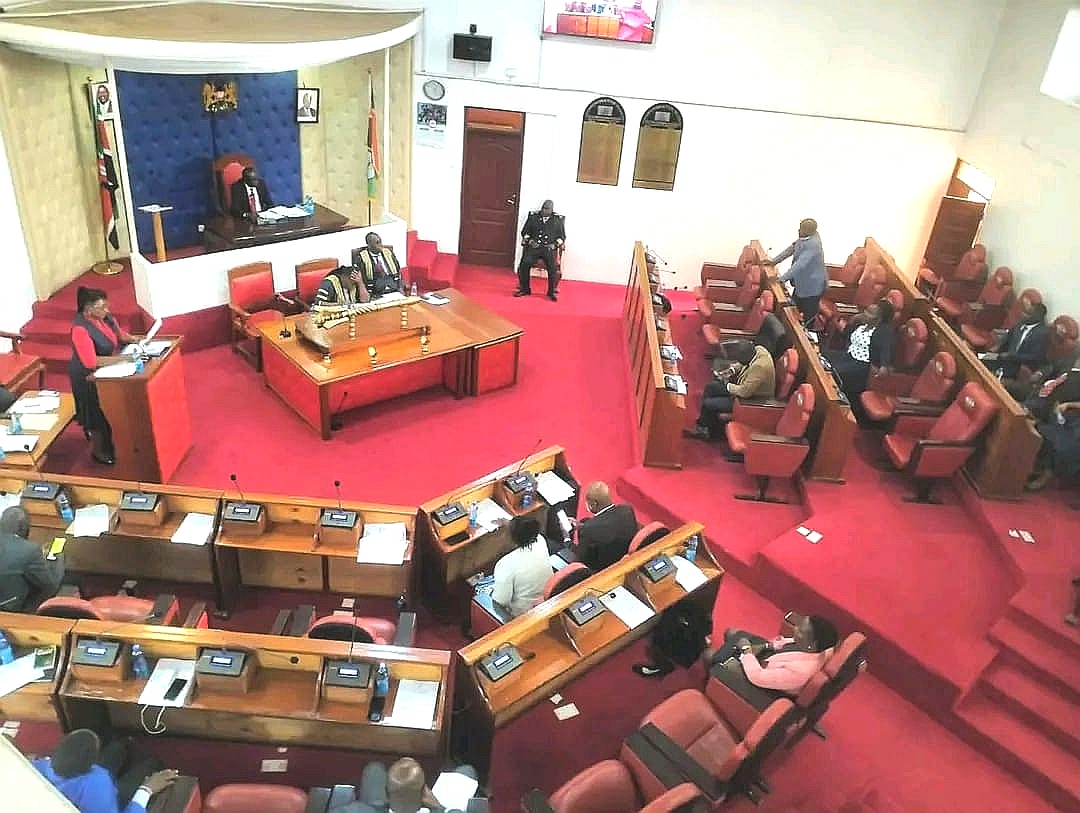
 The county assembly of Vihiga in session
Members of County Assemblies (MCAs) have lost a spirited bid to secure a pension package similar to that enjoyed by Members of Parliament.
This is after MPs sided with the National Treasury and watered down key proposals, saying the demands were unsustainable.
The County Assemblies Forum (CAF), the coordinating body for the 47 county assemblies, asked MPs to provide in law that MCAs contribute 12 per cent of their salary, plus allowances.
It also proposed that county assemblies match this with a 31 per cent contribution and that MCAs be exempted from paying NSSF contributions while under the pension scheme.
CAF further asked MPs to provide a post-retirement medical scheme for MCAs and reduce the retirement age to 45 years from the current 55.
The county lawmakers also wanted their National Assembly counterparts to make allowances pensionable.
CAF made the proposals to the National Assembly's Committee on Social Protection, chaired by Thika Town MP Alice Ng’ang’a, for inclusion in the County Assemblies Pension Scheme Bill, 2024.
The committee, however, rejected all the financial incentives sought by CAF, citing concerns over the sustainability of the retirement package.
In its report to the House, the committee recommended that MCAs contribute 7.5 per cent, with their employer matching this at 15 per cent.
The new pension law is expected to apply only to MCAs elected after the 2027 General Election, meaning it will not apply to those currently in office.
This means the more than 2,200 MCAs who will be elected and nominated to county assemblies in 2027 will, for the first time, be covered by a contributory pension scheme.
Currently, both elected and nominated MCAs receive a gratuity at the end of each five-year electoral term. It is calculated at 31 per cent of their basic salary for every completed year of service.
MPs also recommended that any additional benefits be limited to those approved by the Salaries and Remuneration Commission (SRC).
This affects CAF's proposal for a post-retirement medical cover and for MCAs to begin receiving retirement benefits at the age of 45.
In considering the Bill, MPs agreed with the Treasury that a contributory pension scheme was the best option.
Treasury estimates presented to the committee show that the current gratuity arrangement costs county governments about Sh6.2 billion every five-year electoral cycle.
Under the proposed contributory scheme, the cost is projected to fall to about Sh3 billion. This would translate into taxpayer savings of Sh3.2 billion every electoral cycle and about Sh9.6 billion over three cycles.
CAF expressed concern that the new pension scheme would significantly reduce the retirement package payable to MCAs.
The forum argued that the Bill, as drafted, would leave MCAs with lower retirement benefits than they currently receive under the gratuity system.
"We wish to note that the Bill may not serve the pension needs of MCAs, as the current gratuity framework is much better compared with the pension benefits provided in this Bill," the forum said.
CAF urged MPs to substantially improve the package. Among its biggest demands was an increase in pension contributions.
The forum argued that the higher employer contribution would effectively convert the existing gratuity into pension savings.
It maintained that this was necessary because MCAs serve fixed five-year terms, unlike most public officers who accumulate pension benefits over decades.
CAF further argued that lower contribution rates would violate labour rights under the County Governments Act, leaving those who serve a single term with no meaningful retirement benefits.
The forum also sought to have all allowances, including sitting, committee, responsibility and house allowances, classified as pensionable emoluments, saying they form a substantial portion of an MCA's earnings.
CAF further demanded that retired MCAs and their spouses receive contributory post-retirement medical benefits.
The forum also sought transport benefits after retirement, similar to those enjoyed by certain state officers.
The county legislators also wanted the retirement age reduced to 45 years, matching that of MPs under the Parliamentary Pensions Act.
"CAF reiterates that MCAs should be treated equitably with other state officers in terms of retirement benefits," the forum said.
The National Treasury rejected most of the proposals, warning they would significantly increase counties' wage bills and undermine the objective of creating a sustainable pension framework.
It argued that while the gratuity system provides an immediate lump-sum payment, the proposed pension scheme would offer long-term retirement income, investment returns and survivor benefits.
MPs agreed, saying the gratuity system "provides immediate lump-sum benefits but may raise sustainability concerns in the long run".
The Treasury said the scheme proposed in the Bill would be affordable for counties.
It also said the Bill's provisions could not apply during the current electoral cycle because they would alter MCAs' employment terms midway through their tenure.
MPs declined to guarantee post-retirement medical cover in law, leaving such benefits to future arrangements by trustees.
On CAF's request for exemption from paying NSSF contributions, MPs said MCAs would only qualify after obtaining a contracting-out certificate from the Retirement Benefits Authority (RBA), meaning the exemption would not be automatic.
Despite the setback on benefits, CAF convinced MPs to amend several clauses that had raised constitutional concerns.
The committee agreed that existing pension savings held in schemes such as LAPTRUST, LAPFUND and the County State Officers Pension Fund could not be transferred automatically into the new scheme.
MCAs will have to provide written consent before any transfer of accrued benefits, protecting pension savings as private property in line with previous court rulings and the Retirement Benefits Act.
MPs also removed provisions that gave the National Treasury Cabinet Secretary powers over the appointment and removal of trustees.
Appointments will instead be handled within the scheme under the oversight of the Retirement Benefits Authority, in line with the constitutional independence of county governments.
The committee also replaced criminal penalties for delayed remittance of pension contributions with administrative penalties, civil recovery measures and regulatory sanctions.
MPs argued that county assembly service boards often depend on county treasury releases that are beyond their control.
If approved by Parliament, the legislation will establish the first dedicated contributory pension scheme for MCAs and will apply to those elected in 2027.
It will replace the current gratuity arrangement while significantly reducing the retirement costs borne by county governments.
SRC supported the Bill, saying the scheme should be designed so that a member does not benefit from both pension and gratuity, in line with its remuneration framework.
INSTANT ANALYSIS
The pension battle exposes a sharp divide between MCAs' demand for better retirement protection and the Treasury's push for fiscal sustainability. MPs rejected most of the lawmakers' proposals, opting for lower contribution rates that could save counties billions of shillings. While the new scheme introduces contributory pensions for MCAs, it also reduces their immediate retirement benefits. This could discourage some people from contesting MCA seats across the country.