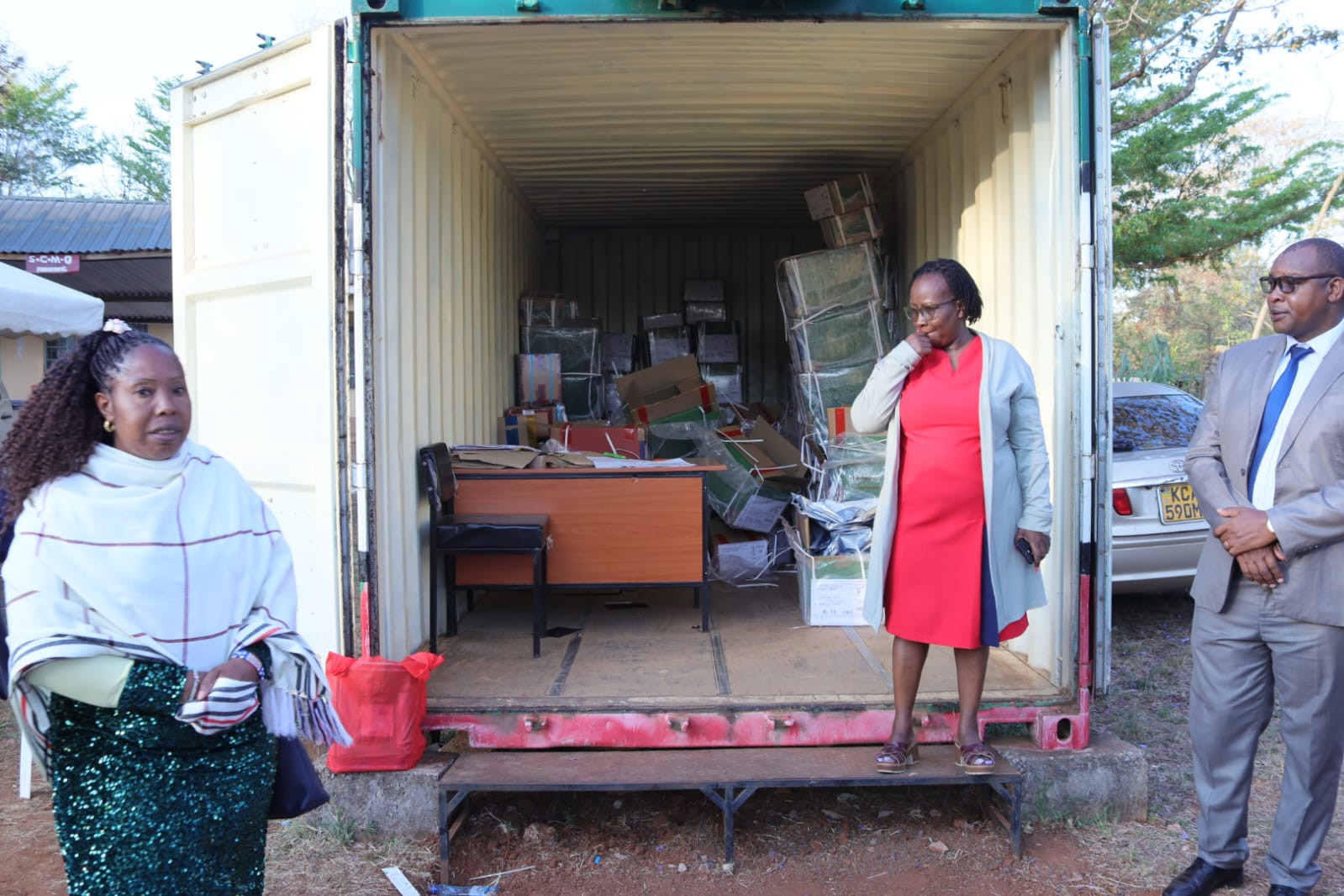
 Officials supervising the distribution of national exam papers at a KNEC container in Yatta, Machakos County on October 27, 2025.
The Kenya National Examinations Council (KNEC) has invited bids for the supply of examination storage containers as it steps up preparations for the 2026 national assessments and examinations.
KNEC will administer the Kenya Primary School Education Assessment (KPSEA) for Grade 6 and the Kenya Junior School Education Assessment (KJSEA) for Grade 9 under the Competency-Based Education (CBE) curriculum, alongside the Kenya Certificate of Secondary Education (KCSE) examinations between October and November.
Chief Executive Officer David Njegere said eligible bidders can obtain the tender documents through the KNEC website, the Treasury's e-procurement portal and the government tender portal.
KNEC introduced secure examination storage containers in 2016 as part of reforms implemented after the 2015 national examinations were marred by widespread leakage and irregularities that led to massive cancellation of results.
Before the reforms, examination papers were distributed through vulnerable logistics channels and local education offices, exposing them to the risk of premature exposure.
The metal containers are fitted with double-lock systems and placed under round-the-clock security by the National Police Service.
Their management involves county and subcounty security officials, reducing reliance on education officials alone.
School heads are allowed to collect examination papers only shortly before the scheduled test time.
The system has evolved to allow separate collection of morning and afternoon examination papers to further minimise the risk of early exposure.
In 2025, KNEC introduced smart padlocks fitted with digital chips that transmit location and time data to the council's command centre.
The system records when containers are locked and unlocked, allowing any unauthorised access to be detected.
Each container also has two separate padlocks requiring different keys, which are held separately by the subcounty director of education and the deputy county commissioner or assistant county commissioner.
The keys are turned in opposite directions, with one lock operating clockwise and the other anti-clockwise.
This ensures that no single official can access the contents of the containers alone.
KNEC ordinarily operates more than 640 containers distributed across the country, guarded by armed security personnel once examination materials are delivered.
The council could require additional containers this year due to the record number of candidates expected to sit the national assessments and examinations.
Njegere said KNEC expects to administer the 2026 assessments and examinations to 3.6 million candidates, the highest candidature recorded in the country's history.
The increased candidature is attributed to the growing school enrolment, two sets of national assessments in primary and junior school and KCSE candidates crossing the one million mark for the first time.
The record KCSE candidature has also been driven partly by the final cohorts of learners under the 8-4-4 system, with candidates seeking to sit the examination before the system is fully phased out in 2027.
Njegere spoke on Thursday, August 6, during a high-level stakeholders' meeting to assess the country's preparedness for the administration of the 2026 national assessments and examinations.
The meeting brought together senior Ministry of Education officials and representatives of the Kenya Secondary School Heads Association (KESSHA), Kenya Comprehensive School Heads Association (KECSHA), Kenya Private Schools Association (KPSA), Special School Heads Association of Kenya (SSHAK) and National Parents Association (NPA).
The meeting, presided over by Principal Secretary for Basic Education John Ololtuaa, underscored the importance of inter-agency cooperation in ensuring the secure and credible administration of the examinations and assessments.
Ololtuaa reaffirmed the ministry's commitment to supporting KNEC and other stakeholders to ensure the 2026 assessments and examinations are conducted efficiently, fairly and free from malpractice.