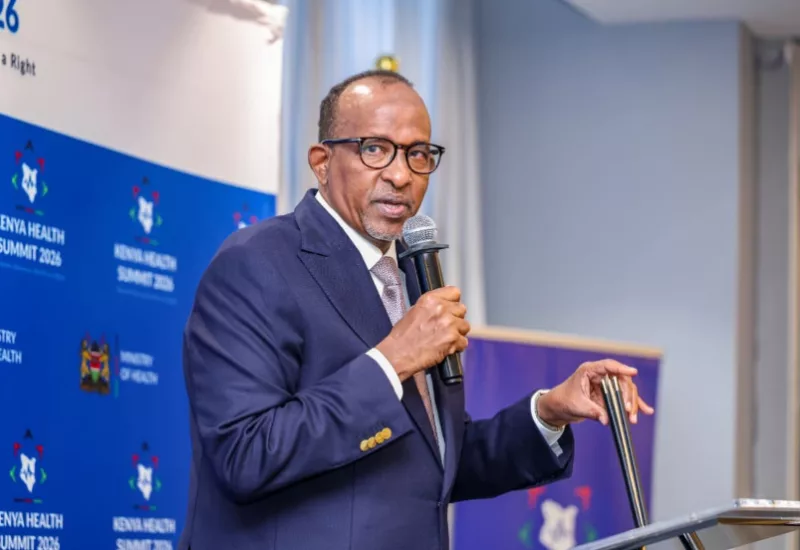
 Health Cabinet Secretary Aden Duale addresses a media town hall ahead of the 2026 Kenya Health Summit at the Kenyatta International Convention Centre (KICC)/ HANDOUT
Health Cabinet Secretary Aden Duale has urged the media to go beyond reporting statistics and scrutinise the impact of ongoing health sector reforms on patients and healthcare workers.
Duale said the media has a critical role to play in examining how reforms under the Taifa Care Model are being implemented and whether they are delivering meaningful changes to Kenyans.
He spoke ahead of the 2026 Kenya Health Summit, scheduled for August 18 and 19 at the Kenyatta International Convention Centre (KICC), where he presided over a media town hall to review progress in the health sector.
“I therefore called on the media to go beyond reporting numbers, interrogate the reforms, engage technical teams, visit health facilities and speak to healthcare workers and patients to establish how these changes are being experienced on the ground,” Duale said.
The CS said the upcoming summit will bring together national and county governments, development partners, healthcare institutions, the private sector, health professionals and citizens to assess progress towards Universal Health Coverage (UHC).
The summit will also examine emerging challenges and chart the next phase of Kenya’s health transformation, with the Taifa Care Model at the centre of the reforms.
Duale said the government’s commitment was to make healthcare a right accessible to every Kenyan.
He said more than 32 million Kenyans have so far been onboarded onto the Social Health Authority (SHA), with nearly 7.9 million claims processed and more than Sh164 billion paid out.
According to Duale, the figures demonstrate progress in expanding access to healthcare and strengthening financial protection for Kenyans.
The reforms have also sought to take healthcare services closer to communities through investments in primary healthcare.
Duale said more than 107,000 Community Health Promoters (CHPs) are being supported through 277 Primary Care Networks as part of efforts to strengthen community-level healthcare.
The government is also investing in medicines, local pharmaceutical manufacturing, medical equipment and health infrastructure as part of the broader health transformation programme.
Duale said emergency healthcare response had also been strengthened through the launch of the National Ambulance Dispatch Centre and the toll-free 922 emergency line.
He said improved disease surveillance and public health emergency systems were further strengthening the country's preparedness for health threats.
However, Duale said the success of the reforms should ultimately be judged by their impact on people's lives rather than the statistics alone.
“Ultimately, the success of these reforms will be measured not only by statistics, but by their impact on people's lives,” he said.
He cited mothers accessing safe maternity care, patients receiving treatment without financial hardship and families accessing quality healthcare closer to home as some of the measures that should be used to assess the reforms.
Duale said an independent and well-informed media was necessary to ensure that health reforms remained people-centred, accountable and responsive.
“A well-informed and independent media remains essential to keeping the reforms people-centred, accountable and responsive,” he said.
![Hamisi Mwaguya [in coulored baseball cap] at the Kings Arena at Khadija estate in Nyali subcounty on Tuesday / BRIAN OTIENO](https://cdn.radioafrica.digital/image/2026/10/340e650a-21d8-475b-b658-a429e82e9367.jfif)