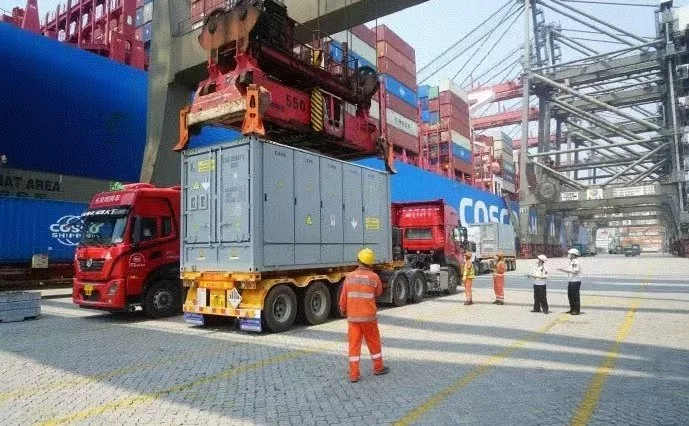
China is turning giant battery-filled shipping containers into a new export industry as countries race to solve the problem of how to store electricity.
Known in the industry as ‘super power banks’, energy storage containers are packed with lithium batteries that can absorb electricity when generation is high and release it when demand rises.
The technology is becoming increasingly important as countries expand solar and wind generation, which can fluctuate depending on weather and time of day.
Xiamen, a major Chinese manufacturing and export hub, is at the centre of the emerging industry.
Giant containers leaving its port may look like ordinary shipping units, but inside them are thousands of lithium batteries capable of storing and releasing electricity on demand.
The southeastern Chinese city is home to several leading manufacturers of lithium-ion battery energy storage systems.
Xiamen Port has also developed direct shipping links with North America, Europe, Southeast Asia and other markets.
The combination of manufacturing capacity and specialised shipping infrastructure is helping Chinese companies take their energy storage technology to the world.
At Hithium Energy Storage Technology Co Ltd in Xiamen, engineers are using digital operation and maintenance systems to monitor and analyse the performance of liquid-cooled energy storage systems.
Some have already been deployed in the Americas even as the company says its services go beyond supplying batteries.
They are also into system design, intelligent control, grid connection, commissioning and remote operation and maintenance.
Hithium says a standard 20-foot energy storage container can hold enough electricity to meet the monthly consumption of about 20 average households, at say, 300 kilowatt-hours a month.
When deployed in large numbers, however, the systems can serve a much bigger purpose.
They can help renewable energy plants, electricity grids, factories and data centres manage fluctuations in electricity supply.
Solar plants, for example, can generate large amounts of electricity during the day when the sun is strong, even when demand is relatively low.
Battery systems can store some of that electricity and release it later when demand rises or solar generation falls.
The same principle applies to wind power, whose output can change depending on weather conditions.
This could come to the rescue of various governments around the world that seek to reduce reliance on fossil fuels without compromising the stability of their power systems.
The rapid development of large-scale batteries is therefore creating a new layer in the global energy industry.
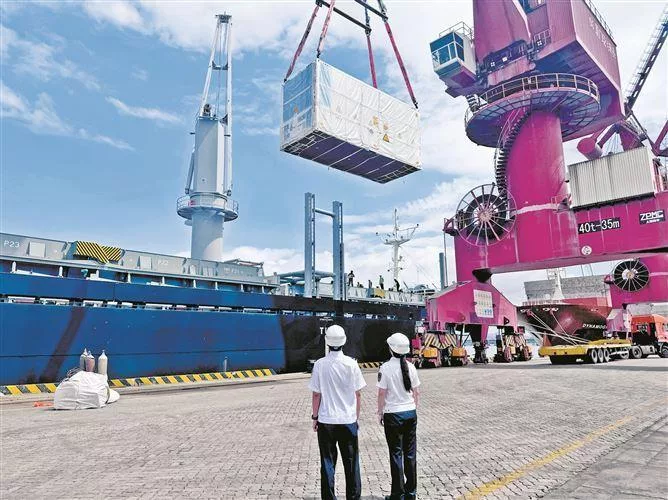
Hithium says its latest-generation products include 1,000Ah battery cells and integrated energy storage systems exceeding 6MWh.
The company says the larger-capacity cells can reduce the number of battery cells required by more than 70 per cent, while also cutting the physical footprint and cabling requirements of the systems.
The equipment is being designed for increasingly diverse environments.
They can be used in the hot deserts of the Middle East as well as the freezing conditions of northern Europe and Japan.
They are also customised for the corrosive coastal environments of Brazil and Southeast Asia, with the manufacturers developing systems capable of operating under difficult conditions.
Hithium says its products have entered more than 40 countries and regions, covering markets in Europe, the United States, Australia, the Middle East and elsewhere.
For Kenya, the technology could offer an answer to the paradox of the country’s renewable energy success, which is how to store electricity when supply is high and release it when demand rises.
Kenya already generates nearly 90 per cent of its electricity from renewable sources, with geothermal, hydropower, wind and solar accounting for the bulk of generation.
But the country is increasingly having to manage fluctuations in renewable power and sharp differences between off-peak and peak demand.
The Energy and Petroleum Regulatory Authority has identified battery energy storage systems (BESS) as one possible solution.
This is particularly as Kenya grapples with excess generation during periods of low demand and pressure on the system during peak hours.
Electricity demand typically peaks between 6 pm and 9 pm, while demand is much lower overnight.
EPRA says utility-scale batteries can store excess electricity during off-peak periods and release it when demand rises.
This is where the Chinese technology could become increasingly relevant to Kenya. The growing international demand is reflected in the activity at Xiamen Port.
Energy storage containers are classified as Class 9 dangerous goods because of the risks associated with lithium batteries.
Their export therefore requires specialised handling, storage and maritime transportation procedures.
Xiamen has spent recent years developing systems to address those challenges, bringing together several departments at the port to improve the safety and efficiency of exports.
Since trial shipments began in 2022, the port says it has safely handled more than 3,500 energy storage containers, with a combined export value of more than RMB10 billion (Sh190 billion).
Between May and June, Xiamen Port broke its record for the number of energy storage containers carried on a single voyage three times.
The largest shipment can carry up to 104 large energy storage units.
By mid-July, the port had shipped 850 energy storage containers this year, an increase of 111 per cent compared with the same period last year.
For countries adding large quantities of solar and wind power, energy storage is increasingly being viewed as the bridge between generation and consumption.
The batteries do not generate electricity themselves. Instead, they provide flexibility by allowing electricity produced at one time to be consumed later.
Solar and wind projects can potentially deliver more value when electricity generated during periods of high production is not wasted or sold at very low prices, but stored.
Large industrial consumers and data centres can similarly use storage systems to improve power reliability and manage fluctuations.
The technology could also support isolated power systems and remote communities by storing electricity from solar or other renewable sources for use after generation falls.