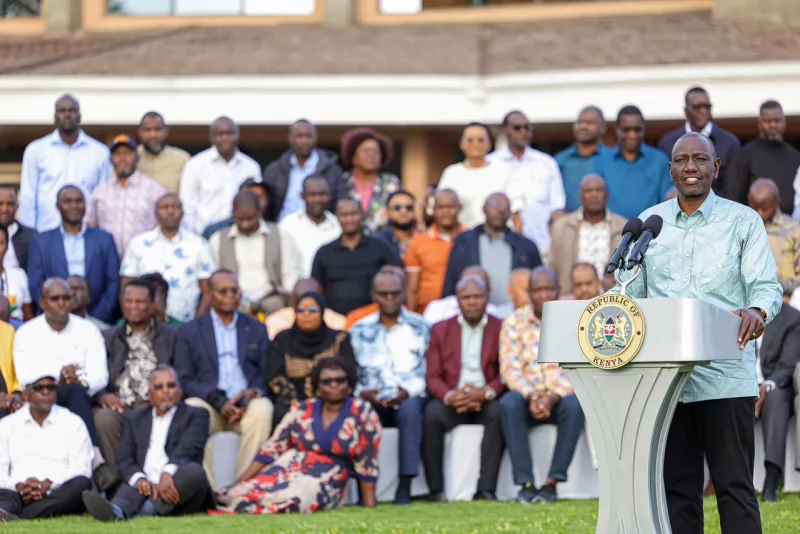
 President William Ruto speaks during the Broad-Based Government Leaders Meeting in Naivasha on August 10, 2026./PCS
President William Ruto has said the government has started using the National Infrastructure Fund to finance the redevelopment of Jomo Kenyatta International Airport (JKIA).
Speaking during the Broad-Based Government Parliamentary Group media briefing in Naivasha on Monday, Ruto said the fund was established to mobilise both domestic and foreign resources for major infrastructure projects.
The President said the National Infrastructure Fund had already started supporting the construction work at JKIA.
“We have now set our eyes on building another 28,000 kilometres of tarmac in Kenya. And that is the reason why we enacted the National Infrastructure Fund, to provide resources in an innovative way to mobilize domestic and foreign resources to underwrite our infrastructure development as a nation,” Ruto said.
“For the record, the National Infrastructure Fund has already begun work with the construction of the airport in Jomo Kenyatta.”
Ruto said the government was targeting expanded infrastructure development across the country, with the proposed 28,000 kilometres of roads forming part of its plans.
The National Infrastructure Fund is designed as a state-sponsored investment vehicle that will finance commercially viable public infrastructure projects while reducing the country's dependence on traditional taxation and external borrowing.
Under the law, the fund seeks to mobilise private capital and other non-traditional sources of infrastructure financing to accelerate the development of strategic national projects.
Unlike conventional government-funded projects, the fund will leverage proceeds from privatisation of state assets alongside investments from institutional investors, pension funds and other private financiers.
The financing model is expected to ease pressure on the national budget while helping reduce Kenya's reliance on sovereign debt to fund infrastructure development.
According to the National Infrastructure Investment Fund Act, the objectives of the fund include scaling up and accelerating national infrastructure development, mobilising private capital, reducing dependence on public debt for commercially viable projects, and strengthening the country's capacity to originate, structure and execute complex infrastructure investments.
Among the priority investments are highways, railway networks, airports, seaports, irrigation infrastructure and power generation projects that are considered commercially viable.
President Ruto has previously described the establishment of the National Infrastructure Fund as one of the most significant economic reforms in Kenya's history.
While assenting to the National Infrastructure Fund Bill, the President said the initiative would transform how Kenya finances development by relying more on domestic and private investment rather than excessive public borrowing.
"The establishment of the National Infrastructure Fund is the most consequential initiative in the development history of our nation," Ruto said.
"The fund marks a new chapter in financing our transformation, making us the architects of our own future."