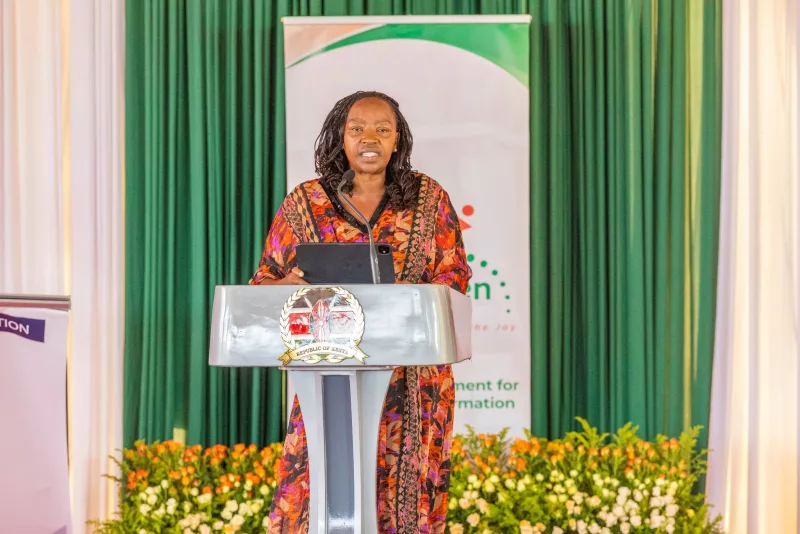
 Former Public Service Cabinet Secretary Moses Kuria speaking on Citizen TV on August 9, 2026. /SCREENGRAB
Former Public Service Cabinet Secretary Moses Kuria has offered a hypothetical theory on how President William Ruto could win re-election in the 2027 General Election even without the Mt Kenya vote that played a pivotal role in his 2022 victory.
Ruto secured roughly 2.9 million votes, or about 40 per cent of his total national tally of 7.17 million, from the region's 10 counties in the last election.
However, his support in the region has appeared to weaken following the controversial impeachment of his then deputy, Rigathi Gachagua, in 2024.
The shift was evident in the July Ol Kalou parliamentary by-election, where Ruto's United Democratic Alliance (UDA) candidate Samuel Muchina Nyagah received about 13 per cent of the valid votes cast, finishing second with 5,450 votes.
Gachagua's Democracy for the Citizens Party (DCP) candidate, Sammy Douglas Kamau Waweru, won the seat with 35,440 votes.
Speaking on Citizen TV on Sunday night, Kuria, a staunch ally of the President, argued that a similar 13 per cent vote share from Mt Kenya in the 2027 presidential election would be more than enough for Ruto to secure a second term.
"If the President gets 13 per cent of Mt Kenya, it's a very big win for him. It's a very big win, it's a bonus. It's more than he needs," he said.
Based on his projection, Kuria said Ruto could theoretically win re-election without a single vote from Mt Kenya.
"So if he wins only 13 per cent that he won in Ol Kalou, it can only be a bonus," he stressed.
In his analysis, Kuria said Ruto's leverage to tip the scales in his favour lies in what he perceives as opposition strongholds and battleground zones.
He said Kenya has eight voting blocs that determine the outcome of presidential elections.
In his estimation, Ruto has solid support in four regions — Coast, North Eastern, Luo Nyanza and a combination of the Kalenjin, Maasai, Turkana and Samburu communities — which he estimated account for about 10.2 million votes.
"The likelihood of him losing votes from these regions is very low," Kuria said.
The former CS identified two other potential vote baskets for Ruto among the remaining four blocs, which he projected would provide the President with support that is nearly equal to that of the opposition.
These are Lower Eastern and Mt Kenya West — comprising Kiambu, Murang'a, Nyeri, Kirinyaga, Nyandarua and parts of Laikipia — which, combined with the Gusii region, Kuria estimated have 9.7 million votes.
"So between these two blocs, we've got a difference of 500,000 votes only (between the government and the opposition). In terms of statistical politics, it's a tie, it's a dead heat," he said.
Kuria said the decisive blocs, which he likened to the Ohio and Iowa swing states in the US elections, would be Western Kenya and Mt Kenya East, comprising Meru, Tharaka-Nithi and Embu.
"So, it boils down to that," he said, adding that Ruto's four voting blocs are "very solid".
Kuria also dismissed the idea of a united opposition, describing it as "a house built on sand".
He argued that the opposition's principals are likely to fall out before the 2027 General Election, potentially dividing their support and benefiting Ruto.
He cited declarations by MPs allied to former Interior Cabinet Secretary Fred Matiang'i over the weekend that they would support Ruto if Matiang'i is not chosen as the opposition's presidential flagbearer as an early sign of such divisions.
"And then, there are people who are saying that more loudly by not saying it — the Kalonzo base. That's what they are saying," he said.
Kuria argued that, in his view, only voters in Mt Kenya West are genuinely committed to removing Ruto from office.
He said supporters in Wiper Patriotic Front leader Kalonzo Musyoka's Eastern base and those from Matiang'i's backyard were in the opposition because it offered their respective leaders prospects of clinching the presidency.
"It's not out of conviction. Maybe they are convinced, but it's not something to die for for them," he said.
Kuria also challenged the assumption that any region or community accounts for a majority of Kenya's 24.45 million registered voters.
He said even the populous Mt Kenya region has only about six million registered voters, arguing that it would therefore be a fallacy for any politician to rely on one region alone to win a presidential election.
"Kenya is a country of ethnic minorities. No one community is a majority. The highest, six million sounds big, but it's only 25 per cent. It's a fallacy, it's a quarter, so 75 per cent are not there. So it's really walking on a banana skin, it's sliding. It can go down south any time."
Kuria said a lot of re-alignments are yet to come, exactly 12 months to the August 10, 2027 General Election.
"That will really determine whether Mt Kenya people will start seeing things differently. It will be driven by the battle within the opposition."