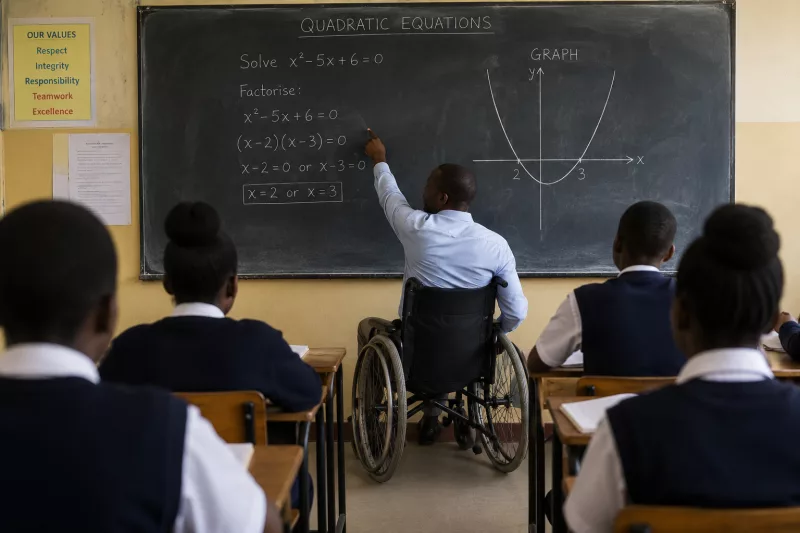
 The audit exposes a significant gap in the representation of persons with disabilities in Kenya's public teaching workforce. /AI ILLUSTRATION
Teachers with disabilities account for only 1.7 per cent of the workforce employed by the Teachers Service Commission (TSC), falling significantly short of the five per cent benchmark for persons with disabilities in public employment.
The finding is contained in study findings by the National Gender and Equality Commission (NGEC) released in July 2026 following an audit conducted in June 2025.
The Teachers of Kenya: Status of Equality and Inclusion in the Teaching Workforce in Kenya, 2025 report found that 7,219 of the 425,613 teachers employed by TSC were persons with disabilities.
Of these, 2,682 were women and 4,537 were men.
The representation is below the five per cent benchmark set by the Persons with Disabilities Act, 2025, which requires employers, including TSC, to reserve at least five per cent of employment opportunities for persons with disabilities.
NGEC said the audit was intended to address the gap by providing critical evidence on the representation of women, youth, persons with disabilities and marginalised groups in the teaching workforce.
"The findings will inform policy recommendations, promote accountability and support the development of a more inclusive and equitable education system in Kenya.”
The gap cuts across the different levels of the teaching workforce. Primary schools had 4,523 teachers with disabilities, including 1,794 women and 2,729 men.
Junior schools had 231, comprising 100 women and 131 men, while secondary schools had 2,409, including 772 women and 1,637 men.
The 37 teachers' training colleges had 56 tutors with disabilities, comprising 16 women and 40 men.
Men therefore accounted for about 63 per cent of teachers with disabilities, compared with about 37 per cent for women.
The disparity is most pronounced in secondary schools, where men accounted for more than two-thirds of teachers with disabilities.
The audit was undertaken to assess the distribution of teachers across primary schools, junior schools, secondary schools and teachers' training colleges, with the data further disaggregated by gender, age, pathway, ability and marginalisation.
It also assessed institutional mechanisms for handling gender-based violence involving teachers and learners and sought to provide evidence-based recommendations for improving equality and inclusion in the teaching workforce.
It covered teachers employed by TSC as at June 2025 and excluded teachers employed by private institutions, county governments and boards of management.
NGEC developed a data collection tool, refined it with TSC, and used it to collect information on teachers by sex, age, disability status and marginalisation.
The report recommends that TSC put in place recruitment practices aimed at gradually increasing the representation of teachers with disabilities to the five per cent benchmark across all levels and cadres.
It also calls for leadership pathways and mentorship opportunities to enable teachers with disabilities to advance into decision-making roles.
The audit was initiated by NGEC as part of its mandate to assess the status of special interest groups and generate evidence on equality and inclusion in the teaching profession.