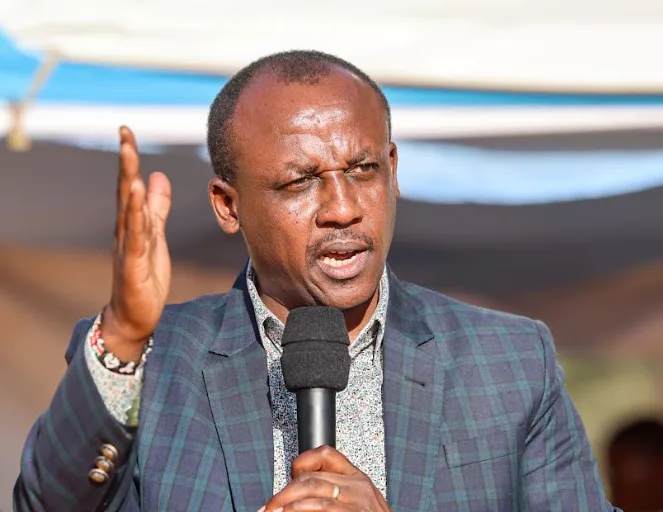
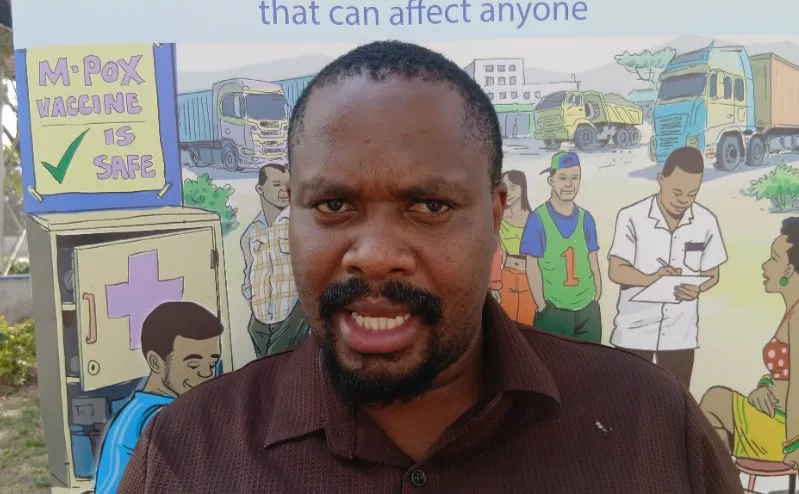
 Athi River Sub-County Medical Supretendant Shadrack Kyengo on July 31 /HANDOUT
The national government and Machakos county have launched a targeted Mpox vaccination campaign in Machakos, prioritising about 1,200 people in high-risk groups along the busy Malaba-Mombasa transport corridor.
Speaking during a sensitisation forum in Athi River subcounty on Saturday, medical superintendent Shadrack Kyengo said the drive targets sex workers, long-distance truck drivers, men who have sex with men, frontline health workers, and hoteliers.
"Today, we have been here sensitising Athi River subcounty residents on Mpox, a disease that has been a problem in our neighbouring countries," Kyengo told reporters.
Kyengo confirmed that Machakos has active Mpox patients.
"The latest is a patient admitted at Kangundo Level 4 Hospital. Others have been treated and discharged," he said.
Kyengo explained that the government chose to focus on mobile and high-contact populations because they drive transmission.
"The Ministry of Health has planned vaccination on this disease. We have decided to ensure that those at risk — people who travel a lot such as truck drivers alongside a special unit that interacts with them a lot like commercial sex workers, both female and male, get vaccinated against the disease," Kyengo said.
Hotspot towns identified include Athi River, Mlolongo, and Kyumbi due to the high number of commercial sex workers and truck stops along the highway.
"So, the people living there are in danger of contracting the disease because if one person contracts the disease, it can highly spread to the population in the area," he added.
The Machakos exercise mirrors similar campaigns already conducted in Mombasa and Busia, where majority of truck drivers and sex workers have been vaccinated.
"Vaccination against Mpox helps prevent spread of the disease to the populace," Kyengo said.
"Though the disease is new in Kenya, the government has put in place various necessary measures to reduce its effects."
Stakeholders in the targeted groups have already been trained on Mpox symptoms, causes, treatment and prevention.
Unlike routine hospital vaccinations, this campaign will take vaccines directly to communities.
Kyengo said the government hopes to eventually vaccinate all Kenyans, but the initial stage will focus on 1,200 people in Machakos.
"The exercise will continue until the disease is suppressed not only in Machakos but across the country," Kyengo said.
Kenya remains Africa’s deadliest Mpox hotspot.
WorldnHealth Organization data shows four of the seven Mpox deaths recorded across Africa between Feb 15 and March 1, 2026 were in Kenya.
By late March, the Ministry of Health had recorded 1,065 confirmed cases across 38 counties, with 78 active cases — the 3rd highest in Africa after Madagascar and DRC.
The case fatality rate stands at 1.6 - 2 per cent.
Early cases were concentrated along transport corridors in Mombasa, Nairobi, Nakuru, Kisumu, Busia, and Malaba, but transmission has now spread to households.
Other affected counties include Makueni, Kiambu, Kilifi and Nakuru.
Mombasa alone has 182 cases, with Nyali and Likoni recording the highest.
Health officials say Mpox spreads through close skin-to-skin contact.
Symptoms include fever, muscle/joint pain, and a skin rash that mostly affects the genital region and whole body.
There is no specific treatment, but early diagnosis and isolation help manage the disease.
The government has received 10,700 doses of MVA-BN vaccine through Africa CDC, WHO, UNICEF and GAVI to support vaccination in high-burden counties.