The country’s public debt will remain above its statutory threshold of 55 per cent to the GDP for the next two years, the National Treasury has said.
The exchequer is projecting that the country will only meet the legal borrowing limit by October 2028 as public debt continues to rise.
The National Treasury told MPs that ongoing fiscal reforms would drive down the present value of public debt from 63.7 per cent of Gross Domestic Product (GDP) to the current legal limit.
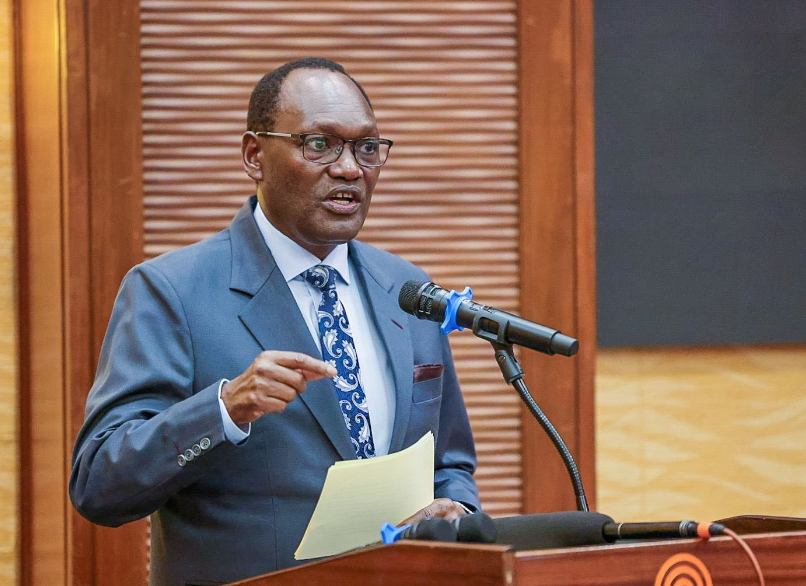
Principal Secretary Chris Kiptoo said there were signs the fiscal consolidation programme aimed at reducing borrowing needs and restoring debt sustainability were bearing fruit.
“The statutory anchor of 55 per cent of GDP in net present value terms is expected to be achieved by the end of October 2028,” he said in a submission to the National Assembly’s Public Petitions Committee.
The disclosure came as the Treasury responded to a petition by Beatrice Waiyaki and others from the Kiambu County Empowerment Network and Bunge Mashinani Initiative.
The group is seeking stronger oversight of public debt, transparency and public participation in debt management.
The petitioners raised concerns over the growing debt burden, arguing that current mechanisms are not sufficient to scrutinise government borrowing.
They want Parliament to establish stronger oversight structures, create a mandatory and publicly accessible debt registry.
The petitions also want an independent expert analysis during debt debates and citizens involvement, particularly young people who will bear the consequences of current borrowing.
But Treasury rejected the call for new legal measures, saying a comprehensive constitutional, statutory and institutional framework governing public debt already exists.
According to the Treasury submission, Kenya’s total public debt stood at Sh12.83 trillion by the end of March 2026.
Domestic debt accounted for the largest share at Sh7.15 trillion, representing 55.7 per cent of the total debt stock, while external debt stood at Sh5.68 trillion.
The debt stock had stood at Sh11.81 trillion at the end of June 2025, when public and publicly guaranteed debt represented 67.8 per cent of GDP.
Treasury said the country’s debt position should be assessed against the legal measure introduced through amendments to the Public Finance Management Act in 2023.
The amendments replaced the previous numerical debt ceiling of Sh10 trillion with a debt anchor pegged to 55 per cent of GDP in present value terms.
During the enactment of the new law, the government was given five years from the commencement of the new provision to align borrowing with the new threshold.
Treasury said the change was designed to ensure borrowing is linked to Kenya’s ability to repay rather than a fixed shilling figure.
“This embeds inter-generational equity directly into the statutory debt architecture… Future borrowing is governed by Kenya’s economic capacity to service it,” the submission stated.
To achieve the target, Treasury said it will reduce fiscal deficit, increasing reliance on longer-term Treasury bonds and prioritise concessional loans over commercial borrowing.
Under the 2026 Medium-Term Debt Management Strategy, the government plans to source 78 per cent of net borrowing domestically and 22 per cent externally, with priority given to cheaper financing.
Treasury also defended its debt transparency record, dismissing claims that Parliament and the public lack access to information on government loans.
It told MPs that a comprehensive Public Debt Register already exists and is maintained in real time through the Meridian debt management system.
The External Public Debt Register, Treasury said, is published annually and contains details on creditors, outstanding balances, loan agreements, maturity dates, repayment schedules and drawdowns.
The ministry added that it publishes monthly debt bulletins showing total debt stock, domestic and external borrowing trends, new loans contracted and debt service payments.
Other reports available to Parliament and the public include the Annual Public Debt Management Report, Medium-Term Debt Management Strategy, Annual Borrowing Plan and Budget Policy Statement.
Treasury, while responding to the petitioners’ call, said public debt management is also subjected to annual audits by the Auditor-General.
It argued that Parliament already has extensive powers to oversee borrowing through committees, including the Finance and National Planning Committee, Public Debt and Privatisation Committee, Senate Finance and Budget Committee and Public Accounts Committee.
The Parliamentary Budget Office also provides independent technical analysis on debt sustainability.
MPs have powers under the Public Finance Management Act to request detailed loan reports from Treasury.
However, Treasury acknowledged that while debt information is available, more needs to be done to make it easier for ordinary citizens to understand.
It committed to developing simplified versions of key debt documents and improving communication on borrowing issues.
The ministry said it would explore ways of presenting debt information in a format citizens, civil society organisations and county-level audiences can easily synthesise.
Treasury also highlighted reforms aimed at broadening participation in government securities markets and improving debt management.
The government also cited improved sovereign credit ratings as evidence of confidence in its debt management framework.
Treasury noted that Moody’s upgraded the country's rating in January 2026, citing reduced default risks, stronger foreign exchange reserves and progress in managing Eurobond obligations.
Despite the assurances, concerns over the sustainability of public debt are expected to remain a major issue, with the focus on development spending, revenue collection and the need to reduce borrowing.