President William Ruto has directed the Social Health Authority (SHA), the Ministry of Health and the Council of Governors to ensure all eligible public, county, faith-based and private ambulance providers are onboarded into the national emergency response system by December 30.
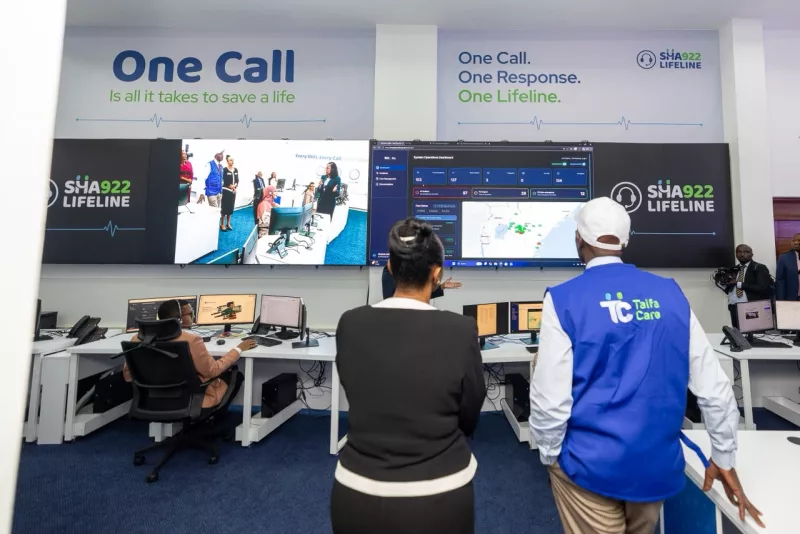
Speaking during the launch of the SHA 922 Emergency Medical Service and the National Ambulance Dispatch Centre in Nairobi on Thursday, the President said the expansion of the network is necessary to ensure no part of the country is left without access to timely emergency medical care.
"I therefore direct SHA, working with the Ministry of Health and the Council of Governors, to complete the onboarding of every eligible public, county, faith-based and private ambulance operator by December 30 this year," Ruto said.
He said the emergency service must be available to all Kenyans regardless of where they live, citing residents in Turkana, Nyeri, Homa Bay, Nairobi and Mandera as among those who should receive dependable emergency response whenever they require urgent medical attention.
"This service must work for the pastoralist in Turkana, the farmer in Nyeri, the fisherman in Homa Bay, the hustler in Nairobi and families travelling across the country. It must be dependable, responsive and accountable," he said.
Ruto said the newly launched emergency medical service marks the beginning of a coordinated national emergency response system designed to ensure patients receive rapid assistance without being delayed by financial constraints or fragmented services.
The service operates through the toll-free 922 emergency number, accessible across all mobile networks even without airtime. Calls are linked to a National Ambulance Dispatch Centre, where trained dispatchers coordinate the nearest available ambulance and direct patients to the most appropriate health facility based on their medical condition.
He said the system is intended to ensure patients are taken to facilities capable of treating their specific emergencies rather than simply the nearest hospital.
The President also reiterated that no patient requiring emergency medical treatment should be denied, delayed, referred or transferred because they cannot pay or because their SHA details cannot immediately be verified.
"In an emergency, the first question must never be whether a patient can pay. The first duty is to save life," he said.
Under the new arrangement, ambulance evacuations and the first 24 hours of emergency treatment will be financed through the Emergency, Chronic and Critical Illness Fund at approved tariffs. Ruto said the protection applies to all patients, including those who are not registered under SHA.
He noted that the national dispatch centre will coordinate ambulances operated by county governments, faith-based organisations, the Kenya Red Cross Society, St John Ambulance Kenya and private providers without taking ownership of the vehicles.
"Coordination is not centralisation. It is the difference between separate systems working together to save lives," he said.
According to the President, 1,243 ambulance and emergency service providers have already been contracted under the programme, describing the figure as a strong foundation but saying more providers are needed to guarantee nationwide coverage.
He urged county governments to contract additional ambulance services to expand coverage and improve response times, saying the government would continue working with humanitarian organisations and private providers to strengthen emergency transport capacity.
Ruto said the emergency service forms part of broader health reforms undertaken since 2023, which include the rollout of SHA, expansion of primary healthcare services and increased investment in preventive care.
He said more than 32.2 million Kenyans have so far registered under SHA, while over eight million have already received treatment through the scheme. He added that the Primary Healthcare Fund has disbursed Sh23.3 billion to contracted health facilities, while more than 107,000 community health promoters have been deployed to strengthen healthcare at the household level.
The President said technology will play a central role in the emergency response system by integrating emergency calls, ambulance dispatch, patient admission, treatment and payment into one coordinated digital process.
"Today's launch may not resolve every weakness in our emergency healthcare system, but it establishes the foundation of a coordinated national service and places upon us the responsibility to improve it continuously," he said.