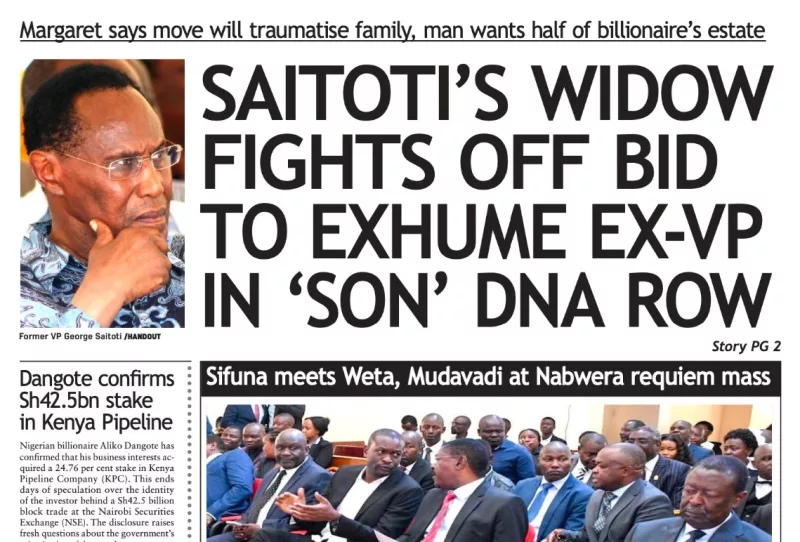
Nigerian billionaire Aliko Dangote has confirmed that his business interests acquired a 24.76 per cent stake in Kenya Pipeline Company (KPC).
This ends days of speculation over the identity of the investor behind a Sh42.5 billion block trade at the Nairobi Securities Exchange (NSE).
The disclosure raises fresh questions about the government’s privatisation of the petroleum transporter, particularly the role of state-owned institutions that bought billions of shillings worth of shares during its initial public offering (IPO) before selling part of their holdings less than eight months later.
According to Bloomberg, Dangote, while speaking in London, revealed that his company had acquired about a quarter of KPC to support the distribution of petroleum products.
“We bought 25 percent of their pipeline network for their distribution of petroleum products,” Bloomberg quoted him as saying.
The transaction involved close to 4.5 billion shares sold at Sh9.02 apiece, giving the block a value of about Sh42.5 billion.
KPC was listed on the NSE on March 9, following the government’s sale of part of its shareholding through an IPO that raised Sh103.45 billion.
While Dangote has confirmed the investment, the legal entity through which he acquired the shares has not been publicly identified in the reports available.
A source familiar with the transaction told The Star that the National Social Security Fund (NSSF) and Uganda’s government were among the substantial shareholders in the investment vehicle.
The source also suggested that keeping the stake below 25 per cent helped avoid a lengthy regulatory approval process. These details could not be independently confirmed.
The deal has attracted attention because it comes against the backdrop of the planned Sh2.2 trillion Dangote East Africa Petroleum Refinery in Lamu, a project that could reshape regional fuel supply and distribution.
The disclosure comes as the government faces growing scrutiny over the IPO, which was presented as a milestone in its privatisation programme.
The government raised Sh103.45 billion from the sale, with the proceeds earmarked for infrastructure investment through the National Infrastructure Fund.
The Treasury has said the fund will support projects including roads, ports, electricity generation, water and irrigation.
However, the offering faced weak demand from private investors before state-backed institutions stepped in.
In August, Business Daily reported that the IPO had attracted less than 10 per cent of the targeted investment days before its closure, prompting the government to turn to parastatals, pension schemes and Uganda to help meet the minimum subscription threshold.
A chief executive of a state corporation, speaking anonymously to the publication, said: “There was tacit order from above to buy the KPC shares. We had not planned, but we bought.”
The report identified the NSSF, Public Servants Pension Scheme, County Workers Pension Fund and Unclaimed Financial Assets Authority among the major institutional investors.
Thirteen state-backed schemes and agencies reportedly invested a combined Sh64.23 billion in the IPO.
The subsequent sale has raised questions about the commercial rationale for the institutions to acquire shares at Sh9 during the IPO and dispose of them at Sh9.02 in October, particularly after transaction costs.
“Although the block trade price was marginally above the IPO price, the difference does not by itself establish whether the sellers made a profit after fees and other costs,’’ Alvin Mutange, a capital markets analyst, told the Star.
“The institutions' individual purchase prices, sale proceeds and transaction expenses would be needed to determine their actual returns.”
President William Ruto confirmed the transfer during Tuesday's Mashujaa Day celebrations in Eldoret, describing the acquisition as evidence of confidence in Kenya's capital markets.
“In demonstration of growing confidence, private investors acquired a 25 per cent stake in Kenya Pipeline Company from public entities,” he said.
Kiharu MP Ndindi Nyoro has challenged that account, alleging that public institutions were pressured into buying the shares before being directed to sell them to a private investor.
In a statement posted on X on Wednesday, Nyoro questioned why the refinery's shareholders' register and investment agreement had not been made public.
He also alleged that the agreement could restrict Kenya from importing petroleum products manufactured by the proposed refinery, even where alternative supplies were cheaper.
“Among the conditions is that Kenya will not import any products made by the refinery even when the prices are double or triple the market price,” he alleged.
The claims have not been independently established.
The available public statements do not demonstrate that the share sale was a contractual condition for the refinery project, nor do they establish the alleged political interests behind the transaction.
The deal nevertheless places renewed attention on transparency in the management of public investments, particularly pension funds whose assets are intended to support members' retirement benefits.
The investment comes as the company reports stronger earnings.
KPC's net profit rose 13.1 per cent to Sh11.58 billion in the financial year ended June 2026, from Sh10.24 billion a year earlier.
Revenue increased 8.8 per cent to Sh42.98 billion, supported by higher local and transit petroleum volumes.
The board proposed a dividend of Sh0.32 per share, equivalent to about Sh5.9 billion, underlining the company's ability to generate returns for shareholders.