President William Ruto has assured the county governments and private ambulance operators that the newly launched National Ambulance Dispatch Centre will not replace or take over their services.
Ruto said the system would instead bring the different providers into one coordinated network, making it easier to locate available ambulances, dispatch them to emergencies and facilitate payment for eligible journeys.
“I acknowledge that this service will not succeed through the national institutions alone. Health is a devolved function, and ambulances are operated by county governments, faith-based organisations, the Red Cross Society of Kenya, the St John Ambulance and private providers,” Ruto said.
“The National Ambulance Dispatch Centre does not take these ambulances away from their owners. It makes them easier to find, coordinate their deployment, and pay for every eligible journey undertaken,” he added.
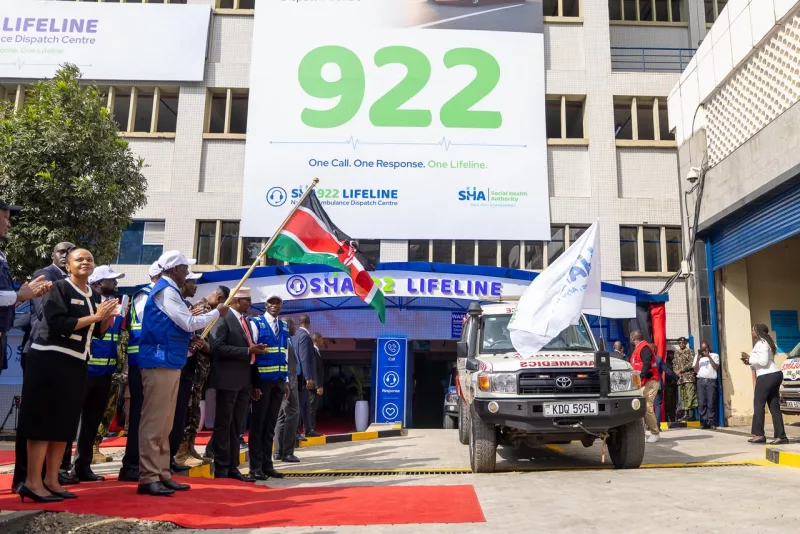
He spoke when he officially launched the Centre at the SHA headquarters and the 922 emergency line, setting the stage for a nationally coordinated system aimed at making emergency medical services faster and more accessible.
Under the system, a person facing a medical emergency will call 922, with a trained dispatcher expected to establish the caller’s location and the nature and urgency of the emergency.
The centre will then identify an available ambulance within the network and coordinate its deployment to the scene before the patient is evacuated to an appropriate health facility.
Ruto said the initiative would help address the challenge of fragmented ambulance services, where patients and families have previously had to search for available emergency transport on their own.
He stressed that coordination should not be mistaken for centralisation, saying the system would allow different ambulance operators to retain ownership while working through a common national platform.
“Coordination is not centralisation. It is the difference between 47 separate systems and one public working together to save lives,” Ruto said.
The President urged more counties to establish mechanisms for contracting additional ambulance providers to increase the number of vehicles available for emergency response.
He said the government would also work with organisations such as the St John Ambulance and the Kenya Red Cross Society to expand their ambulance fleets.
“I hope we are going to work with St John’s and Red Cross to help them get a bigger pool of ambulances, so that finally we have the requisite numbers to make sure that no part of Kenya is too far for us to provide ambulance service for those in need,” he said.
Ruto said 1,243 ambulance and emergency service providers have already been contracted by the Social Health Authority (SHA), describing the figure as a strong beginning but insisting that more providers must be brought into the system.
He directed SHA, working with the Ministry of Health and the Council of Governors, to complete the onboarding of every eligible public, county, faith-based and private ambulance operator by December 30, 2026.
The President said the system must serve Kenyans regardless of their location or occupation, including pastoralists in Turkana, farmers in Nyeri and fishermen in Homa Bay.
The 922 service is part of the government’s wider Universal Health Coverage agenda, with the dispatch centre expected to improve response times, ambulance utilisation and coordination between emergency responders and health facilities.
Ruto said the ultimate test would be whether the system could ensure that an emergency call from any part of the country results in a timely response and lifesaving medical evacuation.