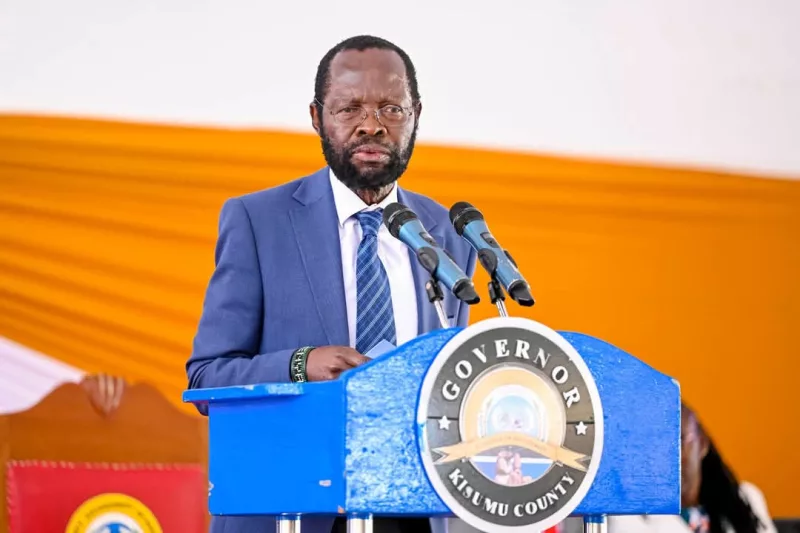
 Kisumu Governor Anyang’ Nyong'o / FILE
Kisumu Governor Prof. Anyang' Nyong'o has said inadequate funding was one of the key reasons Kenya fell short of fully implementing Vision 2030, urging the government to make resource mobilisation the cornerstone of Vision 2060.
Nyong'o said the country did not have enough domestic resources or external financing from development partners to deliver on the ambitious goals outlined in the national development blueprint.
Speaking on Wednesday at Citizen TV, Nyong'o said the experience offers an important lesson as Kenya develops Vision 2060.
"Some of the shortcomings are that we did not have enough resources to realise the goal of Vision 2030, both internal and the resources we could borrow from our development partners. We learned that lesson that to realise Vision 2060, it must focus seriously, accurately and consistently in raising resources," Nyong'o said.
The governor pointed to President William Ruto's wealth fund initiative as an example of the kind of financing mechanism that could support the country's long-term development agenda.
"One example is when President William Ruto came up with the wealth fund that was not thought of before. It is the kind of wealth fund that can help people improve themselves by getting money and investing in developmental projects," he said.
"Such kind of initiatives are important, and we should have more of them in implementing Vision 2060 as much as we had those initiatives in implementing Vision 2030."
Nyong'o also said national development should extend beyond the electoral cycle, arguing that elections only determine who forms the government, while leadership is defined by the policies and direction it provides.
"Well, we have had an election in this country. Elections are not enough really. Elections just decide who governs. But who governs must come up with some policies, some direction of where we are going," he said.
He said every generation has a responsibility to advance the country's development, citing the independence generation that secured Kenya's freedom and the generation that ushered in the 2010 Constitution.
"If you take, for example, the independence generation, which secured the freedom, the 2010 generation that gave Kenya the transformation of the Constitution, our generation now must build a prosperous nation out of that Constitution," he said.
Nyong'o, who was involved in developing Vision 2030, said the country must now begin planning beyond the current blueprint as its implementation period comes to an end.
"When we developed Vision 2030, it was several years ago. Now we are at 2026. Vision 2030 will be ending soon. We must look further than 2030. That's why we're looking at Vision 2060," he said.
President William Ruto unveiled the Vision 2060 framework, describing it as Kenya's next long-term development roadmap that will succeed Vision 2030 and guide the country's economic and social transformation over the next three decades.
The President said the blueprint seeks to build on gains made under Vision 2030 while positioning Kenya as a globally competitive, inclusive and sustainable economy by 2060.
Ruto also announced the formation of an advisory team led by Professor Hiroyuki Hino and Anyang' Nyong'o to spearhead national consultations on the country's long-term development agenda.
According to the President, the process will involve experts, policymakers, the private sector, academia and citizens in shaping a shared national vision beyond the lifespan of Vision 2030.