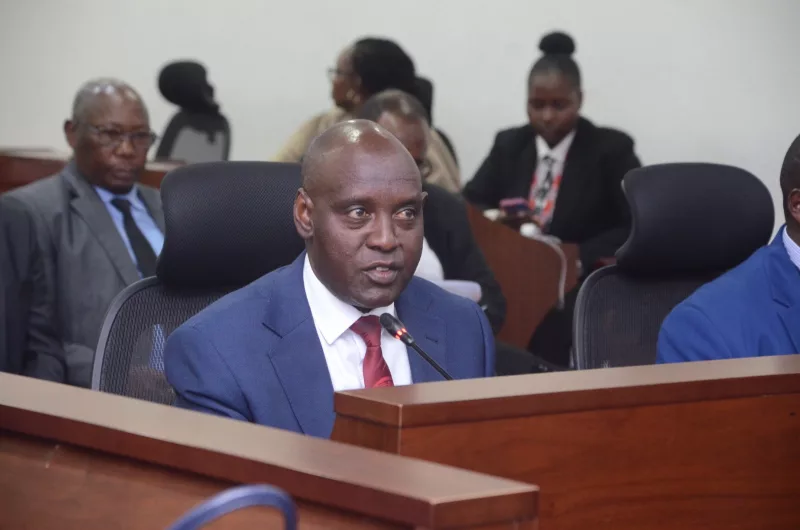
 Basic Education PS John Ololtuaa before the National Assembly’s
Education Committee at Bunge Towers yesterday /DOUGLAS OKIDDY
Basic Education PS John Ololtuaa before the National Assembly’s
Education Committee at Bunge Towers yesterday /DOUGLAS OKIDDY
This is even as the agency plans to gradually roll out paperless exams as it grapples with a widening budget deficit.
Documents presented to the National Assembly Education Committee shows KNEC faces a Sh2.58 billion funding shortfall in the 2025/26 financial year.
Basic Education PS John Ololtua said the deficit is projected to balloon to Sh6.71 billion in 2026/27 if additional resources are not secured.
The shortfall persists despite the government's allocation for examinations rising to Sh10.5 billion.
The figures show that the cost of administering national assessments has continued to exceed available funds as enrolment grows under the Competency-Based Education (CBE) curricullum.
According to the report, KNEC's long-term response is to
transition to paperless examinations.
The PS said they hope to cut the huge costs associated with printing, packaging, transporting and securing examination papers across the country.
The report identifies examination printing as one of the council's biggest expenditure items, with logistics and security costs also rising every year.
Digital examinations are expected to lower operational costs while modernising the assessment system in the long run.
The funding challenge comes as KNEC prepares for one of its busiest examination seasons yet.
The report indicates that 3,634,846 learners have registered for this year's national assessments and examinations.
It comprises 1,380,463 learners for the Kenya Primary School Education Assessment (KPSEA), 1,206,028 for the Kenya Junior School Education Assessment (KJSEA) and 1,048,355 candidates for the Kenya Certificate of Secondary Education (KCSE).
KNEC has already completed validation and verification of candidate registration data ahead of the security printing of examination materials.
The verified data will now be used for printing, packing and routing examination papers to thousands of centres countrywide.
The report further shows that KNEC will administer assessments for learners with severe and profound disabilities under the Stage-Based Curriculum.
This will include the Kenya Intermediate Level Education Assessment (KILEA) and the Kenya Pre-vocational Level Education Assessment (KPLEA).
As MPs considered the ministry's budget proposals, they also raised concerns about the credibility of assessments under the CBE system.
Education committee chairman Julius Melly (Tinderet) questioned whether school-based assessments are sufficiently standardised to ensure fairness across the country.
"How are school-based exams standardised? How credible are they?" Melly asked.
He also sought clarification on the ministry's admission policy, saying schools should not be allowed to admit learners beyond their capacity.
"What's your policy on admission and enrolment so that no one wakes up and gives haphazard numbers?" he posed.
Melly also questioned the ministry's discipline policy, particularly on the use of mobile phones in schools.
"What's the ministry doing on the use of phones?" he asked.
On education financing, Melly demanded to know how much government capitation actually reaches schools.
MPs also want to know whether the ministry was aware that some parents continue to be charged levies in Junior School despite government funding.
Teso South MP Mary Emaase also sought clarity on the fees payable by parents, asking: "How much fees should parents pay for pupils in primary schools?"
Responding to the concerns, PS Ololtuaa acknowledged that the ministry continues to face a shortage of quality assurance officers responsible for monitoring standards in schools.
"On quality assurance, we have had a shortage of officers and we are looking at how to coordinate to ensure the officers are facilitated," he told the committee.
On capitation, Ololtuaa assured schools that delayed government funding would be released before learners return for the third term.
"On capitation, I confirm it is ready and approved by Treasury and will be paid before schools reopen for the third term," he said.
However, he noted that the ministry can only disburse funds within the budget approved by the National Treasury.
"On concerns about the amount, the ministry works with what's provided by Treasury," he said.
He added that the ministry would crack down on schools imposing unauthorised charges on parents.
"We will monitor for adherence to the set fee structure," Ololtuaa said.
The committee also raised concerns over recurring school fires that have disrupted learning in several institutions over the years.
Melly noted that fires have become almost routine during the second term and challenged the ministry to provide a lasting solution.
"School fires are known traditionally to be in second term. What is your lasting solution on school fires?" he asked.
Ololtuaa dismissed suggestions that overcrowding alone is responsible for the incidents.
"On school fires, the concern that overcrowding is the leading cause is not the case as there are other reasons as well," he said.
He nevertheless defended the government's 100 per cent transition policy, saying it has enabled many more children to access education.
"The policy on 100 per cent transition has made it possible for many children to attend school," he said.
The ministry's report shows that interventions undertaken jointly with security agencies have significantly reduced incidents of school unrest and arson this year.
Reported incidents declined from 204 during the first monitoring period to 126 after schools reopened and further dropped to 29 after the June-July half-term break.
Fire incidents reduced from 71 to 24, while cases of student agitation fell from 95 to 29 before dropping to zero in the latest monitoring period. Fatalities also reduced from 18 to none.
The ministry attributed the improvement to better intelligence, strengthened collaboration with security agencies, counselling programmes, early warning systems, fire safety audits and improved supervision in boarding schools.
INSTANT ANALYSIS
MPs indicated that their attention will now shift to whether KNEC receives sufficient funding to administer credible examinations and implement the ambitious transition to paperless testing without compromising the integrity of the country’s national assessments.