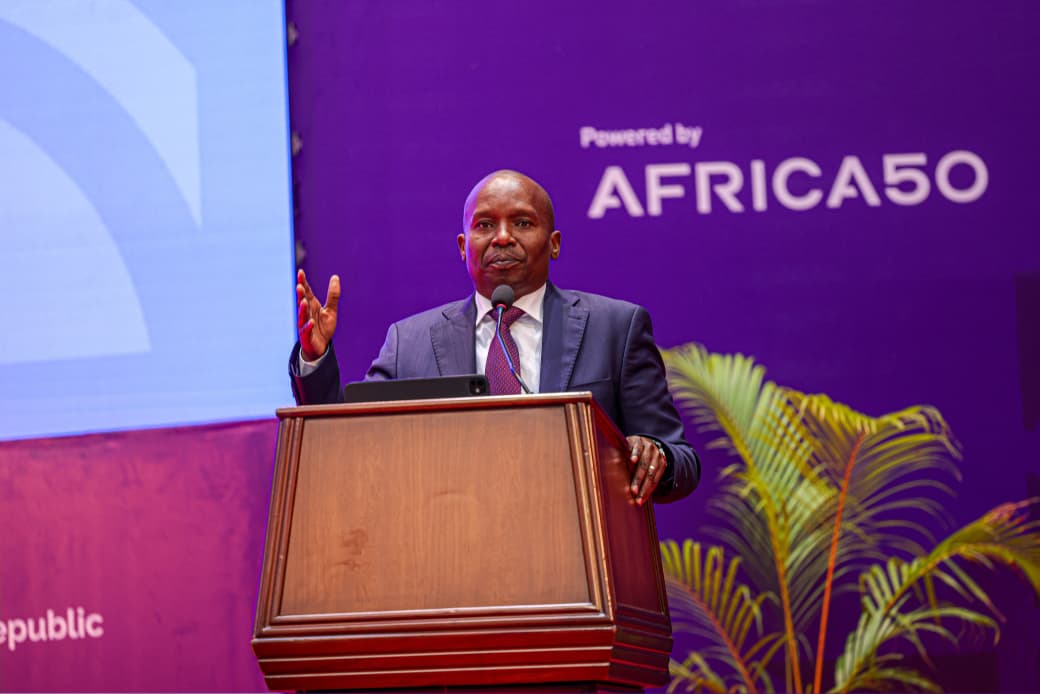
 Deputy President Kithure Kindiki addresses delegates during the Infra for Africa Forum and Africa50 General Shareholders Meeting in Dar es Salaam, Tanzania, on August 5, 2026. /PCS
Deputy President Kithure Kindiki has challenged African countries to pursue long-term development strategies that can transform the continent into a First World economy.
Kindiki said Africa already possesses the natural resources, human capital and potential needed to achieve that goal.
He was speaking during the Infra for Africa Forum and the Africa50 General Shareholders Meeting in Dar es Salaam, Tanzania.
Kindiki said African governments must move beyond short-term political and economic interests and commit to policies that guarantee sustainable development over several decades.
Representing President William Ruto at the forum, the Deputy President said Africa should have confidence in its own capabilities instead of viewing development as an unattainable ambition.
“Africa needs to build confidence in itself. As Africans, we must learn to have confidence in our continent and in our capability to do what others have been able to do,” Kindiki said.
He argued that the continent cannot continue lagging behind despite being endowed with abundant natural resources, a youthful population and growing economic opportunities.
Kindiki said Kenya has already begun implementing reforms aimed at accelerating infrastructure development through innovative financing mechanisms designed to attract private investment while reducing pressure on public finances.
He cited the establishment of Kenya's Infrastructure Fund, saying the government is mobilising capital through the stock market by partially divesting stakes in selected state-owned entities and using the proceeds to leverage additional private sector investment.
“In Kenya, we have just put in place an Infrastructure Fund where we are mobilising resources from the stock market by selling part of the stakes in government-owned entities and using the capital to crowd investment by the private sector,” he said.
The Deputy President said infrastructure remains a critical driver of economic transformation but warned that investments alone would not deliver meaningful development unless citizens directly benefit from them.
“We need to have the people with us. We must carry the people along; women, young people, rural and urban poor. It is not enough to build roads, railways, seaports, harbours and gas pipelines. It is important to ensure the people travel the development journey with us,” he said.
Kindiki identified policy consistency and political stability as some of the biggest requirements for attracting long-term investment, urging African governments to shield national development programmes from disruption during changes in political leadership.
He said democratic transitions should not derail infrastructure projects or national development priorities, noting that continuity is essential for delivering projects whose benefits are realised over many years.
“The biggest threat to Africa’s development today is policy disruption, which is an unintended consequence of democracy. The movement from one administration to another is a good thing but we must find ways of insulating our development agenda from democratic transitions so that we can have continuity in development,” he said.
He also called for stronger regional cooperation, saying African countries should work together to mobilise investment, reduce investor risk and lower the cost of financing large infrastructure projects.
“We need to have innovative ways of mobilising resources both nationally and regionally to be able to reduce investor risk and lower the cost of capital and enable implementation of capital-intensive projects,” Kindiki said.
The forum brought together government leaders, development partners and investors to discuss financing strategies for infrastructure projects across the continent.
Tanzanian President Samia Suluhu delivered the keynote address during the meeting, which was also attended by former Tanzanian President Jakaya Kikwete and other regional leaders.