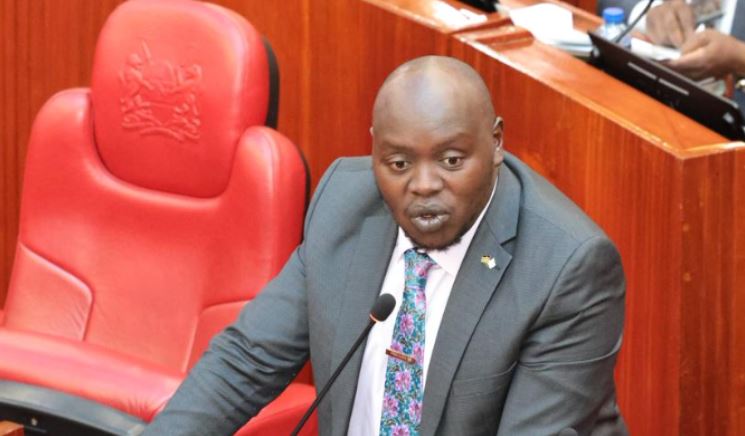
Nandi Senator Samson Cherargei has opposed plans to introduce toll charges on the Mau Summit-Rironi road, warning that motorists from the Rift Valley and Western Kenya would be subjected to double taxation.
Cherargei said motorists already contribute to road maintenance through the Road Maintenance Levy Fund (RMLF) and should therefore not be required to pay an additional toll to use the highway.
“We should not toll that road. Why are we tolling that road yet we are not tolling Mau Mau roads. We will resist, we shall reject. We say no to any intention to toll Mau Summit-Rironi,” Cherargei said.
Speaking on the floor of the House, the senator argued that introducing toll charges while retaining the existing road maintenance levy would amount to unfair taxation of motorists who regularly use the route.
“As we are paying through Road Maintenance Levy Fund, that should be enough. Or you remove the Road Maintenance Levy Fund and toll us,” he said.
Cherargei also questioned what he described as unequal treatment of motorists using different major highways, saying the government should not create a situation where some regions pay additional charges to access key roads while others do not.
“We cannot have second-class citizens in this country, that the people who go to Western through Mau Summit are tolled but the people who go to Mau Mau and Mount Kenya East or West [are not],” he said.
The senator said residents of Nandi and other counties in the region would oppose the proposed tolling arrangement, arguing that they already contribute taxes towards infrastructure development.
“What we are saying is that you cannot toll us. We are not children of a lesser God and therefore we are totally against tolling because it will subject us to double taxation,” Cherargei said.
The senator's opposition comes as the government undertakes the project under a public-private partnership (PPP) arrangement, with tolling expected to provide revenue for the investment, operation and maintenance of the highway.
Treasury Cabinet Secretary John Mbadi has defended the tolling model, arguing that motorists will be paying to use an upgraded highway whose development and maintenance will require substantial investment.
Under the proposed arrangement, motorists are expected to pay according to the distance travelled rather than a uniform charge.
The proposed tariff for the Rironi-Gilgil section is Sh8 per kilometre, while the Gilgil-Mau Summit section has been cited at about Sh8.50 per kilometre.
The charges would therefore vary depending on the section of the highway used and the distance travelled.
Cherargei said he was speaking on behalf of residents who rely on the route to travel to Nairobi and other parts of the country.
“As a representative of the people of Nandi, we will not pay to come to Nairobi through the road. Yet we pay taxes,” he said.
Cherargei urged the Ministry of Roads and Transport to abandon the proposal, describing it as a “stillbirth” that would face resistance from affected communities.
The senator also warned that introducing toll charges could push motorists to seek alternative routes to avoid the additional cost.
“I know people from Bomet can decide to use Ngong-Suswa all the way to Narok. They might not be tolled, but us who come from that region, Mr Speaker, we are against,” he said.
Cherargei repeatedly rejected the proposal, urging the ministry to reconsider the plan.
“We are against, Mr Speaker, and we are against. We want to tell the Ministry of Roads and Transport, please abandon that idea. It is a wrong idea,” he said.