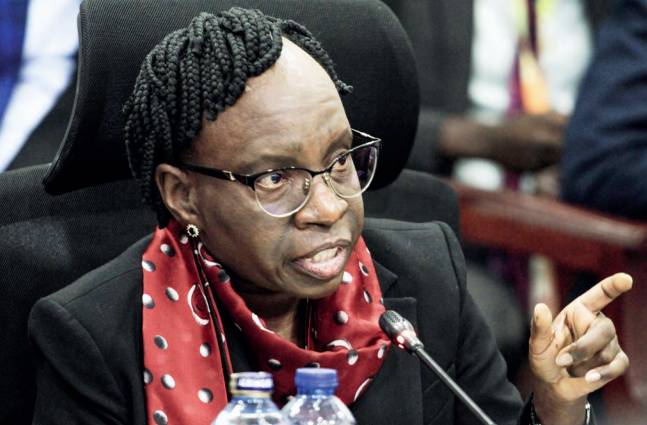
 Auditor General Nancy Gathungu /FILE
Kenya’s public sector continues to struggle with compliance with constitutional requirements on ethnic, gender and disability representation, with fresh audits exposing widespread discrimination and irregular recruitment in national and county governments.
Auditor General Nancy Gathungu told the Senate Standing Committee on National Cohesion, Equal Opportunity and Regional Integration on Tuesday, August 4, that several public institutions had failed to achieve affirmative action targets despite constitutional and statutory requirements.
Gathungu said audits had identified public institutions that were below the five per cent threshold for employment of persons with disabilities, while some had also failed to comply with the two-thirds gender rule and requirements on ethnic diversity.
“In the FY 2024-25, 14 MDAs and donor funded programs were not compliant with the proportion of employees with disability,” the Auditor General said.
The proportion of employees with disabilities in the affected institutions ranged between 0.6 per cent and 3.4 per cent.
The report also raised concern over irregular recruitment, delayed recruitment, unauthorised acting appointments and failure to adhere to approved staffing structures, saying such practices undermine meritocracy and fairness in the public service.
The situation is more pronounced in county governments.
The Auditor General said 11 county executives had failed to meet the statutory requirement on employment of persons with disabilities, with representation ranging between one and 1.5 per cent.
Six county governments had also retained 157 employees beyond the mandatory retirement age of 60 or 65 for persons with disabilities.
Nine counties were faulted for irregular recruitment, including hiring without approval from County Public Service Boards, lack of documented recruitment processes and employing staff outside approved establishments.
A separate audit of county payrolls covering the financial years 2021/22 to 2023/24 found that 21 county executives had engaged in irregular recruitment.
The audit further established that 17 county executives had 1,993 employees who were redesignated, promoted or appointed without meeting requirements under their respective schemes of service.
The ethnic question was equally stark.
Some 28 county executives had more than one-third of their employees drawn from the dominant local ethnic community, contrary to the National Cohesion and Integration Act.
Another 23 county executives failed to comply with the requirement that at least 30 per cent of vacant entry-level positions be filled by candidates outside the dominant ethnic community.
Gathungu attributed the failures to weak human resource governance, inadequate internal oversight and a lack of structured monitoring and reporting systems for gender, disability and ethnic diversity.
She warned that discrimination and inequality in public institutions can undermine public trust and confidence.
“Where it occurs in the delivery of public services, it further undermines public trust and confidence in public institutions,” she said.
The Auditor General said her office would continue supporting Parliament through financial, compliance and performance audits to address diversity and inclusion gaps across the public sector.