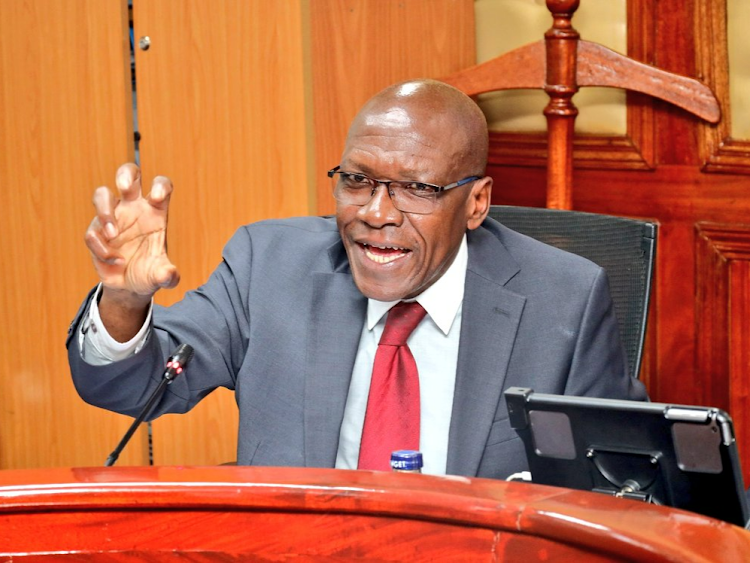
 Kakamega Senator
 Kakamega Senator Boni Khalwale has criticised the frequent reshuffling of parliamentary committees, warning that the changes undermine oversight, weaken institutional memory and interfere with Parliament's constitutional mandate.
Speaking in the Senate during debate on the recent committee changes, Khalwale argued that while political parties are free to appoint or remove internal leaders such as whips, committee membership should not be treated as a political reward or punishment.
He said committees play a critical role in legislative oversight and should be allowed to function without constant disruption.
"It is okay if a political party or a coalition removes a whip or a deputy whip because that is a decision of the party. But on sitting on committees and doing parliamentary work, that we should not accept," Khalwale said.
His remarks followed recent changes on the minority side of Parliament that saw several lawmakers reassigned to different committees.
Among those affected were Nairobi Senator Edwin Sifuna, who was removed as Deputy Senate Minority Whip and reassigned from the County Public Accounts Committee to the Agriculture Committee, and Vihiga Senator Godfrey Osotsi, who was replaced as chairperson of the Senate County Public Investments and Special Funds Committee before being moved to another committee.
Sifuna was replaced as Deputy Senate Minority Whip by Migori Senator Eddy Oketch, while Nandi Senator Samson Cherargei took over as chairperson of the Senate County Public Investments and Special Funds Committee (CPISFC) following Osotsi's removal.
Khalwale argued that legislators with different political positions should not be denied opportunities to serve on parliamentary committees, saying such actions only elevate their political standing.
He cited historical examples of leaders who faced political setbacks but later emerged stronger, saying Parliament should not be used to silence differing opinions.
"Let Parliament function. Let committees work. Let the best among us chair committees," he said.
During his contribution, Khalwale also cautioned against actions that could weaken Parliament as an institution, describing the House as a key pillar in safeguarding democracy and national stability.
His remarks prompted a point of order from nominated Senator Karen Nyamu, who challenged part of his contribution and urged him to confine his remarks to the matter before the House.
Nyamu also objected to comments she considered personal, saying senators should debate the issues under discussion rather than make references to fellow legislators.
The Speaker directed Khalwale to avoid personal remarks and focus on the debate on committee changes, after which he resumed his contribution.
The Speaker also advised Khalwale to refrain from comments that cast doubt on the abilities of other senators and urged members to maintain decorum.
Khalwale complied with the guidance before reiterating his argument that Parliament should be protected from actions that disrupt its oversight work.
He maintained that committee assignments should prioritise competence and continuity rather than political considerations, saying effective oversight depends on stable committee membership.
The recent committee changes have sparked debate within Parliament, with some legislators defending the decisions as internal political arrangements, while others argue that frequent reshuffles affect the effectiveness of parliamentary oversight.