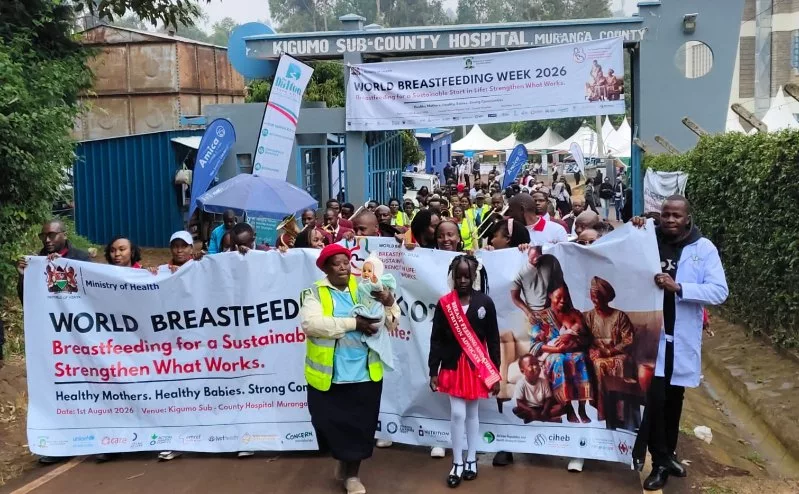
 Stakeholders walk from Kigumo Subcounty Hospital in Murang'a to Kigumo town during the launch of the World Breastfeeding Week on August 1, 2026 /ALICE WAITHERA
Only about 60 per cent of Kenyan mothers exclusively breastfeed their babies for the recommended first six months of life, health experts have said.
This leaves four in every 10 infants at greater risk of poor nutrition and contributes to an estimated Sh373 billion annual loss to the economy from child undernutrition.
Although 89 per cent of births in Kenya are attended by skilled health personnel, only 60 per cent of newborns are breastfed within the first hour after birth, exposing many babies to preventable illnesses and avoidable deaths, the health experts said during the national launch of World Breastfeeding Week in Murang'a.
Representing Public Health and Professional Standards PS Mary Muthoni, assistant director of primary healthcare Norbert Abuya said Kenya had made commendable progress but still had significant gaps that required urgent action.
"The figures are encouraging, but what happens to the child who is left behind? Statistics alone cannot improve the life of a baby who is not breastfed," Abuya said.
He said the country must now shift its attention from celebrating national averages to identifying vulnerable mothers and children who continue to miss essential nutrition services despite improvements in maternal healthcare.
Abuya said while counties such as Murang'a have surpassed the national average with an exclusive breastfeeding rate of 68 per cent, the focus should remain on ensuring every child, regardless of where they are born, benefits from quality nutrition support.
He praised counties that have integrated public, private and faith-based health facilities into maternal and child health programmes, saying quality breastfeeding support should be available across the entire healthcare system.
"We must provide the same quality services whether a mother seeks care in a public, faith-based or private health facility. No Kenyan should be left behind because of where they access healthcare," he said.
Abuya also commended the expansion of the Baby Friendly Community Initiative, saying community health promoters have become central to improving breastfeeding through home visits, mother-to-mother support groups and father engagement programmes.
He urged counties to enrol all community health promoters under the Social Health Authority so they can benefit from health insurance jointly financed by the national and county governments.
Abuya also encouraged fathers to become active participants in newborn care, saying kangaroo mother care should not be viewed as the responsibility of mothers alone.
"Even fathers can practice kangaroo care. Their responsibility does not end when the baby is born. They have a major role in ensuring children survive and thrive," he said.
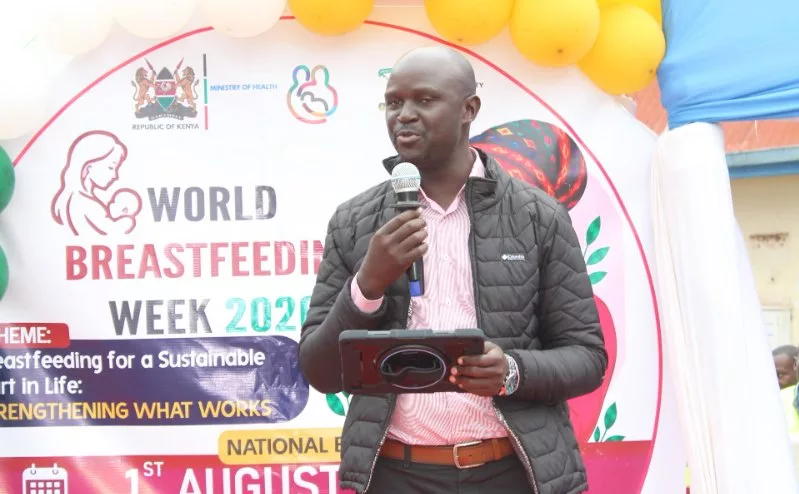 Assistant director of primary healthcare Norbert Abuya during the launch of World Breastfeeding Week in Kigumo, Murang'a, on August 1, 2026 /ALICE WAITHERA
Abuya further expressed concern over persistent child malnutrition, noting some counties continue to report cases of wasting and stunting despite producing adequate food.
He said children affected by malnutrition suffer lifelong consequences, including poor physical growth, impaired cognitive development and reduced productivity later in life.
Reading the PS's speech, Abuya said breastfeeding remains one of the most effective and affordable public health interventions available, protecting infants against infections, promoting healthy brain development and improving maternal health.
He said this year's World Breastfeeding Week theme, 'Breastfeeding for a Sustainable Start in Life: Strengthen What Works,' recognises the need to expand proven interventions instead of developing new programmes.
The Ministry of Health, he said, will continue strengthening national nutrition standards, mobilising resources, supporting counties to scale up evidence-based interventions and promoting research to improve maternal and child nutrition.
Nutrition International Kenya country director Martha Nyagaya said Kenya has strong policies protecting breastfeeding, including the Breastfeeding Act of 2012, but implementation remains inconsistent.
She said nearly four out of every 10 Kenyan infants are still not exclusively breastfed because of workplace pressures, cultural practices, early introduction of complementary foods and violations of regulations governing breast milk substitutes.
"We have the laws and we have the evidence. What we need now is consistent implementation and adequate financing because policies alone cannot change children's lives," Nyagaya said.
She urged employers, particularly in the private sector, to create breastfeeding-friendly workplaces and support mothers returning from maternity leave.
Nyagaya also challenged county governments to allocate more resources to nutrition programmes, saying sustained financing is critical to improving child health.
Using Murang'a as an example, she said dedicated funding for nutrition had increased from Sh3 million to Sh123.7 million within three years, demonstrating what political commitment backed by financial investment can achieve.
"Without funding, nutrition policies remain books gathering dust on shelves. Every county must invest if we are serious about improving child nutrition," she said.
Unicef Kenya chief of field operations Dominic Stolarow said Kenya's exclusive breastfeeding rate has improved significantly over the last two decades, rising from 13.2 per cent in 2003 to 60 per cent today, contributing to a sharp decline in infant mortality.
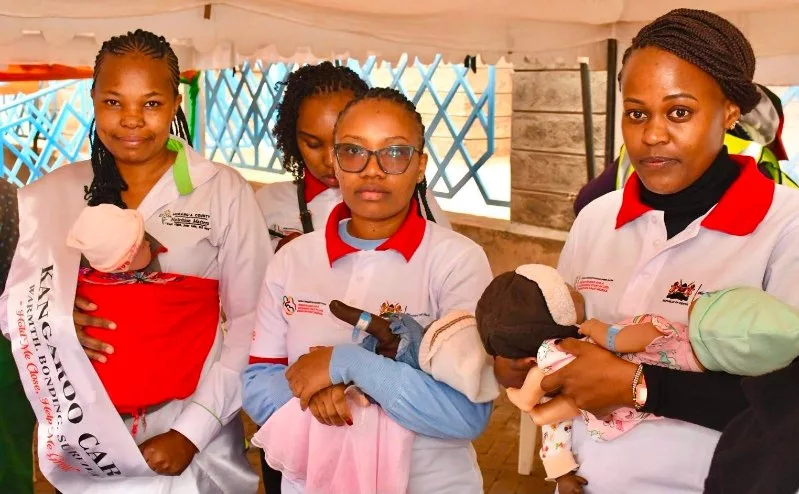 Women demonstrate breastfeeding and Kangaroo Care techniques during the launch of the World Breastfeeding Week launch at Kigumo Subcounty Hospital on August 1, 2026 /ALICE WAITHERA
However, he warned that neonatal mortality has remained largely unchanged, falling only from 22 deaths per 1,000 live births in 2014 to 21 in 2022.
He said more than three-quarters of newborn deaths occur during the first week of life, making early breastfeeding one of the most effective interventions available.
"Breast milk is much more than food. It is a baby's first vaccine, first immune system and, for many newborns, the difference between life and death," Stolarow said.
He said initiating breastfeeding within the first hour after birth significantly reduces newborn deaths and called for greater investment in donor human milk services, observing that Kenya currently has only one operational human milk bank.
Murang'a county nutrition coordinator Nancy Mwangi said partnerships between county governments and development agencies have demonstrated that sustained investments can significantly improve nutrition outcomes.
She said Murang'a had reduced stunting from 19.2 per cent in 2014 to 10 per cent in 2022 through community nutrition programmes, workplace breastfeeding support and dedicated financing for maternal and child health.
Journalist and breastfeeding champion Rebeccah Muiruri shared her personal experience of struggling to exclusively breastfeed her second child because of work commitments before successfully breastfeeding her third child after receiving training on maternal and child nutrition.
She said many working mothers abandon exclusive breastfeeding because they lack adequate workplace support and cannot afford breast milk expression equipment.
"When mothers are informed, they make better decisions. When employers support them, they do not have to choose between their careers and their children. Breastfeeding is a shared responsibility," Muiruri said.
Instant Analysis
Although 89 per cent of births in Kenya are attended by skilled health personnel, only 60 per cent of newborns are breastfed within the first hour after birth, exposing many babies to preventable illnesses and avoidable deaths. Assistant director of primary healthcare Norbert Abuya said children affected by malnutrition suffer lifelong consequences, including poor physical growth, impaired cognitive development and reduced productivity later in life.