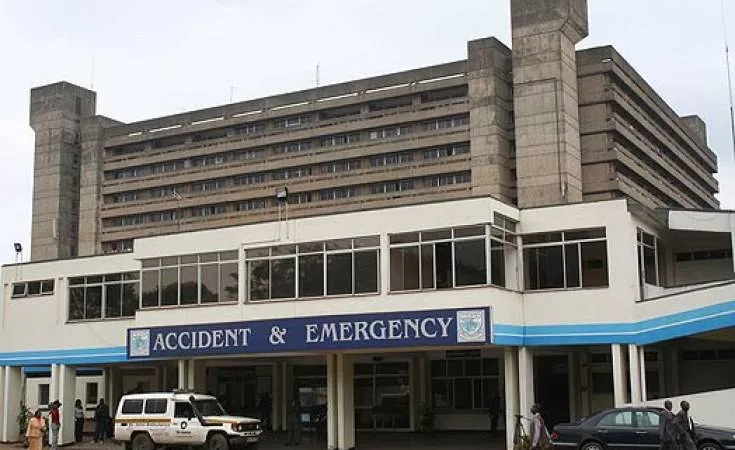
 The Kenyatta National Hospital /FILE
Kenyatta National Hospital (KNH) has defended its decision to remove several aged African acacia trees within its compound saying the move was necessary to protect patients, staff, visitors and the marabou storks that had nested there.
KNH Chief Executive Officer Richard Lesiyampe said the affected trees, which were more than 30 years old, had become decayed and posed a significant safety risk.
He said the hospital acted after a technical assessment and ahead of the rainy season to prevent accidents.
"Kenyatta National Hospital (KNH) has noted the concerns raised regarding the recent removal of trees within the hospital grounds and the reported impact on the marabou storks that had nested there. The affected African acacia trees, which were over 30 years old, had become aged and decayed, resulting in the frequent falling of branches and posing a significant safety risk," Lesiyampe said.
The hospital said falling branches and trees had previously damaged steam pipes, landed on parked vehicles, created safety hazards and even caused the death of some of the birds nesting in the trees.
According to KNH, the removal of the hazardous trees was a preventive measure aimed at safeguarding people, hospital infrastructure and the marabou storks from the dangers posed by the deteriorating trees.
“Following a technical assessment and in anticipation of the rainy season, the hospital undertook the removal of the hazardous trees as a necessary preventive safety measure. The exercise was intended to protect not only patients, staff, visitors and hospital property, but also the marabou storks from the dangers posed by the deteriorating trees,” the CEO added.
The hospital said it is working closely with relevant government agencies to ensure the welfare of the affected birds and facilitate appropriate interventions, including their safe relocation where necessary.
KNH also expressed regret over the disruption to the birds' habitat and pledged to restore the environment through a tree replacement programme.
The hospital said it will plant suitable tree species in appropriate locations across its grounds as part of its commitment to environmental conservation and public safety.
Kenyatta National Hospital (KNH) is Kenya's largest national referral and teaching hospital.
It was established as a State Corporation in 1987 through Legal Notice No. 109 of April 6, 1987, and later amended by the KNH Amendment Order, 2021.
The hospital's mandate is to provide specialised healthcare to patients referred from hospitals within and outside Kenya.
It also serves as a teaching and research facility for the University of Nairobi and other health institutions, offers training for nurses and allied health professionals, and participates in national health planning as the country's national referral hospital.
KNH provides specialised medical services to patients from Kenya, the Great Lakes region, Southern Africa and Central Africa.
These include open-heart surgery, neurosurgery, orthopaedic surgery, reconstructive surgery, burns management, critical care, newborn care, cornea transplants, liver resections, oncology, palliative care, and renal services, including kidney transplantation.