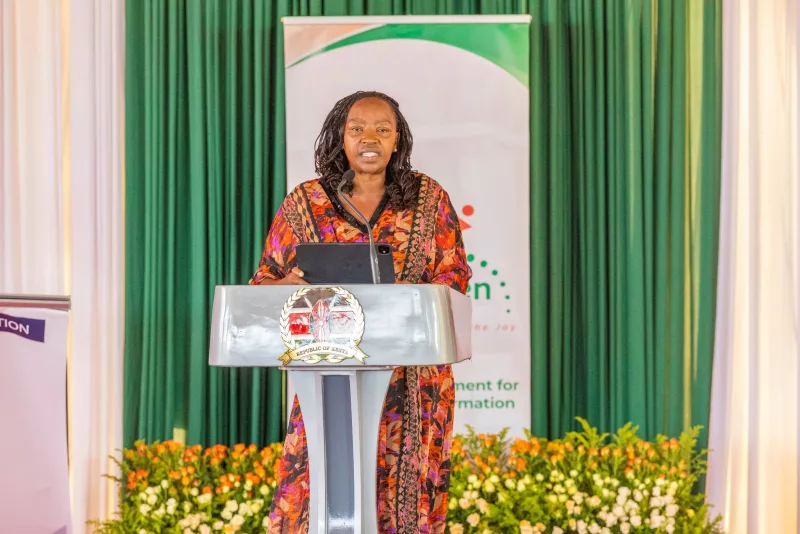
 Justice Joel Ngugi speaks during the launch of AJS in Kericho/JUDICIARY
Alternative Justice Systems (AJS) can play a critical role in improving access to justice, strengthening social cohesion and promoting economic development in Kenya’s counties, Deputy Chief Justice Philomena Mwilu has said.
Mwilu said communities must remain at the centre of designing and implementing justice solutions that respond to their unique needs and circumstances.
She said this in a statement read on her behalf by the chairperson of the National Steering Committee on the Implementation of AJS, Justice Joel Ngugi, during the launch of the Kericho County Alternative Justice Systems County Action Plan.
The DCJ said AJS should ensure justice begins where people live, work, raise their families, cultivate their land and build their communities.
She said the County Action Plan demonstrated a commitment to creating a justice ecosystem in which different justice actors and institutions work together to deliver accessible and effective justice.
Mwilu linked AJS to the objectives of devolution, saying both were people-centred constitutional initiatives intended to bring governance and public services closer to citizens.
She said devolution seeks to redistribute power, democratise governance and promote equitable development, while AJS similarly brings justice closer to communities through accessible mechanisms for resolving disputes.
“Just as devolution deepens democracy by making government more accessible and more answerable to the people; AJS does exactly the same from an access to justice perspective,” she said.
Mwilu said effective access to justice was a critical foundation for county development, noting that economic growth, social cohesion and sustainable development could not be achieved where communities lacked effective mechanisms for resolving disputes, enforcing rights and holding institutions accountable.
She cited Kericho’s agricultural economy as an example of the importance of accessible dispute resolution mechanisms.
The county faces disputes involving land boundaries, succession, grazing rights, water resources, labour relations, contracts, family matters and shared community resources.
Unresolved disputes, she said, could have significant economic and social consequences, including delaying investments, disrupting agricultural activities, fracturing families and weakening relationships within communities.
“A peaceful farming community is a productive farming community; a community whose disputes are resolved fairly and promptly is one that can focus its energy on growing crops, expanding businesses and educating its children instead of sustaining unnecessary conflict,” she said.
Justice Mwilu said AJS provides an opportunity to resolve disputes before they escalate into serious conflicts by bringing together trusted elders, community leaders, religious leaders, women and youth representatives to facilitate dialogue, reconciliation and consensus-building.
She described AJS as more than a justice initiative, saying it was also a peace-building, economic development and social cohesion intervention capable of strengthening communities and preventing conflict.
The DCJ noted that many everyday disputes in Kenya are already resolved outside formal courts through dialogue, reconciliation, consensus-building and restoration of relationships.
AJS, she said, should therefore complement rather than undermine the formal justice system by providing additional avenues for resolving appropriate disputes while preserving relationships within communities.
She said the Kericho County Action Plan would provide a structured roadmap for the Judiciary, county government and other justice stakeholders to identify local justice needs, strengthen referral pathways and build institutional capacity.
The initiative, she added, would help ensure communities have access to appropriate, timely and effective mechanisms for resolving disputes while strengthening confidence in Kenya’s justice system.