Somewhere in Wajir, a county that a 2022 peer-reviewed geospatial study found had not a single dental facility within its borders, a child is crying tonight with a swollen jaw.
Somewhere in Turkana, in Mandera , in the sparsely served wards of counties far from Nairobi's private dental suites, a mother is deciding whether the nearest help, three hours away, is worth the bus fare she does not have.
This is the emergency that Kenya's oral health debate should be about. Instead, for the better part of this year, it has been consumed by a different and smaller argument, one professional association's insistence that another lawfully licensed cadre of health workers be publicly branded as "quacks."
It is time to set that word down, and to look, calmly and with the evidence in front of us, at what the law, the data and simple decency actually require.
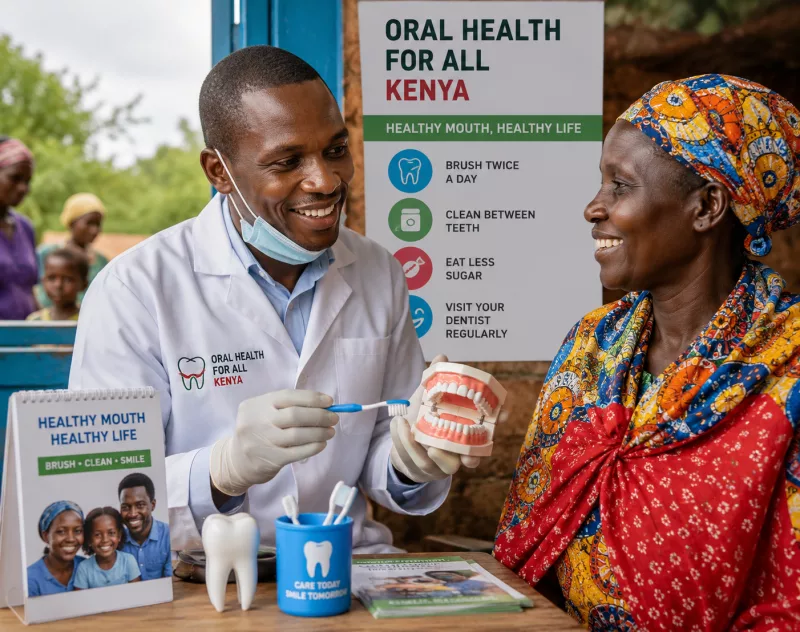
Let it be said clearly and without rancour at the outset: Community Oral Health Officers, or COHOs, are not impostors. They are not the backstreet operators that genuinely endanger patients and that every serious health professional, dentist and COHO alike, has every reason to want out of practice.
They are graduates of accredited diploma, higher Diploma and Degree Programmes, trained since the Kenya Medical Training College's first intake enrolled in 1985 and graduated in 1988, examined and licensed by the same Kenya Medical Practitioners and Dentists Council that licenses dentists, and bound, since a scheme of service was first issued by the Ministry of Health in 2003 and later formalised by statute, to a defined scope of practice.
As of the Council's current practitioner register, 867 Community Oral Health Officers are licensed and practising alongside dentists across the country.
Their existence is not a loophole ;it is the deliberate policy of a nation that could not otherwise staff its oral health system.
The Arithmetic of Scarcity
That policy choice is not a matter of opinion. It is arithmetic. The Ministry of Health, marking World Oral Health Day in March 2025, confirmed that Kenya's dentist to population ratio stands at roughly 0.27 per 10,000 people, translating to something in the order of one dentist for every 37,000 Kenyans, against a World Health Organization benchmark of one for every 7,000.
A 2022 geospatial workforce study published in the Annals of Global Health, drawing on Ministry of Health and Council registers, put the historical figure at closer to one dentist per 42,000 and found that dentists, who make up roughly 72 per cent of the oral health workforce nationally, are concentrated overwhelmingly in Nairobi, which alone hosts 43 per cent of all dental professionals in the country despite occupying a small fraction of its land and population.
The same study found that only 58 per cent of Kenyans live within twenty kilometres of any dental clinic at all. The 2023 Kenya Health Facility Census, for its part, found that only thirteen per cent of health facilities nationwide offer any oral health service whatsoever.
And the burden waiting on the other side of that scarcity is immense. The 2015 Kenya National Oral Health Survey, still the most comprehensive of its kind, found that three in every four five year olds examined had bleeding gums, that gum disease was present in more than 98 per cent of adults screened, and that dental caries and periodontal disease went largely untreated across every age group sampled.
These are not the numbers of a system that can afford to send home a trained and licensed pair of hands. It is against that backdrop, and not in a vacuum, that Community Oral Health Officers do their work.
In practice, and this is a pattern any Kenyan who has sat in a public hospital corridor will recognise, it is the nurse, the clinical officer and the Community Oral Health Officer who are present through the working day, while specialists move between a morning ward round and an afternoon private clinic.
This is not a complaint against dentists, many of whom carry genuinely heavy caseloads and serve their patients with real dedication. It is simply an honest description of how Kenya's health workforce is structured at every level, and it is worth remembering that the same structure holds for medicine generally.
Nurses and clinical officers, who do not hold medical degrees, run the country's dispensaries, deliver its babies and manage its chronic disease burden every single day, each operating within a scope of practice fixed by law and enforced by a regulator, and nobody today seriously proposes that Kenya's primary healthcare system should instead wait for a fully trained physician to be available at every turn.
Community Oral Health Officers occupy exactly that same functional space in dentistry, and the logic that makes the nurse and clinical officer model work is the same logic that makes the COHO model work: a clear scope of practice, honest supervision and enforcement against anyone who steps outside it, dentist or COHO alike.
Global Precedent, Local Need.
This is also, it is worth adding, precisely the direction in which global health policy has been moving for close to two decades, and not against it.
The World Health Organization's 2008 global recommendations on task shifting, developed to help countries facing workforce shortages redistribute defined clinical tasks to appropriately trained cadres, and the WHO's Global Oral Health Action Plan for 2023 to 2030, which explicitly calls on countries to strengthen oral health workforce policy through team based, task sharing models, both point the same way Kenya's own regulator has already gone.
A COHO performing a scaling, a fluoride application or a straightforward extraction of a child's primary tooth within a published scope of practice is not a deviation from international best practice, It is an application of it. It is worth pausing here, and looking outward, because the question of whether midlevel oral health cadres belong in a well-run health system is not one Kenya is being asked to answer for the first time.
It has already been answered, repeatedly and conclusively, by the very countries whose health systems the world holds up as models.
The Global Burden of Disease Study's Healthcare Access and Quality Index, published in The Lancet Global Health in 2022 and covering 204 countries from 1990 to 2019, consistently places Iceland, Norway, the Netherlands, Finland, Switzerland, Australia and Sweden at or near the very top of global rankings, each scoring in the mid to high nineties out of a possible one hundred.
None of these countries reserves oral healthcare exclusively for practitioners bearing the title "dentist." New Zealand, though outside that particular top tier on the HAQ Index, is instructive precisely because it is where this entire model began, and because so many others copied it afterward.
In 1921, New Zealand established what it then called the school dental nurse service, training a mid-level cadre to provide preventive and basic restorative care, including the extraction of primary teeth and the placement of fillings, to the country's children.
That cadre, since evolved into today's registered dental therapists and oral health therapists, still performs fillings, pulpotomies, primary tooth extractions, local anaesthesia and radiography, working under scopes of practice gazetted by the country's own Dental Council in the same manner that Kenya's Council gazettes scopes of practice for COHOs.
According to the United States' own National Academies review of international oral health workforce models, this New Zealand approach had, by the early twenty first century, been adopted in some form in more than fifty countries.
The Netherlands, consistently among the world's highest scoring health systems on the HAQ Index, goes further still. Dutch dental hygienists are legally permitted, under the country's health professions legislation, to remove decay and place restorations independently, tasks that in Kenya's current debate are treated as the exclusive preserve of a dentist.
Norway, Finland and Sweden, all likewise near the summit of the same global rankings, lean heavily on dental hygienists and dental therapists within their public dental services, particularly for the care of children and adolescents, precisely the population most exposed to the untreated caries and gum disease that Kenya's own 2015 survey documented.
The lesson from that comparison is not that Kenya must copy any single country's model wholesale. Health systems differ, and rightly so, according to history, geography and resources.
The lesson is narrower and, in a way, more useful. Not one of the world's best performing health systems has organised itself around the idea that a single professional title must personally perform every task within a clinical field before that field can be considered safe.
Each has instead asked a different and more practical question, namely what skills a task requires, who can be trained and regulated to perform it safely, and how that person's competence will be verified and supervised.
Title, in every one of these systems, is a description of training completed. It is not, on its own, a guarantee of competence, and its absence is not, on its own, evidence of danger. Skill, properly trained, properly examined and properly regulated, is what protects patients.
Kenya settled that same question for its Community Oral Health Officers through statute and through the Council's scopes of practice years ago. The debate now underway does not ask Kenya to catch up with the rest of the world. It risks, if pressed to its logical conclusion, asking Kenya to fall behind it.
Training, Regulation and the Law
None of this is to say that concerns about training standards or scope creep are illegitimate, and it would be unfair to suggest otherwise. Professional bodies have every right, indeed a duty, to insist that scopes of practice be clear, that internship supervision be rigorous and that any practitioner who exceeds their licensed scope, dentist or COHO, be held to account.
But there is an internal tension in the argument as it has sometimes been made in the media, worth naming gently. Every Community Oral Health Officer licensed in Kenya passed a mandatory internship in which procedures were performed under the direct supervision of a qualified dentist, who then certified that officer competent to practise. If that supervision and certification was sound, then the resulting licence should be respected.
If it was not, then the conversation Kenya needs is about strengthening internship supervision for everyone's benefit, not about retroactively disowning graduates who relied in good faith on the certification they were given. It may also be worth asking, with genuine curiosity rather than accusation, why this particular framing, that a licensed and statutorily recognised cadre must nonetheless be publicly branded a threat, has taken such firm hold among some of the profession's most senior voices.
One plausible part of the answer lies not in dentistry at all but in the educational system that shaped a generation of Kenyan professionals.
The 8-4-4 curriculum, in place for over three decades, was built around a single, unforgiving sorting mechanism, the national examination, its cut off points and the ranking of courses and institutions by prestige. It produced many excellent professionals, and it deserves credit for that.
But a system organised so completely around hierarchy and competitive ranking can also, understandably, leave its most successful graduates instinctively defensive of status and territory, inclined to see an adjacent profession's growth as a demotion of their own rather than as a partnership.
That is not a personal failing of any individual so much as a reasonable, human response to the incentives of the system that trained them. Kenya's newer competency based curriculum is deliberately built to reward collaboration over ranking, and if the country's health training institutions lean further into that shift, the next generation of dentists and Community Oral Health Officers may find this entire debate unrecognisable.
There is, in addition, a legal and constitutional dimension that deserves a fair and complete telling, since it has occasionally been summarised in the press in a way that overstates its effect. In Kenya Dental Association v Kenya Medical Practitioners and Dentists Council; Oral Health Association of Kenya & another (Interested Parties) [2021] KEHC 6286 eKLR, the High Court at Nairobi, hearing a challenge brought by the Kenya Dental Association against the Council's registration of Community Oral Health Officers, found a narrow and technical gap, namely that the Act had not, at that time, expressly spelt out the registration process for the cadre in the same detail it had for dentists.
On that basis, the court suspended its quashing order for one hundred and eighty days specifically to allow the Council to regularise the position through stakeholder consultation, and it granted no order banning or excluding Community Oral Health Officers from practice.
The Council duly responded, publishing the country's first ever Scope of Practice for medical and dental practitioners and Community Oral Health Officers in March 2022, and has since updated that framework through 2025.
When an attempt was later made, through contempt proceedings, to use that same judgment to force the recall of COHO licences altogether, the High Court, in Malenya v Kenya Dental Association & another (Judicial Review Application 74 of 2020) [2025] KEHC 9406 eKLR), struck the application out in 2025 for lack of legal standing, declining to let the earlier judgment be repurposed into a tool of exclusion it never authorized.
Moving Beyond Professional Turf Wars
It is also worth reflecting, briefly and respectfully, on the appropriate space for this debate to be settled. Kenya's Law Society exists under its founding Act to serve the public interest and to assist the courts and government in the administration of justice, not to lend its institutional weight to either side of what is, at its core, a dispute between two lawfully licensed professional cadres over market share.
Where any professional body's public interest mandate is invoked in service of a sectional or commercial position, whichever profession benefits, that is worth naming plainly, because the public interest in oral health is served by more trained and licensed hands reaching more Kenyans, not by fewer.
Equally, the Supreme Court's own guidance on public participation, developed in British American Tobacco Kenya PLC v Cabinet Secretary for the Ministry of Health & 2 others; Kenya Tobacco Control Alliance & another (Interested Parties); Mastermind Tobacco Kenya Limited (Affected Party) (Petition 5 of 2017) [2019] KESC 15 eKLR, is instructive here.
Meaningful consultation, the Court held, must be real and not a mere formality, but it does not entitle any single stakeholder to a veto or a guarantee that its preferred outcome will prevail. The Kenya Dental Association has been, and will continue to be, a heard and respected voice as scopes of practice are periodically reviewed.
Being heard, however, is different from being obeyed, and the country's regulatory processes are healthier when every profession accepts that distinction. Finally, there is a principle of fairness in our administrative law, the doctrine of legitimate expectation, recognised by our courts including in the Court of Appeal's guidance in Kenya Revenue Authority v Menginya Salim Murgani [2010] eKLR, [2010] KECA 164 (KLR), which holds that where a settled state of affairs has been allowed to persist and relied upon in good faith, it should not be reversed abruptly and without due process.
Community Oral Health Officers have trained, worked, built careers and served patients under a recognised scheme of service since 2003 and under statute since 2019.
Thousands of Kenyan families have, in turn, come to rely on them, often as their only realistic point of access to oral healthcare. That settled and lawful arrangement deserves the law's protection, not its sudden reversal by press statement.
Kenya's oral health crisis is large enough for every trained and licensed hand the country has. Three in four of our children have bleeding gums. Fewer than one in seven health facilities offer any dental service at all. Entire counties have no dental clinic to speak of.
Against that reality, the energy currently spent contesting the legitimacy of a statutorily recognised, decades old, properly licensed profession would be better spent extending oral healthcare to the Kenyans who still cannot reach it at all.
Dentists and
Community Oral Health Officers are not, and need not be, rivals. They are, if the law
and the evidence are allowed to speak, colleagues serving a common purpose that is
larger than either profession alone.