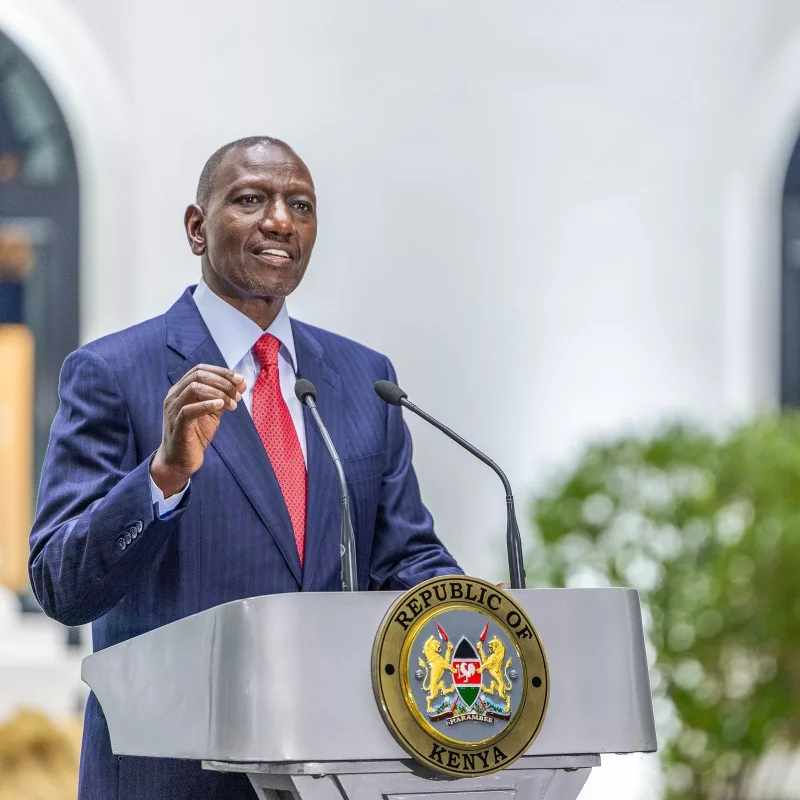
President William Ruto last night kickstarted the process of replacing Vision 2030, admitting Kenya squandered decades of economic opportunities and invited the public to help write a new blueprint to transform the country over the next 30 years.
In a national address, he said he will spearhead a nationwide conversation on August 12 to craft a successor to Vision 2030, describing the event as the most consequential public engagement since the promulgation of the 2010 constitution.
The new roadmap would not be yet another policy document, but a long-term national development charter designed to outlive political administrations and election cycles.
"We must craft a new national development charter that gives effect to the aspirations of our constitution and decide together what kind of Kenya we want to build over the next generation," Ruto said.
The announcement begins the search for a growth strategy beyond Vision 2030, the blueprint introduced in 2008 that was meant to create a middle-income economy.
With only four years left to 2030, Ruto said the time had come to honestly assess what Kenya achieved, where it fell short and what should define the next chapter.
In one of his strongest acknowledgements yet of Kenya's economic shortcomings, he said successive governments failed to take advantage of major global waves of industrialisation that transformed countries which once had economies comparable to or even weaker than Kenya's.
He pointed to South Korea, China, Vietnam and Bangladesh as countries that embraced long-term reforms, attracted investment and rapidly industrialised while Kenya repeatedly missed similar opportunities.
Ruto noted that Kenya and South Korea each had a GDP per capita of about $110 (Sh14,137) in 1965. But today, South Korea's stands at more than $36,000 (Sh4.6m), compared to Kenya's $2,400 (Sh308,462).
He said China, whose income per person was lower than Kenya's in 1980, now records more than $14,000 (Sh1.7m) per capita, while Vietnam, whose economy once lagged behind Kenya's, now has an income per person of about $5,000 (Sh641,630).
Ghana and Zimbabwe have also overtaken Kenya on GDP per capita.
"The question we must ask ourselves honestly is why other nations fulfilled so much of their potential while we repeatedly fell short," Ruto said.
Despite the sobering review, Ruto argued that Kenya now has an opportunity to reverse that trajectory.
His administration had spent its first four years restoring macro-economic stability after inheriting an economy facing severe pressure, creating conditions that now allow the country to focus on long-term change.
He announced that inflation had fallen, the shilling has stabilised, foreign exchange reserves have risen to nearly $14 billion, borrowing costs have declined and investor confidence has improved.
He cited record foreign direct investment of $3.2 billion (Sh411bn) in 2025 and Kenya's ranking as Africa's most competitive economy in the 2025 IMD World Competitiveness Ranking as evidence that the country's economic foundations have strengthened.
"Because we have restored stability and rebuilt investor confidence, now is the perfect opportunity for Kenya to begin shaping the next phase of our national development," he said.
At the heart of Ruto's proposal is a development charter that he said would be anchored in the constitution rather than the agenda of any administration.
While Kenya successfully entrenched democratic governance through the 2010 constitution, it has not fully translated the constitution's economic and social aspirations into measurable outcomes.
The constitution guarantees rights to healthcare, education, housing, food, water and social protection, but the country has never agreed on the standards for delivering those promises.
"Development is not simply a policy preference of those governing. It is a constitutional imperative," he said.
He challenged the nation to define what quality healthcare, accessible education, adequate housing, food security and clean water should practically mean for every citizen and how progress should be measured over time.
A consensus on those benchmarks would prevent development priorities from changing with every election and allow future governments to compete on implementation rather than constantly introducing new schemes.
"Once we define our national destination, the real contest in our democracy should be about who has the best ideas and the best capability to take us there faster and more efficiently," he said.
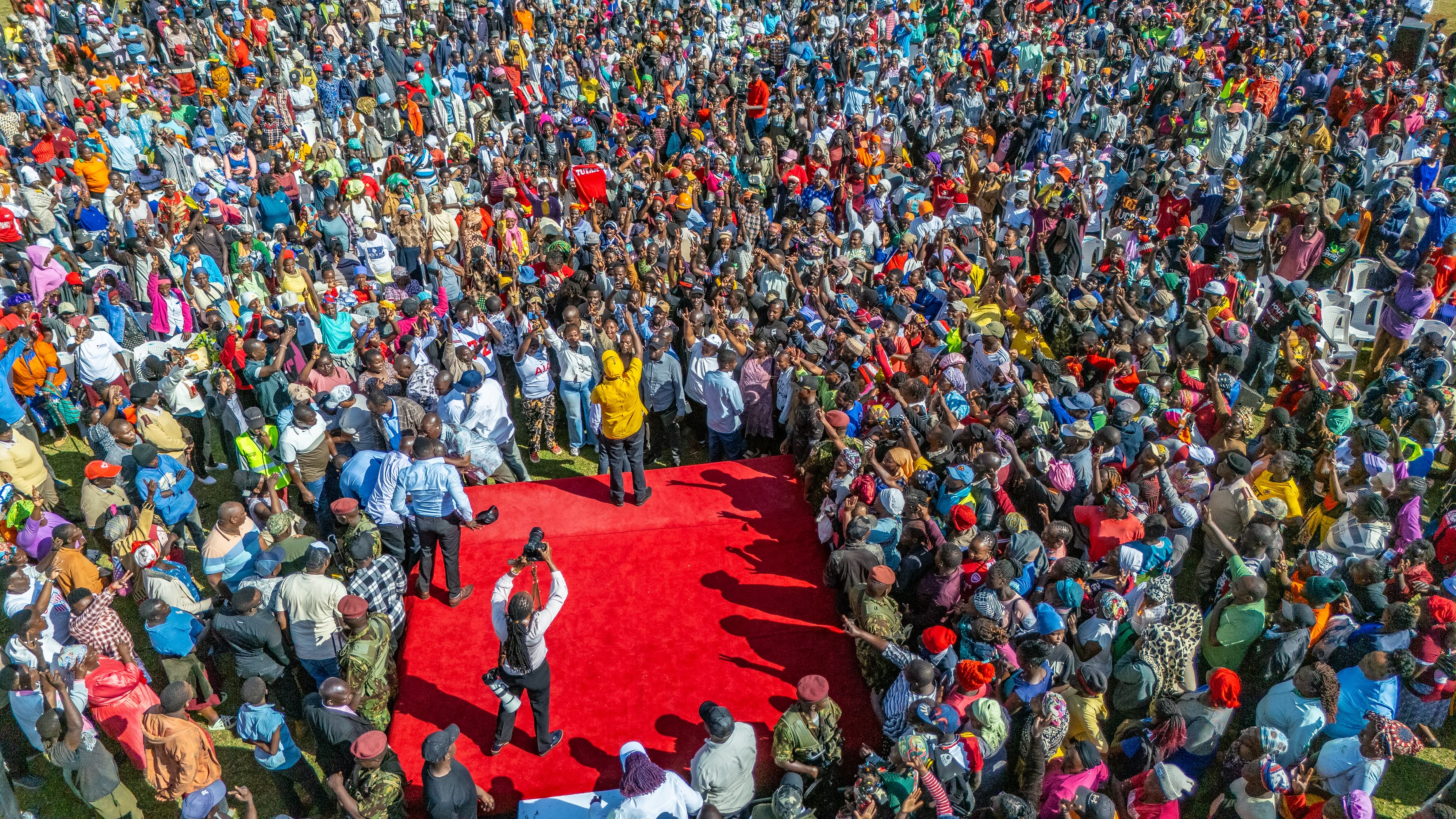
The national conversation would bring together political parties, county governments, Parliament, universities, professional associations, faith organisations, civil society, the private sector, workers, innovators and young people.
No institution, government or political leader should write Kenya's next long-term vision alone.
"This vision belongs to the people of Kenya. It must be people-driven, citizen-centred and future-focused," he said.
He disclosed that a team led by Prof Hiroyuki Hino and Prof Anyang' Nyong'o had prepared strategic proposals to guide debate on Kenya's future after Vision 2030.
The experts concluded that Kenya has a chance to become a prosperous, industrialised and globally competitive high-income country within one generation if it maintains policy consistency, strengthens institutions and commits to long-term planning.
Those recommendations, he said, will now form the basis of wider public participation before a final national development charter is adopted.
He highlighted institutions his administration has created to support long-term economic planning, including the National Infrastructure Fund and the Sovereign Wealth Fund, saying they are meant to finance strategic investments and preserve wealth for future generations.
The two funds, he said, are designed to outlive political change of governments and provide continuity.
The launch of the process comes as Vision 2030 approaches its expiry date with several flagship targets still unmet, including Kenya's ambition of attaining upper-middle-income status by the end of the decade.
The shortcomings should not be viewed as failure but as lessons for building a stronger and more realistic development roadmap.
The next chapter should be guided by consensus rather than partisan politics and urged Kenyans to seize what he described as a once-in-a-generation opportunity to redefine the future.
"Somewhere in Kenya tonight is a child too young to understand this conversation," Ruto said.
"They may never remember Vision 2030 or this address, but they will live in the Kenya we choose to build. The defining responsibility of our generation is to build a nation worthy of our Constitution."