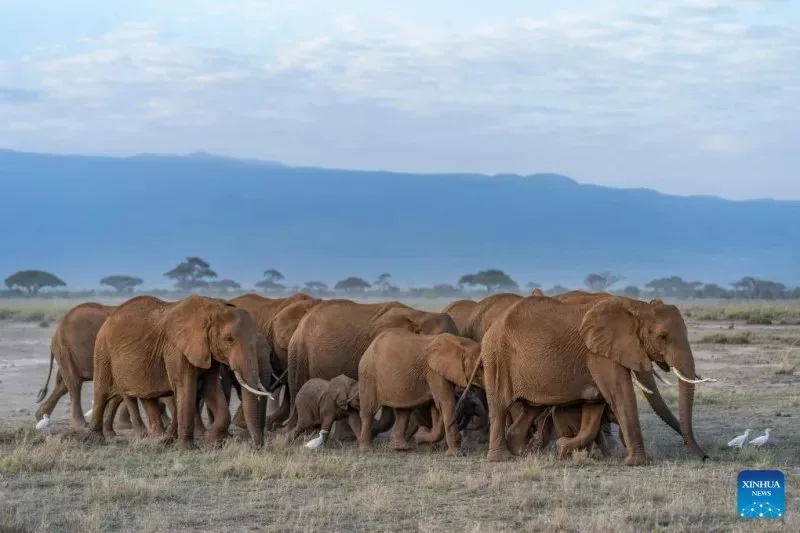
Elephants are pictured at the Amboseli National Park in Kenya, Jan. 8, 2026. Amboseli National Park is one of Kenya's premier vacation destinations and a world-renowned tourist spot. The park is located at the border between Kenya and Tanzania and sits at the foot of Africa's highest mountain, Mount Kilimanjaro. (Xinhua/Xie Jianfei)
The Kenya Wildlife Service (KWS) has announced the formation of a multi-agency team to establish how cyanide suspected to have poisoned 15 elephants in Kimana, Kajiado County, found its way into the animals’ food chain.
KWS Director General Erustus Kanga said preliminary results from samples taken from the elephants showed traces of cyanide, a chemical used in pesticides, prompting authorities to launch investigations into how the substance reached the animals.
Speaking on Friday during the commemoration of World Rangers Day, Kanga said the circumstances surrounding the poisoning were yet to be established.
“We don't know how this happened,” Kanga said.
“Through our minister's office, we are establishing a multi-agency committee that is comprised of all people that are involved,” he said.
Kanga disclosed that he had assigned the Pest Control Products Board the responsibility of coordinating a team of experts to investigate the incident.
“I have given that responsibility to the CEO of Pest Control Products Board because that is the regulator, to coordinate a team of experts and we get to the bottom and find out how cyanide got into that food chain,” he said.
Preliminary findings, the KWS boss noted, were based on tests conducted after samples were taken from the elephants.
“In this instance, according to preliminary results, the test we got when we opened gut of sampled 15 elephants, there were traces of cyanide, used in pesticides,” Kanga said.
The probe comes against the backdrop of growing human activity in wildlife areas, with Kanga warning that land-use changes and the conversion of important landscapes into farms and settlements were putting pressure on wildlife.
Kanga specifically pointed to Kimana, where the incident occurred, adding that the area has experienced significant agricultural activity.
He noted that the region has high agricultural production, particularly of tomatoes, onions, cabbages and watermelons, supported by water from Mount Kilimanjaro.
“In the agricultural landscape, we have people using pesticides,” Kanga said.
He described the deaths as an isolated incident but expressed concern over the scale of the loss.
“It's an isolated incident. I feel saddened to lose 15 elephants at a go because I know the efforts our rangers put in protecting and ensuring our elephants are here,” he said.
Kanga said the deaths also had wider implications for Kenya's tourism sector and communities whose livelihoods depend on wildlife.
The KWS director general cautioned that the incident underscored the need for wildlife and farming communities to coexist, particularly as Kenya's population grows and land available for different activities remains limited.
"When we got independence, the country had about 10 million people. 60 years down the line, we are beyond 55 million, but the size of Kenya has remained the same," he stated.
"Land use change and conversion of important areas into farming and settlement has taken a toll."
He described the elephant deaths in Amboseli as “an unfortunate incident for the country and world at large”, stressing the need for stronger cooperation between conservation agencies, farmers and communities living alongside wildlife.