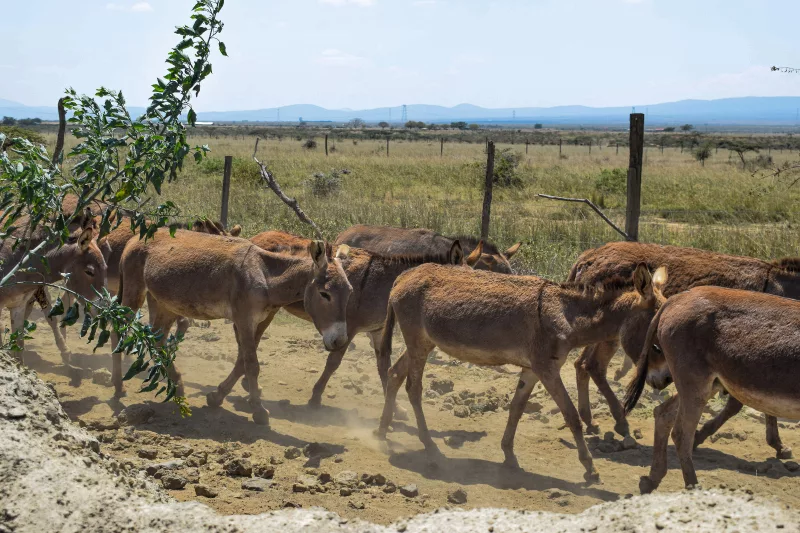
 Donkeys being pushed from Mulot area towards Narok town direction/KNA
A new study has revealed that donkey theft and the illegal trade in donkey skins and related products have evolved into a sophisticated criminal enterprise in Kenya, threatening rural livelihoods, public health, animal welfare and national security.
The study found that criminal syndicates, driven by high international demand for donkey hides, operate through clandestine slaughterhouses and cross-border smuggling networks that circumvent veterinary inspections and leather industry regulations.
Researchers warn that the illicit trade has contributed to a sharp decline in Kenya's donkey population, which fell from 1.8 million in 2009 to 1.1 million in 2019, depriving rural households of an essential source of transport, farm labour and income.
The research sought to examine current patterns of donkey theft and illegal trade, understand the criminal networks behind the business, assess its socio-economic impacts and evaluate the effectiveness of existing interventions aimed at curbing the vice.
The National Crime Research Centre (NCRC) will on Thursday launch a landmark report detailing the extent of donkey theft and the illegal trade in donkey skins and related products in Kenya, shedding light on what it describes as an emerging security and socio-economic challenge.
The report, titled Theft and Illegal Trade in Donkey Skins and Related Products in Kenya, is the first comprehensive national study examining the scale, drivers and impacts of donkey theft and the illicit trade in donkey skins.
According to the NCRC, the findings expose the complex nature of the illegal trade, including the involvement of organised criminal groups, sophisticated supply chain networks and the growing threat posed by transnational organised crime.
The study also outlines a raft of recommendations aimed at strengthening law enforcement responses, enhancing policy and legislative frameworks, improving inter-agency coordination, promoting regional cooperation and safeguarding Kenya's donkey population.
The report comes at a time when Kenya is intensifying efforts to curb illegal donkey slaughter and trafficking following the government's ban on commercial donkey slaughter for skin production. Authorities have also expressed concern over the emergence of criminal networks exploiting the illicit trade despite the ban.
Dr Dickson Gitonga, Principal Research Analyst at the NCRC, said the study establishes a clear link between international demand for donkey skins and the persistence of the illegal trade.
"Our research shows that the illegal donkey skin trade is driven by strong international demand and enabled by weaknesses in enforcement. The impacts extend beyond animal welfare to affect rural livelihoods, food security and community well-being. We hope these findings will inform evidence-based policies and stronger regional cooperation," he said.
NCRC Deputy Director Dr Tioko Logiron said the report provides critical evidence to guide government agencies and other stakeholders in addressing the growing challenge.
"This study provides a strong evidence base to guide policy and operational responses to an emerging security and socio-economic challenge. We encourage all stakeholders to work together to implement the recommendations and strengthen the protection of Kenya's donkey population. The Centre will continue to support research that informs effective crime prevention and public policy," he said.
The report is expected to inform future policy interventions and strengthen collaboration among government agencies, law enforcement agencies, animal welfare organisations and regional partners in tackling the illegal donkey skin trade.
The qualitative study covered nine counties identified as hotspots for donkey theft and trafficking: Machakos, Kajiado, Mombasa, Embu, Kitui, Nakuru, Narok, Turkana and Kiambu.
Researchers interviewed 205 respondents, including donkey owners, animal welfare organisations, law enforcement officers, prosecutors, members of the Judiciary, county livestock officials, slaughterhouse operators, middlemen and community leaders. Data was collected through key informant interviews, focus group discussions and field observations.
The findings paint a grim picture of the far-reaching consequences of the illegal trade.
According to the report, the loss of donkeys has significantly reduced agricultural productivity, limited access to markets and essential services, and increased poverty among rural households that depend on the animals for farming and transportation.
Women, children, the elderly and people living in remote areas are among the hardest hit, as they rely heavily on donkeys to transport water, farm produce, firewood and other essential commodities.
The study also found that illegal slaughterhouses operating without veterinary oversight expose consumers to serious health risks.
Meat from clandestine slaughter sites may carry diseases such as anthrax and parasitic infections, while poor hygiene and the absence of food safety inspections increase the risk of bacterial contamination.
Researchers further warned that the illegal dumping of donkey carcasses contaminates rivers and other water sources used by humans and livestock.
Decaying carcasses abandoned in bushes also contribute to air pollution and create environmental health hazards for surrounding communities.
The report notes that donkey theft severely disrupts rural transport systems, making it difficult for farmers to move crops to markets before they spoil. This often results in heavy financial losses after months of agricultural investment.
Women bear a disproportionate burden when donkeys are stolen, the study found. Tasks such as fetching water and transporting goods, previously handled by the animals, become manual chores that consume several hours each day, limiting opportunities for education and income-generating activities.
Children are also affected, with many reportedly missing school or dropping out altogether to help their families perform labour-intensive tasks previously undertaken by donkeys.
Researchers observed that the theft of even a single donkey can disrupt planting and irrigation cycles, reducing crop yields and threatening food security, especially in arid and semi-arid regions where the animals play a critical role in transporting water.
Beyond the economic losses, the study found that the growing scarcity of donkeys is eroding traditional community support systems. Owners have become increasingly reluctant to lend animals to neighbours, fostering mistrust and weakening social cohesion.
The report also raises concerns about the long-term survival of Kenya's donkey population, warning that the animals' slow reproductive cycle of three to four years cannot keep pace with current levels of theft and illegal slaughter.
Researchers caution that unless decisive action is taken, the continued depletion of donkey populations could permanently undermine rural livelihoods that have depended on the animals for generations.
The study further found that donkey owners suffer psychological distress following the theft of their animals, with many describing them as trusted household partners rather than mere working animals. In many communities, donkeys also serve as an early warning system against night-time intruders, meaning their loss leaves households feeling more vulnerable to insecurity.
The researchers called for stronger enforcement against organised criminal networks, tighter regulation of livestock movements, enhanced cross-border cooperation, improved veterinary surveillance and greater community awareness to combat the illegal trade and safeguard Kenya's remaining donkey population.