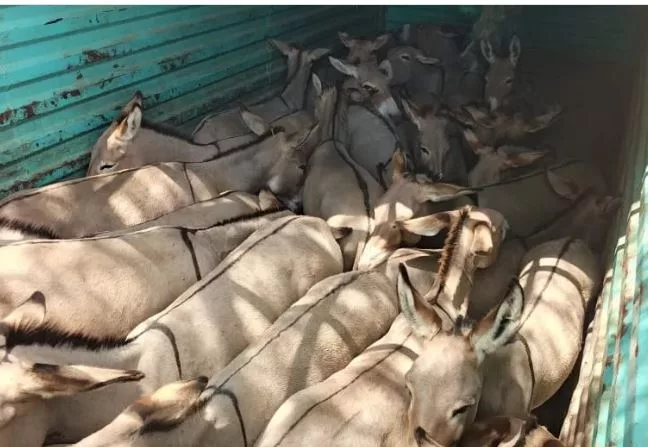
 Donkeys./FILE
The National Crime Research Centre (NCRC) will on Thursday launch a landmark report detailing the extent of theft and illegal trade in donkey skins and related products in Kenya, shedding light on what it describes as an emerging security and socio-economic challenge.
The report, titled Theft and Illegal Trade in Donkey Skins and Related Products in Kenya, is the first comprehensive national study examining the scale, drivers, and impacts of donkey theft and the illicit trade in donkey skins.
According to the NCRC, the findings expose the complex nature of the illegal trade, including the involvement of organised criminal actors, sophisticated supply chain networks and the growing threat posed by transnational organised crime.
The study also outlines a raft of recommendations aimed at strengthening law enforcement responses, enhancing policy and legislative frameworks, improving inter-agency coordination, promoting regional cooperation and safeguarding Kenya’s donkey population.
The report comes at a time when Kenya is intensifying efforts to curb illegal donkey slaughter and trafficking following the government’s ban on commercial donkey slaughter for skin production. Authorities have also expressed concern over the emergence of criminal networks exploiting the illicit trade despite the ban.
Dr Dickson Gitonga, the Principal Research Analyst at the NCRC, said the study establishes a clear link between international demand for donkey skins and the persistence of the illegal trade.
“Our research shows that the illegal donkey skin trade is driven by strong international demand and enabled by weaknesses in enforcement. The impacts extend beyond animal welfare to affect rural livelihoods, food security, and community well-being. We hope these findings will inform evidence-based policies and stronger regional cooperation,” he said.
NCRC Deputy Director Dr Tioko Logiron said the report provides critical evidence to guide government agencies and other stakeholders in addressing the growing challenge.
“This study provides a strong evidence base to guide policy and operational responses to an emerging security and socio-economic challenge. We encourage all stakeholders to work together to implement the recommendations and strengthen the protection of Kenya’s donkey population.
The Centre will continue to support research that informs effective crime prevention and public policy,” he said.
The report is expected to inform future policy interventions and strengthen collaboration among government agencies, law enforcement bodies, animal welfare organisations and regional partners in tackling the illegal donkey skin trade.
Donkey products have become on demand which has seen a spike their stealing in several parts of the country.
The commercial slaughter of donkeys is illegal in Kenya, but an active underground trade persists where donkey meat is secretly distributed and sold to unsuspecting consumers disguised as beef.
While donkeys were legally classified as food animals in 1999, the government later instituted bans on commercial slaughter due to rapidly dwindling donkey populations and animal welfare concerns.
Animal welfare experts note a complex legal paradox—while the commercial slaughtering process is outlawed, individual consumption of the meat itself is not explicitly criminalized. There has been an increase in underground slaughter of the animals where cartels operate clandestine "bush slaughterhouses."
They blend donkey meat with cow meat and sell it directly to
butcheries, local eateries, and major city meat outlets.
Officials have been staging operations to address
the menace.
Kenya's population of donkeys is under threat after the High Court lifted a 2020 ban on donkey slaughterhouses, allowing them to resume selling the meat and hides to Asian markets.
Donkey slaughter was legalized in Kenya in 2012, leading to a rapid decimation
of the animal population and cross-border theft.
Although veterinary experts say donkey meat is safe for human consumption, its consumption is yet to gain ground in Kenya. Most Kenyans don’t consume donkey meat.
A report from the Kenya Agricultural and Livestock Research Organization (KALRO) showed that more than 4,000 donkeys were reported stolen over the period from April 2016 to December 2018.