President William Ruto has explained why he tasked Professor Hiroyuki Hino, Professor Anyang’ Nyong’o and their distinguished colleagues with examining Kenya’s future beyond Vision 2030, saying the country needs to begin preparing for a new development era anchored in the Constitution and informed by long-term thinking.
Ruto said the experts were engaged to provide an informed starting point for a wider national conversation on the country's future.
He said the exercise was necessary as Vision 2030 approaches its horizon and Kenya prepares to define a new national development charter that will guide the country beyond the current development framework.
"It was in that spirit that I invited Professor Hiroyuki Hino, Professor Anyang’ Nyong’o and their distinguished colleagues to begin examining Kenya’s future beyond Vision 2030," Ruto said.
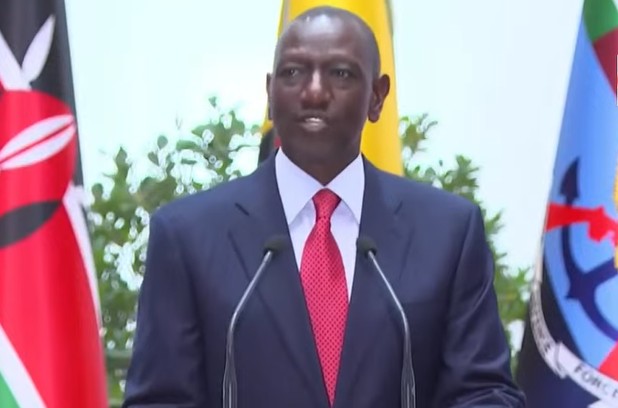
In his special national address on Kenya’s development vision beyond Vision 2030, the President said he had received proposals from the team on strategic guidelines for Kenya's long-term national transformation, describing their recommendations as ambitious but achievable.
"Last week, I had the honour of receiving their proposals on strategic guidelines for Kenya’s long-term national transformation," he said.
According to Ruto, the central idea emerging from the experts' work is that Kenya can become a prosperous, high-income, industrialised and globally competitive nation within one generation.
"The thrust of their proposals is both ambitious and achievable: that Kenya can become a prosperous, high-income, industrialised and globally competitive nation within a generation," he said.
He, however, stressed that the experts' work was not intended to produce a final government blueprint.
Instead, Ruto said the proposals would serve as a foundation for a broader process in which Kenyans themselves would determine the country's long-term development priorities.
"These proposals provide the foundation for a much broader national conversation; a conversation that now belongs not to Government, nor to its authors, but to every Kenyan," he said.
The President said the next development framework must not be driven by political interests or limited by electoral cycles.
"A vision worthy of guiding Kenya for the next generation cannot be written by Government. It cannot be crafted by a handful of experts, however distinguished," he said.
Ruto said the process must draw from the experience and ideas of farmers, workers, entrepreneurs, professionals, scholars, faith communities, young people and other citizens.
"It must be forged through a genuinely people-driven, citizen-centred and future-focused national process," he said.
The President said the decision to involve experts was therefore intended to bring together research, experience and global lessons as Kenya prepares to define its next development path.
He noted that Vision 2030 had provided a common direction for two decades, influencing public policy and investment, but that the country needed to honestly assess its successes and shortcomings before designing what comes next.
Ruto said the ultimate objective is to develop a national charter that translates the development aspirations contained in the 2010 Constitution into measurable outcomes and lasting improvements in the lives of Kenyans.
He announced that the National Conversation on Kenya’s Future Beyond Vision 2030 will formally begin on August 12, 2026, involving institutions, counties, sectors and generations across the country.
The President said the conversation should ultimately produce a shared national consensus on the Kenya citizens want to build for themselves and future generations.