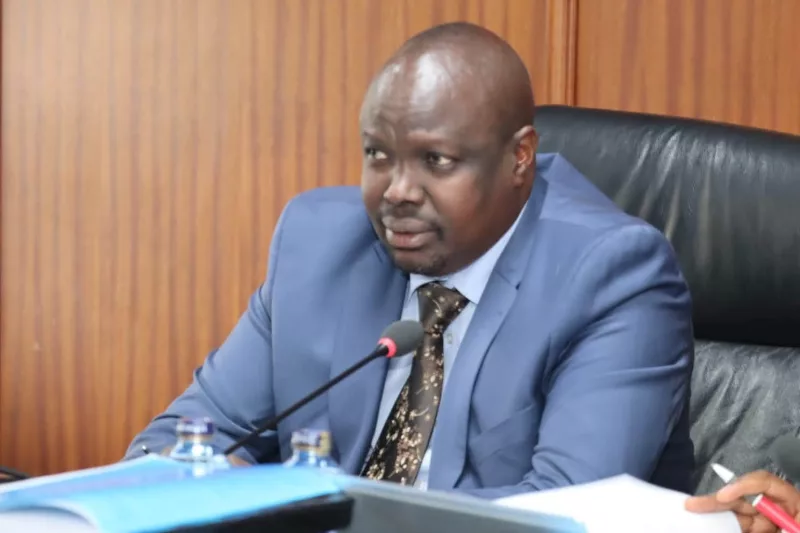
 PIC Commercial Affairs and Energy David Pkosing during the meeting with KEWI managers at Parliament Buildings.
A parliamentary committee has questioned a Sh800 million consultancy fee for upgrading Kenya Water Institute (KEWI), demanding a breakdown of the work and an explanation of how the amount was arrived at.
The Public Investments Committee on Commercial Affairs and Energy, chaired by Pokot South MP David Pkosing, raised concerns over the consultancy contract, including how it was entered into without a fixed total sum.
The committee was told that the consultant has already been paid Sh330 million, including an initial payment of Sh100 million that was reportedly made without proper approvals.
A further Sh230 million was later paid, bringing the total amount disbursed to Sh330 million, although the consultancy contract remains in force.
The committee wants Kewi to provide the contract, details of the work to be undertaken at each campus and the basis on which the Sh800 million fee was calculated.
"How do you allocate Sh800 million to a consultant? For what kind of work?" Pkosing asked during a meeting to review the institute's audit queries.
Kewi chief executive Leiro Letangule told the committee that the consultant was hired to develop a master plan covering the institution's infrastructure.
"It has civil and architectural designs. It was envisioned that we have a Kewi campus in all the 47 county governments," Letangule said.
He said the plan covered the expansion and upgrading of existing campuses, as well as the establishment of Kewi facilities across the country.
A building at the Nairobi campus is currently about 40 per cent complete, the CEO said.
The committee, however, questioned the scale of the consultancy fee in relation to the actual work being undertaken.
"Can we see a list of what was to be done in each county?" Pkosing asked.
He said the committee needed to examine the contract carefully before allowing Kewi to proceed with the expenditure.
"We must look at this contract. There are serious questions. How do we sign a contract without a sum? What's your safety net?" the chairman asked.
An official appearing before the committee said a number of buildings at the various campuses were to be redesigned under the consultancy.
The official explained that the consultancy fee was calculated as a percentage of the estimated construction cost.
Letangule defended the fee, saying it was based on a formula used by the state department for Public Works to determine consultancy charges.
"There is a formula public works applies to calculate the consultancy fees," he said.
But Pkosing said the explanation was insufficient and demanded that Kewi provide the actual computation showing how the Sh800 million figure was reached.
The committee also questioned the process used to identify the consultant.
Kaloleni MP Paul Katana, a member of the committee, asked; "How was the contractor identified?"
The committee also wanted an explanation as to why the contract did not contain a clear overall sum.
"How did we agree on a contract without a figure (total sum)?" Pkosing asked.
Katana questioned the urgency of the project, its source of funding and whether the procurement process complied with the law.
"What was the rush for? What was the source of funds?" he asked.
Katana said the Sh800 million under scrutiny was a substantial amount that could have financed critical development projects elsewhere.
"Sh800 million can do a lot of wonders in my constituency. It can build roads, sink boreholes and upgrade classrooms," he said.
Letangule told the committee that the project dates back to 2019 and had received approval from the National Treasury.
He said the upgrading was intended to be implemented in phases and financed through normal budgetary provisions.
The CEO said implementation had been delayed because the college could not proceed without the consent of the Judiciary.
He also said a ministerial committee had previously reviewed the project and addressed questions surrounding it.
The explanation did not satisfy Pkosing, who said the consultancy arrangement required a fresh and thorough review by the committee.
The chairman directed that the query be held pending the submission of key documents.
"We need a practical explanation. We pend the query pending submission of the contract, the subcommittee report dealing with the payment of Sh100 million, and a breakdown of the Sh800 million consultancy fee," Pkosing said.
He said the committee needed to establish precisely what the consultant was expected to deliver at each Kewi campus and how the fee was determined.
"This is a lot of money to be said to be payment for a consultant. We need to understand this figure. What are they supposed to do in the mentioned colleges? We need to know how they arrived at the amount," he said.
The committee will review the ministerial approval for the project, the Public Works assessment used to determine the consultancy fee and the consultancy contract itself.
The review is also expected to examine the circumstances surrounding the initial Sh100 million payment, which the committee was told had been made without proper approvals.
Kewi said work had already started at its existing campuses in Nairobi, Chakariga, Kitui and Kisumu.
The institution's broader plan is to expand its presence across all 47 counties, with the consultancy covering civil works and architectural designs for the planned infrastructure.
However, the committee's concerns centre on whether the proposed Sh800 million fee is proportionate to the work to be undertaken and whether the procurement and payment processes complied with public financial management and procurement requirements.
With Sh330 million already paid and the contract still in force, the committee's review could determine whether Kewi should proceed with the remaining consultancy payments.
The matter will return to the committee after Kewi submits the requested documents and a breakdown of the consultancy fee.