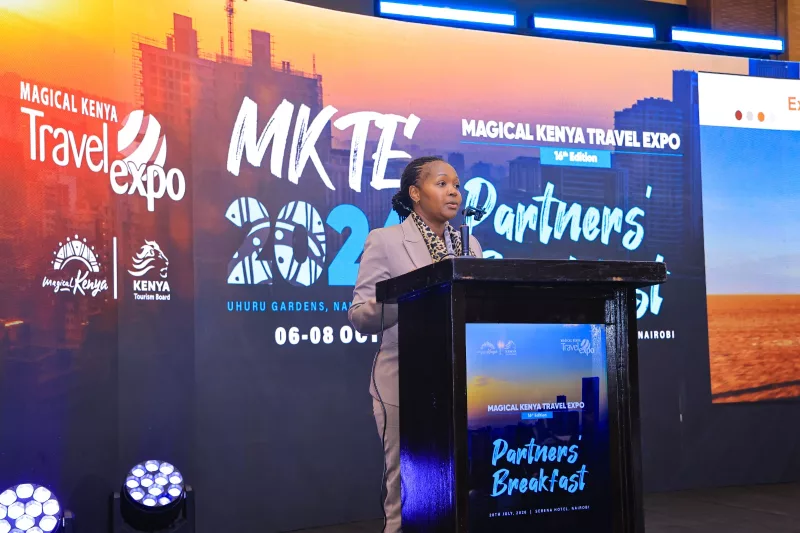
 Kenya Tourism Board (KTB) Chief Executive June Chepkemei /HANDOUT
Kenya is betting on business events, conference tourism and data-driven marketing to drive international visitor arrivals to five million by the end of 2027.
The strategy, according to Kenya Tourism Board positions Nairobi as East Africa's leading hub for meetings, incentives, conferences and exhibitions (MICE).
This is a shift from primarily relying on leisure travellers to attracting higher-spending business visitors through MICE.
The segment, industry players say delivers greater economic returns by filling hotels, supporting taxi sector, boosting airline traffic and increasing spending on transport, restaurants and other hospitality services.
The renewed focus comes as the country prepares to host the 16th edition of the Magical Kenya Travel Expo (MKTE) from October 6 to 8 at Uhuru Gardens, Nairobi, where more than 10,000 delegates from 40 countries are expected to attend in what will be the event's biggest edition yet.
Kenya Tourism Board (KTB) Chief Executive June Chepkemei said the expo has evolved beyond a tourism showcase into a trade platform that connects international buyers with Kenyan tourism businesses while supporting the country's long-term growth ambitions.
Attendance is projected to rise by about 30 per cent from the 7,691 delegates recorded last year, with more than 400 exhibitors and over 250 pre-qualified international buyers expected to negotiate travel contracts and partnerships.
"Every element of this year's MKTE programme, from the buyer selection to the seminar agenda, is informed by data and consumer demand intelligence. We know what the interests of our visitors are and what it takes to convert interest into arrivals,” said Chepkemei.
She noted that KTBs marketing campaigns, both domestic and international, are built on already gathered data and evidence, and MKTE is the platform where we bring those insights to life for the partners.
Kenya MICE Association chairman Duncan Muriuki said attracting business events offers a faster route to growing tourism revenues than focusing solely on leisure arrivals.
"MICE is the next frontier for growing tourism revenue. Our focus is not just on increasing visitor numbers, but on attracting high-value business events that deliver greater economic impact," said Muriuki.
"Through the Kenya MICE Club, we are working with government and the private sector to develop competitive bidding packages that include destination incentives and a compelling value proposition. With world-class facilities and strong 'bleisure' offerings in Nairobi and Mombasa, Kenya is well positioned to win more global events and convert business travel into longer, higher-value visitor experiences."
The concept of "bleisure"—where business travellers extend work trips for holidays, has become an increasingly important source of tourism revenue globally as destinations seek to maximise visitor spending.
The Tour Operators Society of Kenya (TOSK) said government efforts to simplify travel through visa reforms and expanded international air connectivity have strengthened Kenya's appeal to both business and leisure travellers.
"The Government's efforts to improve visa access and expand air connectivity have created a strong foundation for tourism growth," TOSK chairman Raymond Cheruiyot said.
Kenya welcomed an estimated 7.9 million tourists in 2025, comprising 2.7 million international visitors and 5.2 million domestic travelers.
The sector generated approximately Sh500 billion in total earnings, positioning it as a key pillar of the national economy.
The 2025 Tourism Sector Performance Report showed that domestic travel continued to play a stabilising role, cushioning the industry against external shocks and seasonal fluctuations while maintaining steady demand throughout the year.