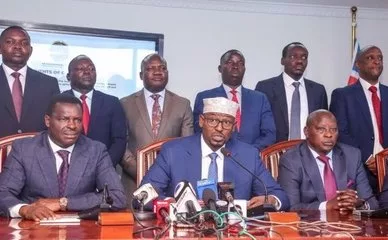
 The leadership of the council of governors/HANDOUT
Governors have suffered a twin blow after the Senate voted to gain direct access to county financial transactions, even as the court ruled they cannot deny senators access to public records.
Read Also
In a landmark judgment, a three-judge bench of the High Court declared that senators and MCAs are entitled to obtain information held by county governments whenever they request it.
The judgment, delivered by Justices William Musyoka, Jacqueline Kamau and Alice Bett, followed a petition filed by Busia Senator Okiya Omtatah against Busia Governor Paul Otuoma and the county executive.
“A declaration be and is hereby granted that, given the shared oversight mandate with Senators, MCAs are entitled to personally access all information and documents on their county government transactions at all times,” the court ruled.
The judges held that Senators and MCAs must be promptly allowed full access to all the information and documents on their county government's transactions whenever they request them.
The judges further said an election to Parliament does not take away a senator's constitutional rights as a citizen.
"Whether as a citizen or as Senator for Busia county, the petitioner's right to access information and documents held by the Busia County Government had been infringed," the court said.
The ruling came just hours after senators approved a motion requiring the Treasury CS to submit monthly IFMIS transaction reports for all 47 county governments to the Clerk of the Senate for onward transmission to the respective senators.
The motion by Omtatah aims to provide senators with real-time access to county financial data, thereby strengthening oversight and enhancing accountability in the management of devolved funds.
“Ifmis is the major tool for misappropriation in the counties. This is where they collude to void transactions and make illegal payments,” Omtatah said.
Ifmis is a comprehensive, automated platform managed by the National Treasury to streamline government financial operations and enhance transparency.
It integrates key public finance functions, including planning, budgeting, procurement, expenditure tracking and reporting.
However, senators argue that instead of promoting accountability, Ifmis has become a "one-stop shop" for financial abuse in county governments.
They claim it enables unscrupulous officials to manipulate records and siphon public funds with minimal oversight.
“We want access to the system because that is where the collusion is happening. For a long time, we have relied on third-party reports from the Controller of Budget and the Auditor General, but they don’t give us the full picture,” Omtatah said.
Senators argued that delays in reports from the Auditor General and the Controller of Budget have weakened Parliament's oversight role by denying lawmakers timely access to financial information.
Speaking to the Star, Controller of Budget Margaret Nyakang’o backed the senators’ assertions, describing Ifmis as the “engine” of the financial mess plaguing counties.
Nyakang’o said massive data manipulation and collusion happen within the system, facilitated by users with privileged access.
“Ifmis is where a lot of problems are. There’s massive manipulation going on—only those with access can truly understand it. That system is at the heart of the mess,” she said.
However, Nyakang’o also cautioned that senators could be overwhelmed by the volume of data generated daily by the counties.
They may require expert assistance to interpret the information meaningfully.
“That information will be too much. I don’t know what they’ll do with it because it needs to be synthesised for proper understanding,” she said.
In the High Court petition, Omtatah sued Governor Otuoma, who repeatedly declined to provide documents relating to the Busia Trailer Park project, procurement processes, the demolition of kiosks, the construction of new kiosks, and other county projects.
Busia county argued that the senator could only obtain the documents through Senate committees and maintained that some of the records were protected under procurement laws.
However, the judges rejected the argument, holding that Article 35 of the Constitution guarantees every citizen, including elected leaders, the right to access information held by public institutions.
The court also found that the governor is the principal officer responsible for ensuring county governments comply with constitutional obligations on disclosure of public information.
The judges ruled that Busia county's refusal to release the documents violated the constitutional principles of transparency, accountability, public participation and good governance.
They issued an order compelling the county government to release within 21 days all documents requested by Omtatah in 15 separate letters written between June 2023 and January 2024.
The records include procurement documents, expenditure reports, project implementation records and other official documents relating to county finances and development projects.
The court, however, clarified that while senators have an unrestricted constitutional right to obtain information from county governments, formal oversight of counties remains the responsibility of the Senate acting as an institution rather than individual senators.
Nyamira Senator Okong’o Omogeni said governors who intimidate their finance officers to manipulate the financial system are the weakest link in the counties.
“If anyone does not want transparency and accountability, they should quit,” Omogeni said,
Omogeni said transparency and accountability are key tenets of the constitution, adding that their demand for access to the financial system is squarely within the Kenyan laws.
INSTANT ANALYSIS
The Senate's push for monthly IFMIS reports and the High Court's affirmation of senators' right to access county records mark a significant expansion of financial oversight over devolved governments. The twin decisions are likely to increase transparency by giving senators timely access to expenditure data and official documents, making it harder to conceal procurement irregularities or misuse of public funds. However, the court preserved the constitutional balance by maintaining that formal oversight remains the collective responsibility of the Senate, not individual legislators.