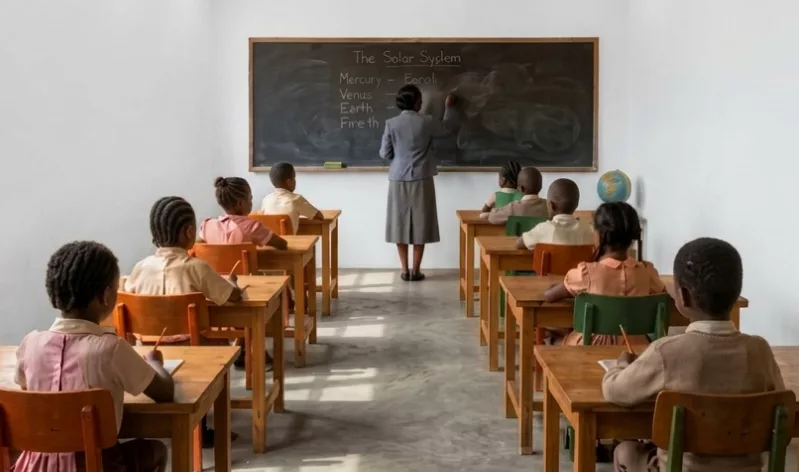
 The Teachers of Kenya: Status of Equality and Inclusion in the Teaching Workforce in Kenya, 2025 report shows female teachers dominate classroom teaching. /AI/NGEC
Male teachers continue to dominate leadership positions in Kenya's public schools despite their female counterparts accounting for slightly more than half of all staff employed by the Teachers Service Commission (TSC), a new audit has revealed.
The findings are contained in a report released by the National Gender and Equality Commission (NGEC) in July 2026 following an audit conducted in June 2025.
The report titled Teachers of Kenya: Status of Equality and Inclusion in the Teaching Workforce in Kenya, 2025, focused exclusively on teachers employed by TSC as of June 2025.
The audit covered 425,613 teachers across 34,630 public learning institutions comprising 24,918 primary schools, 21,488 junior schools, 9,675 secondary schools and 37 teachers' training colleges.
It examined teacher appointments across the cadres of education, analysing the workforce through the lenses of gender, age, disability and marginalisation.
The objective was to analyse the distribution of teachers and generate evidence-based recommendations to improve equality and inclusion in the teaching workforce across public learning institutions.
According to the report, women make up 50.2 per cent of the 425,613 teachers employed by TSC, while men account for 49.8 per cent.
However, only 27 per cent of the 28,925 heads of public learning institutions are women, with men occupying the remaining 73 per cent of the positions.
The disparity is more pronounced in primary schools, where women constitute about 55 per cent of teachers but hold only 24.2 per cent of headship positions.
The report also notes that although gender parity has been achieved among teachers in junior schools, administrative positions remain male-dominated.
In secondary schools, the top six administrative positions are predominantly occupied by men.
To conduct the audit, NGEC developed a data collection tool in collaboration with TSC to capture information on teachers by sex, age, disability status and marginalisation.
TSC populated the tool using official records from its Integrated Payroll and Personnel Database and the Teacher Information Management System before the two institutions jointly validated and analysed the data.
TSC welcomed the audit, saying the findings would help shape future policy and improve inclusion within the teaching profession.
"Findings from the audit will inform policy refinement, strengthen institutional accountability and support targeted interventions aimed at enhancing equitable representation, participation and advancement of special interest groups within the teaching profession."
NGEC chairperson Rehema Jaldesa said the evidence-based findings will also influence policy review in other state agencies and help promote equality in work environments.
"The findings herein will be of value not only to the TSC in strengthening inclusive hiring and promotion practices, but also to other state agencies, policymakers and stakeholders seeking to uphold Kenya's national values of equity and equality."